

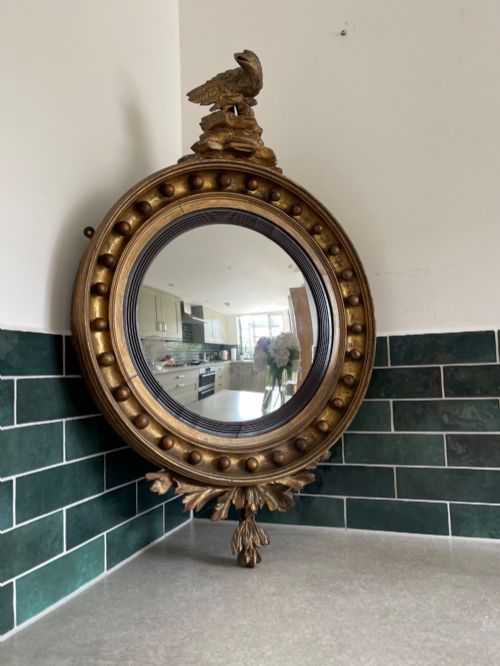


Gold Eagle Mirror
A gold eagle mirror commands a room, bringing together carved timber and gilded surfaces beneath the watchful gaze of a bird crest.
Gold Eagle Mirror
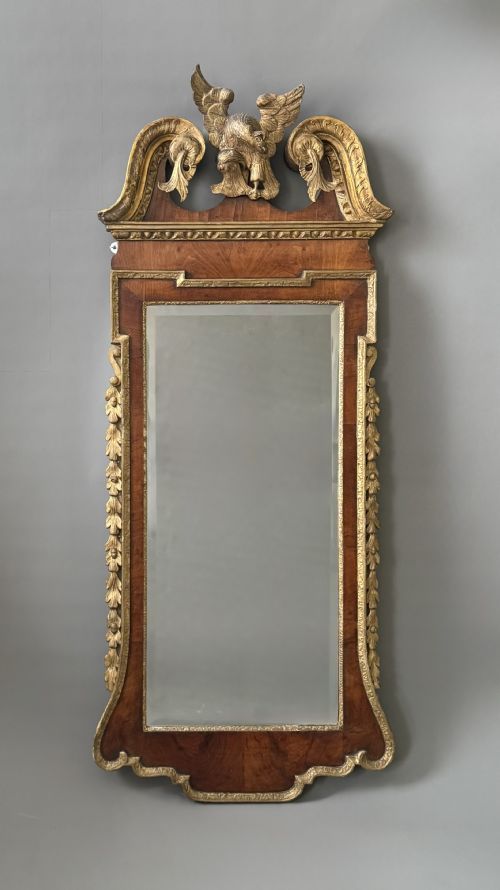
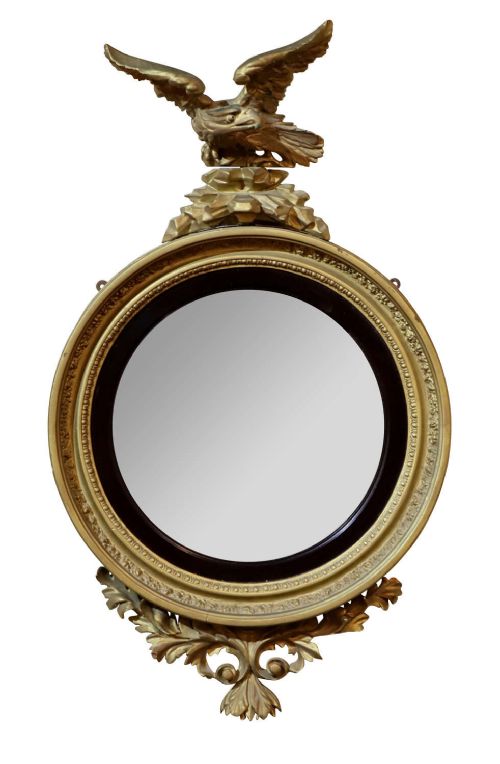
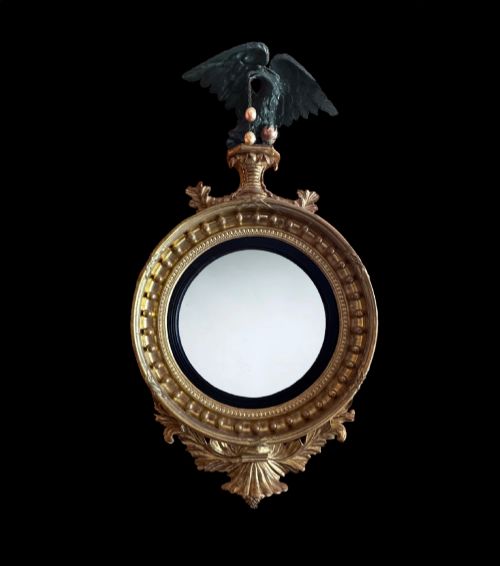
When you search for a gold eagle mirror, you encounter pieces designed to reflect light and dominate a wall through striking proportions and classical ornamentation. These wall mirrors appear primarily in Regency and Georgian styles, taking circular convex forms or rectangular overmantel formats.
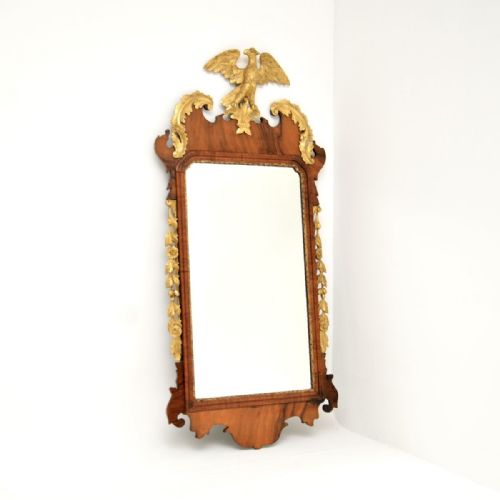
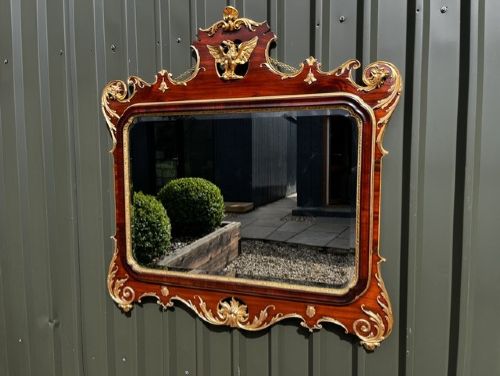
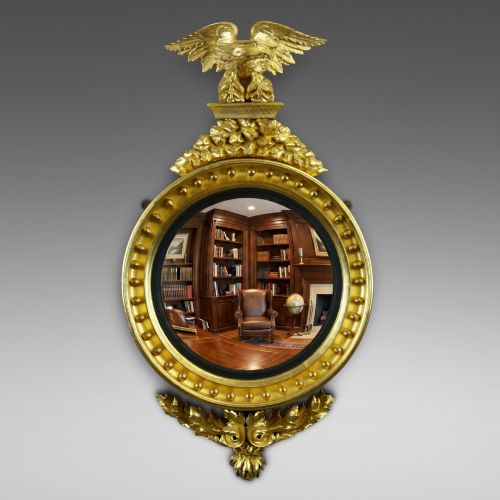
The most common version meeting this search is the circular convex mirror from the early nineteenth century, featuring a prominent spread eagle perched atop the frame. Alongside these, buyers find mahogany and walnut parcel gilt designs influenced by Chippendale aesthetics and later revivals from the twentieth century.
Materials and Construction
Carvers shaped frames from timbers such as mahogany and walnut, applying gesso to create crisp relief details before laying gold leaf across the surface. Ebonised wood often provides contrast against the bright gilding, particularly around the inner reed moulding of convex glasses.
Makers utilised mirror glass cut to fit deep circular bowls or rectangular plates, securing them within rebated wooden frames often accented by brass components and candle sconces.
Current listings span the Georgian, Regency, Victorian, and Edwardian periods, utilising giltwood, gesso, mahogany, and ebonised wood.
Judging Quality
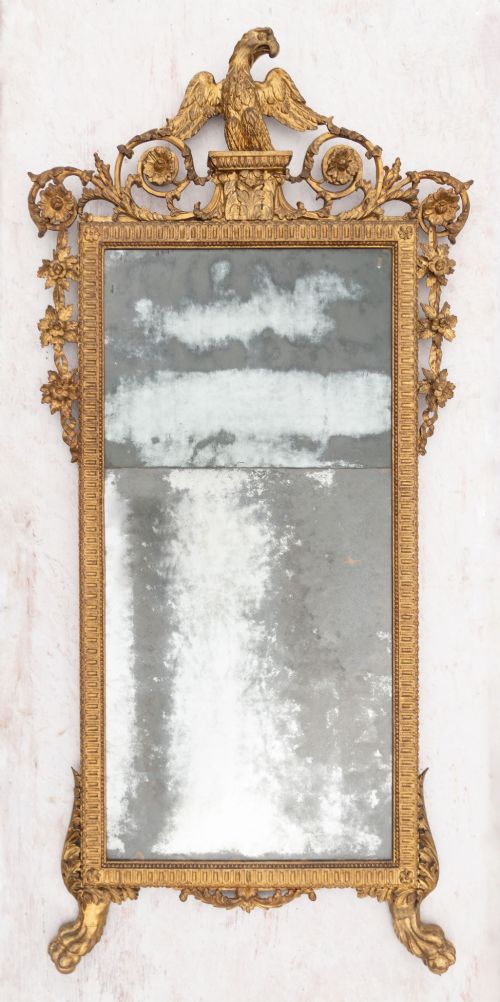
The distinction between tiers rests upon the crispness of the wood carving and the depth of the gilding. A superior piece displays sharply defined feathers on the eagle surmount and delicate modelling on the surrounding acanthus leaves or ball ornaments.
Proportion dictates presence, where the scale of the bird balances the diameter of the glass without feeling heavy or diminutive. The preservation of the original mercury or mirror glass surface further separates standard examples from exceptional survivals.
The Gold Eagle Mirror Glossary
- Convex mirror
- A circular looking glass with a curved surface that distorts reflections to encompass a wider view of the interior. These pieces became immensely popular during the Regency period.
- Giltwood
- Timber carved and coated with gold leaf over a prepared gesso ground. This technique creates a luminous surface that catches candlelight and daylight alike.
- Parcel gilt
- A decoration method where only specific portions of a wooden frame receive gold leaf while the underlying wood grain remains visible. It appears frequently on eighteenth-century mahogany and walnut pieces.
- Surmount
- The decorative ornament fixed to the top of a mirror frame. In these pieces, an eagle or bird crest serves this structural and visual role.
- Girandole
- A wall mirror equipped with attached candle sconces or branches. The arms project forward to multiply the illumination within a room.
Gold Eagle Mirror: Frequently Asked Questions
Where should I hang a gold eagle mirror?
These mirrors suit principal reception rooms, hung above a fireplace mantelpiece or centered on a principal wall where they can reflect natural light.
Because of their optical properties, convex formats perform best opposite a window or doorway to draw the room inward.
How do I identify a Regency period piece?
Regency examples typically feature circular convex glass set within a frame adorned with reeded ebonised slips and spherical ball ornaments.
The eagle surmount often stands upon a rocky outcrop or bracket, flanked by scrolling foliage typical of the early nineteenth century.
What is the difference between a pier mirror and an overmantel mirror?
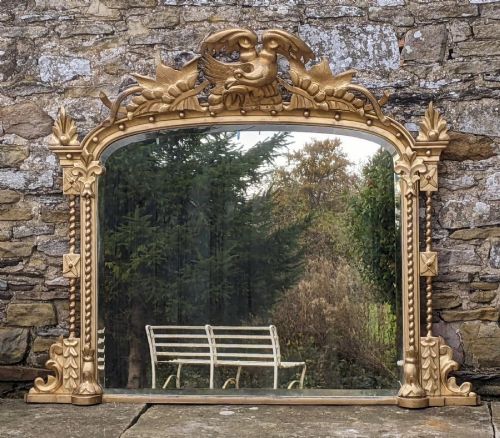
Pier mirrors are tall, narrow glasses designed to hang on the wall space between windows. Overmantel mirrors possess wider rectangular proportions built to sit directly above a fireplace.
Both formats utilise parcel gilt woodwork and bird crests within the recorded inventory.
How should I clean the gilded frame?
Dust the carved surfaces gently with a soft, dry brush to prevent accumulation in the recesses of the gesso and leaf. Avoid moisture and commercial cleaning agents, which damage historical gilt layers.