
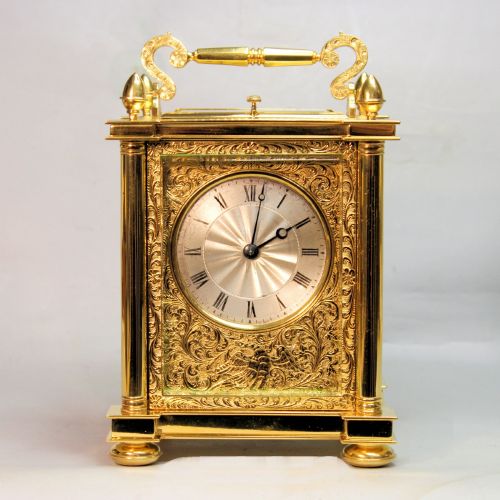
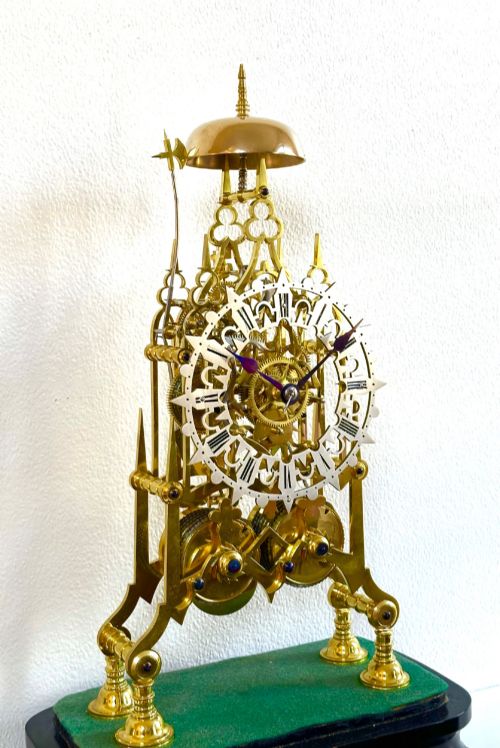


Gold Brass Fusee Clock
These gold brass fusee clock examples combine precise English mechanical movements with rich gilt brass and bronze cases.
Gold Brass Fusee Clock
A gold brass fusee clock represents a pinnacle of traditional English horology, merging reliable timekeeping mechanics with decorative metalwork. When searching for a gold brass fusee clock, collectors encounter several distinct formats ranging from table clocks and mantel clocks to wall-mounted dial clocks and skeleton movements.
The pieces appearing on this page span the Regency and Victorian periods, with specific examples referencing the mid-nineteenth century and around eighteen ninety. Formats vary from architectural mantel pieces and figural designs featuring cherubs to architectural skeleton clocks and mahogany wall dials.
Maker signatures frequently accompany these items, pointing to prominent London workshops of the nineteenth century. These clocks served both a domestic utilitarian purpose and a decorative function in period drawing rooms and parlours.
Assessing quality and craftsmanship
Quality reveals itself in the crispness of the gilt bronze chasing and the complexity of the movement. Cases with detailed figural elements or architectural motifs display superior metalworking skill compared to plainer housings.
The presence of a signed dial from a notable London maker adds considerable weight to an item's pedigree. Furthermore, the complexity of the movement, such as double fusee setups or quarter-striking capabilities, distinguishes standard timepieces from higher horological achievements.
Object types seen include mantel clocks, wall clocks, and table clocks, representing Regency, Victorian, and Rococo Revival styles.
Cousens & Whiteside·John Barwise·William Hardy·James Murray·FB Adams·Fisher Braithwaite·Perigal & Duterrau·Baetens·Bently & Beck
The Gold Brass Fusee Clock Glossary
- Fusee
- A conical pulley connected to the mainspring by a chain or cord, designed to maintain constant torque as the spring unwinds. This mechanism ensures consistent timekeeping accuracy throughout the power reserve.
- Ormolu
- Finely chopped gold or gold amalgam applied to a bronze base, creating a rich golden surface finish. It defines the appearance of many Regency and Victorian decorative cases.
- Skeleton clock
- A timepiece designed with an open framework that exposes the entire gear train and movement plates. This style allows light to pass through the construction and showcases the mechanics.
- Chapter ring
- The outer ring on a clock dial that bears the numerals for the hours. They often feature black enamel markings against a silvered or gilt background.
- Anchor escapement
- A mechanical linkage that controls the release of the gear train while imparting impulse to the pendulum. It forms the heart of traditional pendulum-driven clocks.
Gold Brass Fusee Clock: Frequently Asked Questions
What is a fusee movement?
A fusee movement uses a conical pulley and chain to equalise the power delivered by the mainspring. This keeps the driving force constant as the spring winds down.
This mechanical arrangement is a hallmark of traditional English clockmaking, prized for improving timekeeping precision.
How do I wind these clocks?
Winding requires a matching key inserted into the dial aperture to tension the mainspring via the fusee chain. Care must be taken not to overwind the mechanism.
Many of these antiques are designed to run for eight days before requiring another wind.
Where were these clocks made?
The majority of these pieces originate from London workshops active during the Regency and Victorian eras. Master horologists signed the dials and movements.
Craftsmen in the capital produced everything from simple dial clocks to elaborate gilt bronze figural mantel pieces.
Are skeleton clocks different?
Skeleton clocks differ by omitting a traditional solid case, exposing the gear train and movement plates between glass domes or open frames. They emerged as decorative showpieces.
While they still utilise fusee movements, their visual focus rests entirely on the intricate brass machinery.