



Gilt Wood Writing Desk
A gilt wood writing desk brings unmistakable continental splendour to a room, offering a functional surface framed in rich carved timber and metallic lustre.
Gilt Wood Writing Desk
When you search for a gilt wood writing desk, you encounter sophisticated forms designed for correspondence and display, ranging from freestanding bureau plat tables to compact bonheur du jour cabinets. The pieces listed on this page span several centuries, with a strong representation of nineteenth-century French revival pieces alongside earlier seventeenth and eighteenth-century continental examples.
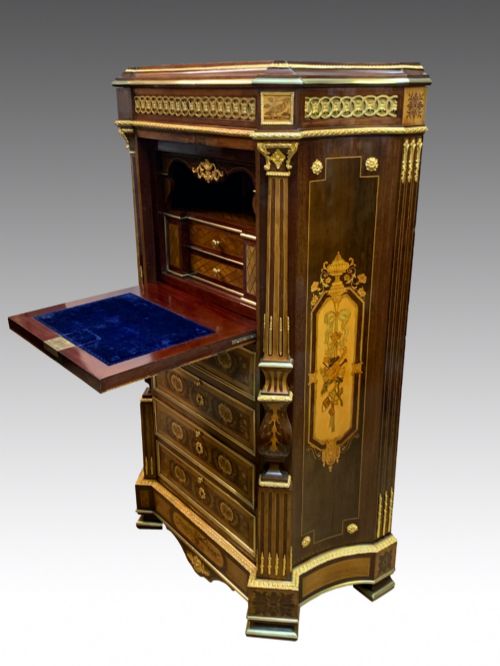
The most common iterations on this page are French nineteenth-century bureau plat tables and marquetry-inlaid desks, often finished with detailed ormolu mounts and contrasting exotic veneers. Alongside these, buyers find specialised forms such as secretaire cabinets, travelling bureaux, and occasional writing tables reflecting Louis XV and Louis XVI styles.
How they were made
Cabinetmakers constructed these desks using sturdy foundational timbers such as mahogany, walnut, and oak, which were then veneered with decorative woods including kingwood, tulipwood, amboyna, and burr walnut. Complex floral marquetry and parquetry patterns involved meticulous hand-cutting and fitting of different timber species to create pictorial or geometric surfaces.
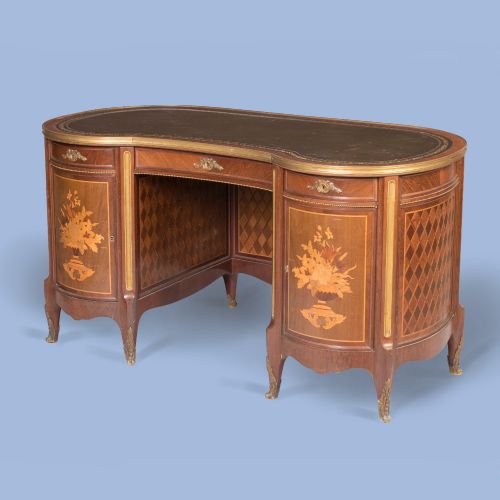
Gilt decoration and metalwork played a central role in the construction, combining carved and gilded wood with cast bronze and ormolu mounts, sabots, and handles. Many writing surfaces were completed with inset tooled leather to provide a durable and tactile panel for writing.
Listings feature woods such as kingwood, rosewood, amboyna, and burr walnut, often complemented by ormolu mounts and tooled leather.
What varies in quality
The calibre of a gilt wood writing desk rests upon the precision of its marquetry inlay and the crispness of its carved and gilded woodwork. Superior pieces exhibit seamless veneer matching and finely chased ormolu mounts that integrate harmoniously with the carcase.
Structural integrity and the retention of original decorative finishes determine the standing of individual examples. Desks retaining their patinated leather inserts, original bronze mounts, and authentic period gilding command greater appreciation among collectors.
Maison Krieger·Gillows
The Gilt Wood Writing Desk Glossary
- Bureau plat
- A freestanding double-sided writing table, usually featuring drawers in the frieze and an inset leather top. These tables were designed to sit in the centre of a room rather than against a wall.
- Ormolu
- Gilt bronze ornamentation applied to furniture, cast and chased to produce sharp decorative details. This technique was widely utilised on high-end French furniture.
- Marquetry
- Decorative patterns formed by fitting together thin slices of various coloured woods and other materials onto a carcase. It requires considerable skill to execute complex floral or geometric scenes.
- Bonheur du jour
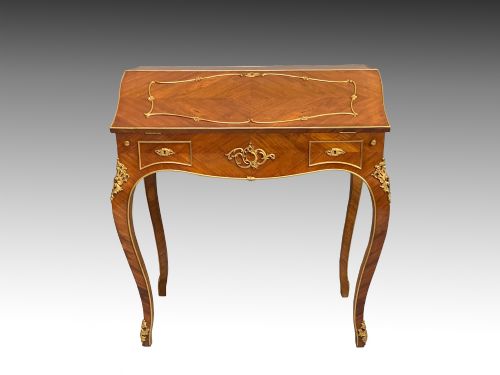
- A small, light ladies' writing desk featuring a cabinet or super-structure with shelves and drawers above the main writing surface. The form gained popularity during the Louis XV period.
- Sabot
- A metal mount fitted to the foot of a furniture leg to protect the timber from wear and moisture. They are frequently cast in brass or ormolu and shaped to match the leg style.
Gilt Wood Writing Desk: Frequently Asked Questions
Where should I place a gilt wood writing desk?
These desks are often designed as freestanding pieces intended to command attention in the centre of a study or reception room. Their finished backs and ornate ormolu mounts allow them to be viewed from any angle.
Alternatively, smaller forms like the bonheur du jour or ladies' writing cabinet suit placement against a principal wall or beside a window where natural light assists with correspondence.
How do I care for the leather writing surface?
The inset leather panel requires gentle maintenance using specialised leather balms or soft, dry cloths to prevent the material from drying and cracking over time. Avoid harsh chemical cleaners or excessive moisture during routine cleaning.
Preserving the tooled gilt borders around the edge of the leather helps maintain the visual integrity of the writing surface.
How can I distinguish Louis XV from Louis XVI style?
Louis XV pieces are characterised by flowing serpentine lines, asymmetrical curves, and cabriole legs terminating in scroll feet or sabots. The overall aesthetic leans towards organic rococo movement and abundant floral marquetry.
In contrast, Louis XVI style reflects a turn towards neoclassical symmetry, featuring straight fluted legs, geometric veneers, and architectural mounts influenced by classical antiquity.
What is the difference between a bureau plat and a secretaire?
A bureau plat is an open writing table with drawers set into the frieze beneath the top surface, lacking any vertical superstructure or enclosed cabinet space. It serves primarily as a decorative table for daily correspondence.
A secretaire incorporates a writing flap or fall-front that opens to reveal internal compartments and pigeonholes, allowing papers to be concealed when not in use.