
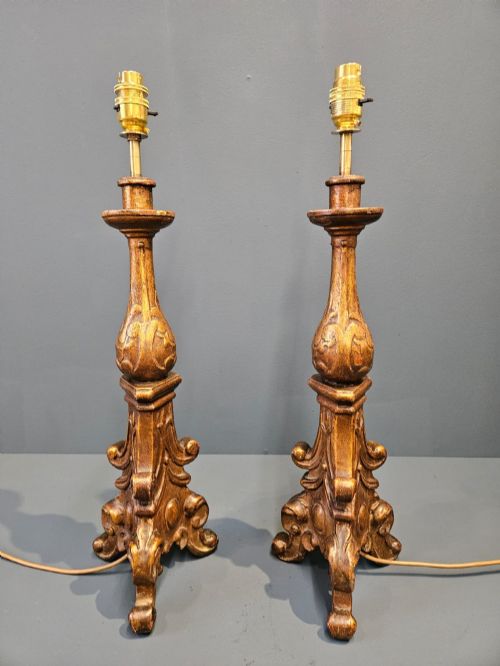
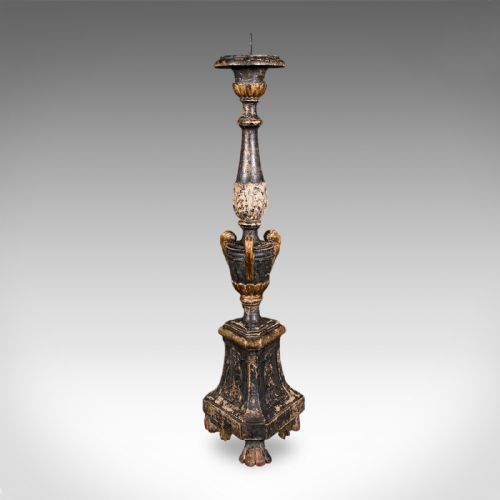


Gilt Wood Candlesticks
These gilt wood candlesticks bring warmth and historic presence to a room, functioning either as altar pieces or substantial lamp bases.
Gilt Wood Candlesticks
When you search for gilt wood candlesticks, you encounter carved wooden objects finished with gold leaf, gesso, or silvered mecca, often adapted as table lamps or standard lamps. The selection spans the eighteenth century through to the Victorian era and the early twentieth century, showing strong continental origins alongside English examples.
The most common forms on this page include tall altar-style candlesticks and pricket sticks, frequently discovered in pairs. Italian and Spanish Baroque styles dominate the record, alongside Georgian, Victorian, and Florentine designs.
Many of these pieces began life on church altars before finding a second chapter in domestic interiors. Whether retained as candle holders or converted to electricity, they offer sculptural weight and aged surface character.
Materials and carving techniques
Carvers shaped timber, often softwoods or hardwoods, into elaborate turned and sculptural forms before applying layers of gesso to smooth the surface. Artisans then laid gold leaf or silver leaf over the gesso base, burnishing the metal to achieve a luminous finish.
Alternative surface treatments include ebonisation, marbling, and mecca, a transparent varnish applied over silver leaf to simulate the rich tone of gold. Iron and brass components occasionally appear in structural fixings or pricket spikes.
Listings feature items spanning the eighteenth century to the twentieth century, employing giltwood, gesso, brass, iron, and carved wood.
Distinctions in craftsmanship and survival
The depth and vigour of the hand carving set individual examples apart, with finer pieces displaying crisp acanthus leaves, scrollwork, and balanced proportions. The retention of the original gilt or gesso surface, showing natural craquelure and gentle wear rather than unsympathetic repainting, defines a superior survivor.
Scale also influences distinction, as taller altar pieces and matched pairs command greater presence. The integrity of the timber core and the subtlety of the historical alterations, particularly where wiring has been integrated, complete the assessment.
The Gilt Wood Candlesticks Glossary
- Giltwood
- Wood that has been coated with gold leaf or gold powder. This finish creates a reflective, metallic surface that softens as the underlying gesso and timber show through with age.
- Gesso
- A plaster mixture applied to wood as a preparation for gilding or painting. It provides a smooth, chalky ground that carvers could shape in fine detail before applying metal leaf.
- Pricket
- A sharp metal spike on a candlestick designed to skive into the base of a candle. This form is frequently found on altar candlesticks from ecclesiastical settings.
- Mecca
- A transparent golden varnish applied over silver leaf. It was used by craftsmen to imitate the appearance of gold leaf at a lower cost.
- Treen
- Small handmade wooden household objects. In these listings, it denotes turned wooden elements associated with the construction of the candlesticks.
Gilt Wood Candlesticks: Frequently Asked Questions
Are these converted to lamps?
Many examples listed here have been adapted to function as table lamps or standard lamps, while others remain configured for candles as pricket sticks. Conversions often utilise existing central channels or discreet wiring routes to preserve the exterior carving.
Buyers can choose between retaining the historical candle configuration or enjoying the practicality of a fitted lamp base. Each listing specifies whether the piece operates as a lamp or a traditional candlestick.
Where do these pieces originate?
The evidence points strongly towards continental workshops, particularly in Italy and Spain, alongside English pieces. Italian Baroque and Spanish Baroque styles feature prominently, reflecting ecclesiastical commissions from the eighteenth century onwards.
Regional characteristics appear in the carving style and the choice of underlying woods and finishes. Florentine and Venetian influences are particularly visible in the decorative scrollwork and silvered mecca treatments.
How do I care for giltwood?
Giltwood requires gentle maintenance to protect the delicate gold leaf and gesso layers from damage. Dusting should be done lightly with a soft, dry brush, avoiding any moisture, abrasive cloths, or chemical cleaning products.
Keeping these pieces away from direct sunlight and excessive humidity prevents the timber from warping and stabilises the historic surface finishes. Careful placement ensures the longevity of the original gilding.
How are periods identified?
Dating relies on the stylistic markers of the carving, such as the exuberant scrolls of the Baroque era or the restrained symmetry of Neoclassical design. Material evidence, including the composition of the gesso and the wear patterns on the gold leaf, also guides attribution.
Construction methods, such as the use of hand-turned timber components and early fixings, help distinguish eighteenth-century pieces from later nineteenth-century revivals and twentieth-century interpretations.