
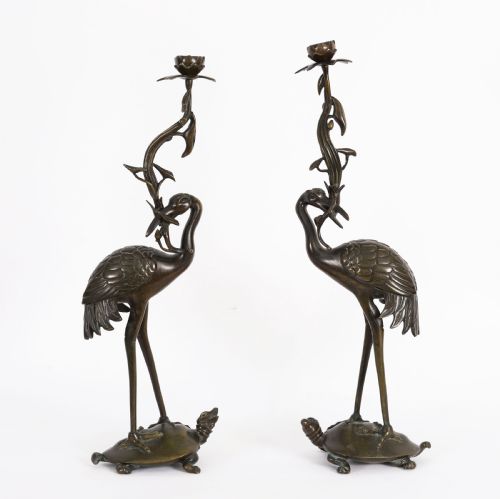


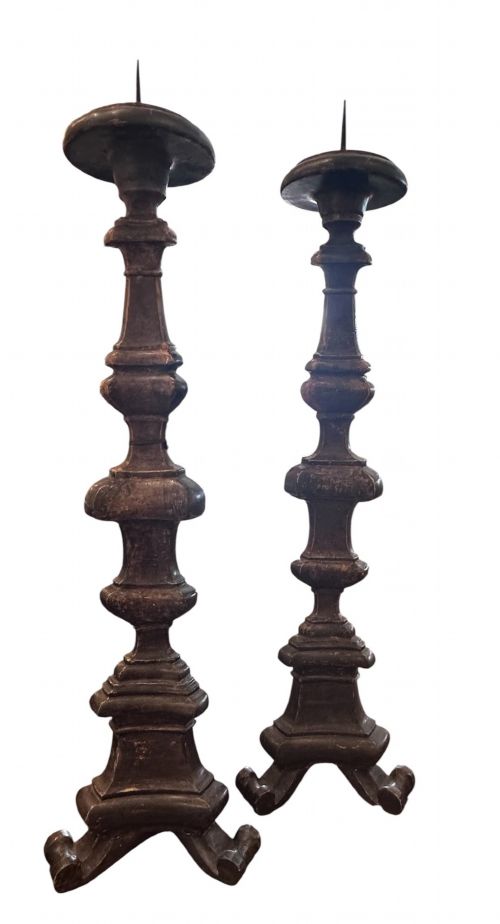


19th Century Pricket Candlesticks
These 19th century pricket candlesticks bring altar-forged presence to a room, driven by upward spikes designed to impound heavy wax candles.
19th Century Pricket Candlesticks
When you search for 19th century pricket candlesticks, you look at altar and church furnishings that rely on a central vertical spike rather than a socket to hold a candle. The examples most frequently met here span the 19th century, drawing on Gothic Revival and continental styles.
Forms range from tall floor standing church candle holders to table candlesticks and altar lamps. Many items carry regional character, noted as 19th century Italian or French chateau pieces alongside Victorian Gothic interpretations.
Makers adapted these ecclesiastical items for domestic interiors, resulting in pieces later converted to lamp bases or preserved as purely decorative floor and table candlesticks. Pairs and single sticks alike appear, constructed from durable metals and carved woods.
How they were made
Makers relied on cast and forged metals such as brass, iron, wrought iron, bronze, and ormolu to build sturdy shafts and broad bases. These metal pieces often take heavy use from molten wax and time.
Woodworking traditions brought forth treen, giltwood, and carved wooden supports finished with gesso, gold leaf, or silver leaf. Polychrome decoration frequently adds colour and depth to Italian and French altar pieces.
Periods represented include the 19th century, Victorian era, and specific dates such as 1850 and 1860.
What varies in quality
The weight and integrity of the casting or carving dictate the calibre of a piece, with dense metals and finely layered gesso or leaf holding the eye. Superior items maintain their original surface finishes without heavy modern intervention.
The fidelity of the style, whether strict Victorian Gothic Revival or florid Rococo Revival, separates routine utility items from sculptural altar pieces with strong decorative presence.
The 19th Century Pricket Candlesticks Glossary
- Pricket
- A sharp metal spike atop a candlestick that secures the base of a candle. This form predates the standard socket candlestick.
- Gesso
- A plaster-like mixture applied to wood surfaces as a base for gilding or painting. It provides a smooth ground for gold and silver leaf.
- Ormolu
- Finely chased and gilded bronze used for decorative mounts and altar candlesticks. The technique gives a rich, gold-coloured finish to metalwork.
- Treen
- Small handmade wooden objects for the home. These items display the natural grain and turned shapes of nineteenth-century woodwork.
- Polychrome
- Decorated in multiple colours. This surface treatment brings painted detail to carved wooden altar pieces.
19th Century Pricket Candlesticks: Frequently Asked Questions
What is a pricket candlestick?
A pricket candlestick uses an upright metal spike to hold a candle in place, differing from standard socket holders.
This design stems from ecclesiastical traditions where large wax tapers needed a secure spike to stand steadily on church altars.
How were they used originally?
These items stood upon altars and in chapels to provide illumination during religious services and ceremonies.
Large floor-standing versions held heavy church candles to light deep chancels and sanctuaries.
Can I use standard candles on them?
Pricket sticks require candles with a hollowed or softened base that can press down firmly onto the vertical spike.
Many modern buyers prefer to use them for display or adapt them safely rather than burn heavy candles.
Why are some converted to lamps?
Electric wiring allows tall altar candlesticks to function safely as practical table lamps in modern rooms.
This conversion preserves the decorative giltwood or brass form while providing everyday domestic lighting.