
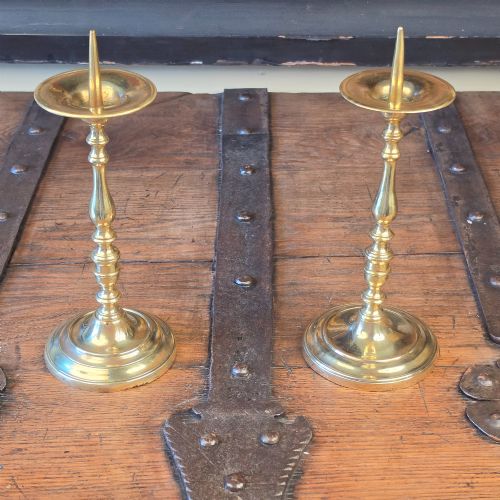


Vintage Gold Pricket Holders
These vintage gold pricket holders combine rich ecclesiastical presence and decorative warmth, offering a striking focal point for any room.
Vintage Gold Pricket Holders
Vintage gold pricket holders comprise candle stands and chandeliers designed with a central spiked metal pin, known as a pricket, to secure large candles rather than standard socket nozzles. The selections available encompass nineteenth-century items alongside revival pieces executed in seventeenth-century and continental baroque styles.
Buyers will frequently encounter paired candlesticks and larger church-style floor or table lighting, spanning periods from the mid nineteenth century through to the early twentieth century. Forms range from ornate brass designs to substantial wooden structures finished with gilt surface treatments.
Originating largely from continental and British workshops, these objects carry heavy religious or ceremonial aesthetic influences. Gothic revival and Italian baroque influences dominate the visual character of the pieces meeting this search phrase.
How they were made
Makers utilised traditional timber construction, carving wood and applying gesso before finishing the surfaces with gold leaf or giltwood layers. Metal examples employ cast brass and wrought iron, occasionally paired with glass elements.
The combination of carved wooden bases and applied gilding creates a textured surface that reflects candlelight effectively. Structural integrity relies on heavy turned wooden or cast metal shafts designed to support substantial wax tapers safely.
Several heavy church candlesticks weigh enough to double as improvised fitness weights if altar service gets overly rigorous.
What varies in quality
Depth of carving and the finesse of the surface gilding separate standard production from superior examples. Heavy gauge brass casting and substantial timber turning indicate higher grade workmanship.
Proportion and scale distinguish finer church-grade altar pieces from domestic adaptations. The integrity of the original gold leaf surface and the weight of the base metal significantly influence the overall character.
The Vintage Gold Pricket Holders Glossary
- Pricket
- A metal spike set into the top of a candlestick to hold a candle in place. This traditional method predates the common socket holder.
- Giltwood
- Wood that has been coated with gold leaf or a gold-coloured finish. It provides a luminous surface often used in baroque and revival interior schemes.
- Gesso
- A plaster-like mixture applied to wood surfaces as a base for paint or gold leaf. It allows craftsmen to carve intricate decorative details before gilding.
- Gothic Revival
- An architectural and decorative style drawing inspiration from medieval design. It frequently incorporates pointed arches and ecclesiastical motifs.
- Baroque
- A style of European architecture and ornament characterised by elaborate detail and dramatic ornamentation. It heavily influences many continental candlesticks from this selection.
Vintage Gold Pricket Holders: Frequently Asked Questions
What is a pricket holder?
A pricket holder is a type of candle support featuring a sharp spike instead of a hollow cup. The base of the candle is pressed onto this spike to hold it upright.
This design appears frequently in church and altar lighting from various centuries.
How do I date these candlesticks?
Dating relies on examining the materials, construction methods, and stylistic revival markers present in the piece. Nineteenth-century examples often combine period manufacturing techniques with earlier baroque or gothic design influences.
Details like hand-turned wood and applied gesso point toward older craftsmanship.
Are these made of solid gold?
These items are not made of solid gold, but rather utilise gold leaf or gilt finishes applied over wood or base metal. Giltwood and brass are the primary materials providing the golden appearance.
This technique achieves a rich metallic aesthetic while maintaining structural stability.
How were church candlesticks used?
Church candlesticks stood on altars or floors to provide ceremonial illumination during religious services. Their substantial size ensured they remained visible across large ecclesiastical spaces.
Today, similar pieces serve as decorative focal points in domestic interiors.