
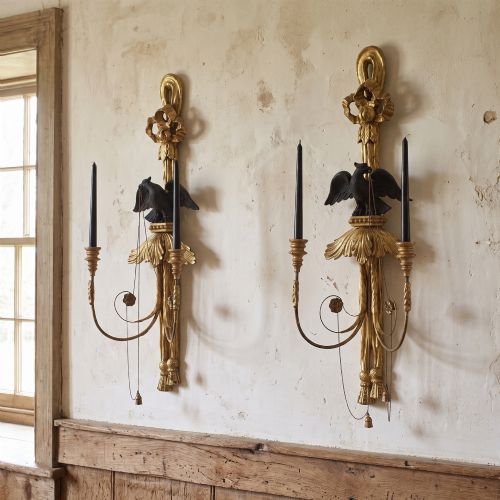


Gold Wooden Candle Holders
Gold wooden candle holders bring warmth and historical texture to a room, spanning Baroque excess and George III elegance.
Gold Wooden Candle Holders
Gold wooden candle holders combine carved timber bases with gilded surfaces, taking forms from altar sticks and prickets to wall sconces and candelabras. When searching for gold wooden candle holders, buyers encounter pieces fashioned from carved wood, gesso, and giltwood, often enriched with polychrome paint or iron elements.
The selection ranges across the eighteenth and nineteenth centuries, featuring styles such as Venetian Baroque, French Neoclassical, and George III. Buyers are most likely to meet pairs of candlesticks or wall sconces originating from Italian and French workshops, alongside larger altar-type candle holders of impressive proportions.
Makers utilised various configurations, including single-branch sticks, three-branch sconces, and figural supports like carved Blackamoor figures adapted as candelabras. Some examples have later been adapted into table lamps or lamp bases while retaining their original carved and gilt structure.
How they were made
Artisans carved the foundational forms from solid timber, shaping intricate details such as acanthus leaves, architectural mouldings, and figural elements by hand. Carved wood provided a sturdy substrate capable of supporting elaborate ornamentation.
Craftsmen applied layers of gesso over the timber base to create a smooth, receptive surface for subsequent gilding with gold leaf. Polychrome paint was frequently introduced to accentuate specific contours or provide contrasting colour against the bright metallic leaf.
Several pairs double as silent footmen, holding candles aloft while wearing exquisitely painted historical garments.
What varies in quality
The finesse of the hand-carved detail distinguishes superior examples, where crisp lines and deep undercutting reveal the hand of a skilled artisan rather than mechanical repetition. Proportions also dictate value, with larger altar-type pieces and balanced pairs commanding particular attention.
The integrity and application of the gilding surface matter greatly, as original gold leaf and gesso layers age with distinct patination that modern restorations cannot replicate. The harmony between the underlying carved wood and any polychrome paint finishes establishes the visual weight of the piece.
The Gold Wooden Candle Holders Glossary
- Giltwood
- Wood that has been coated with gold leaf or gold paint. This technique was widely utilised across eighteenth and nineteenth-century European decorative arts to create opulent lighting fixtures.
- Pricket
- A sharp metal spike on a candlestick designed to secure a candle in place. Such items frequently appear in eighteenth-century ecclesiastical or altar contexts.
- Gesso
- A plaster-like mixture applied to wood as a smooth base before gilding or painting. Its presence under the gold leaf is typical of traditional craftsmanship.
- Sconce
- A candle holder fixed to a wall to provide ambient illumination. Many surviving examples feature paired branches and elaborate carved motifs.
- Polychrome
- The practice of decorating architectural elements or sculptures in a variety of colours. On these pieces, paint often highlights carved details alongside gilt surfaces.
Gold Wooden Candle Holders: Frequently Asked Questions
How do I clean a giltwood candle holder?
Dust the carved surfaces gently with a soft, dry brush to prevent accumulation without disturbing the delicate gold leaf layers.
Avoid liquid cleaners, moisture, and abrasive cloths entirely, as these substances can strip the historic gesso and gilding.
Are these candle holders safe for daily use?
Most antique pieces function well with standard taper candles, though larger prickets require specific candle types with central holes.
Due to the age of the wood and dry gesso, use drip protectors and supervise burning candles closely to protect the finish.
How can I tell an eighteenth-century piece apart from a later style?
Eighteenth-century originals display organic wear patterns, hand-forged iron elements where applicable, and dense timber bases consistent with period tools.
Later interpretations in historical styles often feature uniform machine preparation or different structural joinery under the gesso layer.
Can converted lamp bases be returned to candle holders?
Reversibility depends entirely on how the wiring was integrated into the original carved wood structure.
Some conversions pass through existing central channels without damage, while others require professional assessment to restore the piece to its original configuration.