
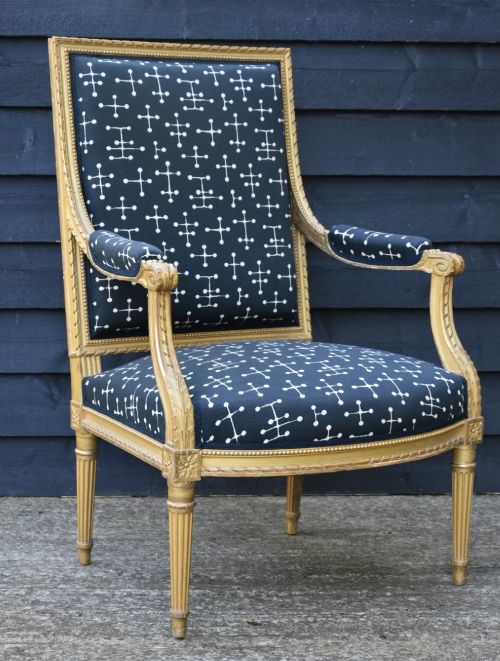
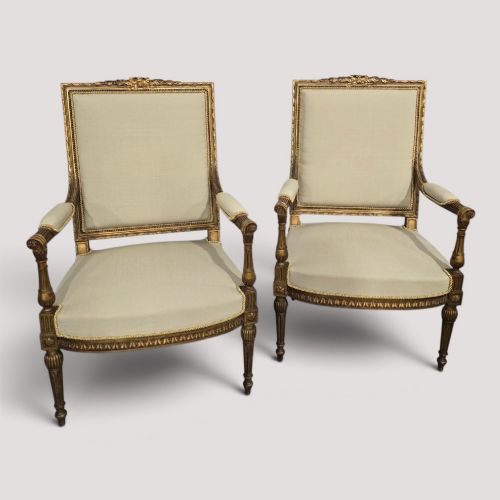
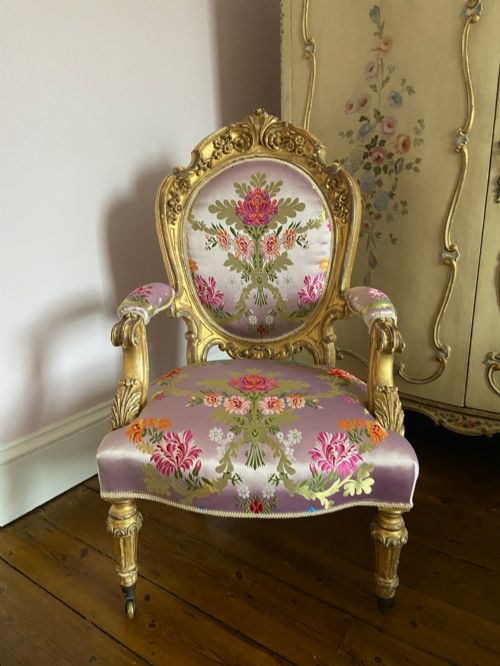


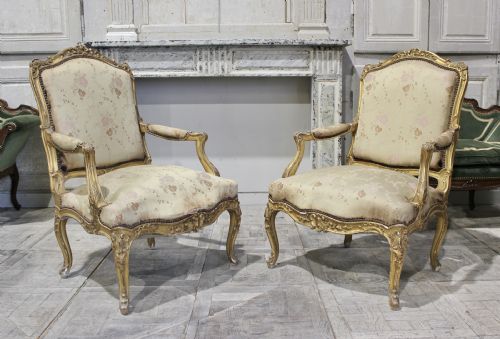
Gilt Framed Armchair
These gilt framed armchair pieces bring grand French and English revival seating into a room with rich carved detail and comfortable upholstery.
Gilt Framed Armchair
A gilt framed armchair is a decorative seating form designed for formal reception rooms and parlours, originating primarily from nineteenth century revival movements. These chairs draw heavily on French court aesthetics, displaying the flowing lines of the Rococo Revival and Louis XV style alongside stricter French Neoclassical or Regency Revival proportions.
Buyers encounter a variety of forms on this page, ranging from open armchairs in carved giltwood to upholstered tub chairs and larger salon suites. The majority date from the nineteenth century, though early twentieth century revival pieces also appear alongside walnut and beech frames upholstered in velvet, silk, or fabric.
How they were made
Makers shaped these chairs from solid timbers such as beech, walnut, and wood, often building up intricate decorative relief before applying a gold leaf or paint finish. Giltwood surfaces involve laying thin sheets of metal leaf over a prepared base, creating the luminous metallic sheen characteristic of these frames.
Upholstery forms an integral part of the construction, employing traditional stuffing and springs covered in textiles like silk, velvet, or woven fabric. Frames frequently feature hand-carved ornamentation that mirrors historic Louis XV and Louis XVI motifs.
Some nineteenth-century makers snuck ebonised legs onto tub chairs just to keep formal drawing rooms guessing.
What varies in quality
The distinction between standard and superior pieces rests on the crispness of the wood carving and the depth of the gilding. Hand-carved giltwood with sharp, well-defined motifs commands greater attention than simpler moulded decoration or plain painted finishes.
Frame stability and timber selection also divide the range, as dense woods like walnut and beech provide enduring structural integrity. Original upholstery schemes and high-grade textiles such as silk and velvet elevate the overall refinement of the seating.
The Gilt Framed Armchair Glossary
- Giltwood
- Wood that has been decorated with gold leaf or powder applied over a prepared surface. This finish gives the wooden frame its characteristic metallic brilliance.
- Rococo Revival
- A nineteenth century design movement that reinterprets the asymmetrical curves, C-scrolls, and naturalistic plant motifs of the eighteenth century French style. It dominates many of the ornamental armchairs found in this category.
- Bergere
- A closed-upholstered armchair with wooden armrests and an upholstered back and sides. This French form provides a deep, enclosing seat.
- Savonarola chair
- A folding chair constructed from multiple intersecting wooden slats forming a distinctive X-shaped frame. It takes its name from a famous Florentine friar.
Gilt Framed Armchair: Frequently Asked Questions
What periods do these armchairs come from?
The pieces span the nineteenth and early twentieth centuries, capturing major revival phases from eighteen-sixty through nineteen-ten. Most examples reflect Victorian interpretations of earlier French designs.
Craftsmen drew inspiration from seventeenth and eighteenth century royal courts to produce these decorative seating options for wealthy households.
How were gilt framed armchairs used?
These seats served primarily in formal reception rooms, salons, and withdrawing rooms where appearance mattered as much as comfort. They furnished conversational groupings alongside matching settees and side chairs.
Owners positioned them to highlight interior decoration schemes during formal gatherings and receptions.
How do I care for giltwood furniture?
Giltwood surfaces require gentle dusting with a soft, dry cloth to prevent abrasion of the delicate gold leaf finish. Avoid harsh cleaning products, moisture, and direct sunlight, which can cause the metallic leaf to flake or fade.
Maintaining stable room humidity protects both the underlying timber frame and the traditional joinery.
How do I distinguish Louis XV and Louis XVI styles?
Louis XV style armchairs feature asymmetrical curves, flowing cabriole legs, and naturalistic floral carvings that create an organic silhouette. In contrast, Louis XVI pieces adopt straight tapered legs, geometric symmetry, and classical architectural motifs.
Examining the leg shape and frame symmetry provides the quickest indicator of which French royal period inspired the maker.