





Gilt Base Clock
A gilt base clock brings gleaming metalwork and sculptural weight to a mantelpiece, offering both reliable timekeeping and period charm.
Gilt Base Clock
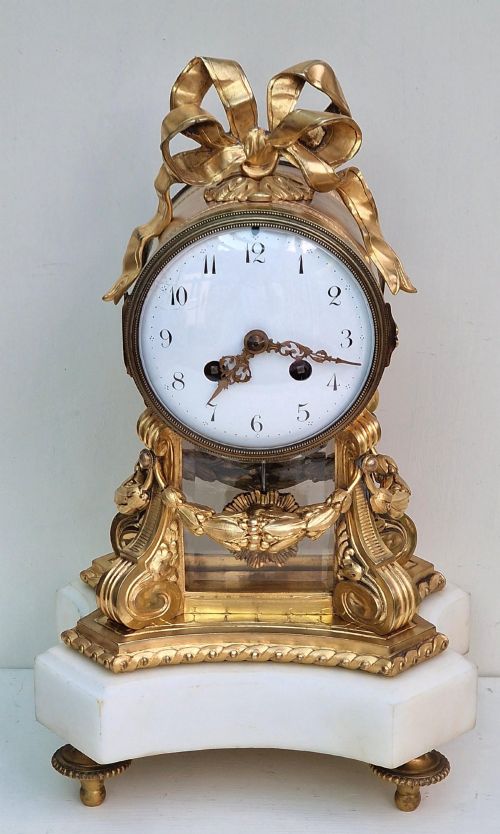
A gilt base clock sits firmly within a lineage of decorative timepieces produced across the nineteenth century, drawing heavily on French Rococo Revival, Louis XVI, and Regency aesthetics. These objects combine substantial metalwork with contrasting plinths, frequently uniting gleaming metal finishes with white marble or variegated marble stands.
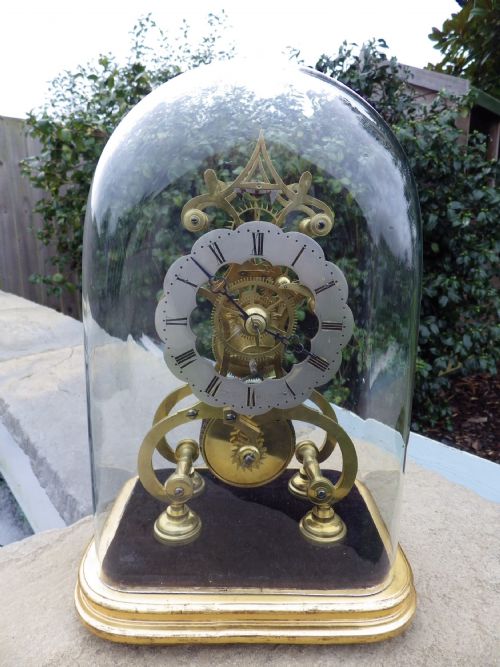
The versions most commonly encountered on this page include French mantel clocks and English fusee examples, often incorporating detailed figures such as cherubs or botanical motifs like dragonflies. They function as both domestic timepieces and sculptural centrepieces for a room.
Originating largely from English workshops and Parisian makers during the Victorian and Regency eras, these clocks reflect diverse regional movements. Some pieces adhere to strict classical symmetry, while others embrace ornate, fluid curves associated with revivalist design.
How they were made
Makers utilised cast bronze, ormolu, and gilt metal for the structural casings and decorative mounts, applying fire gilding or chemical finishing to achieve a bright golden lustre. These metallic elements were paired with contrasting natural materials such as white marble, variegated marble, and ebonised wood to build a stable and visually rich foundation.
Enamel dials with painted numerals were fitted behind protective glass doors or bezels, housing intricate mechanical movements driven by springs or fusee chains. English makers often employed precise single fusee movements, whereas French workshops integrated detailed pendulum mechanisms alongside porcelain and cast sculptural figures.
Gilt Base Clock Retail Price Guide 2026
Typical asking prices for gilt base clock among the pieces listed under this phrase on Sellingantiques today, from the lower quarter to the upper quarter. They describe what is for sale here now, not the wider market.
Listings feature periods spanning from the Regency era through the late Victorian period, alongside twentieth-century Edwardian examples.
What varies in quality
Another differentiator lies in the quality of the housing materials, such as heavy, solid white marble or variegated stone bases compared to lighter substitutes. The sophistication of the internal movement, from standard timepieces to precise English fusee mechanisms, also dictates the distinction between standard and exceptional pieces.
Le Roy Paris·William Hardy London·Henry Berkeley Square London·Payne of London
The Gilt Base Clock Glossary
- Ormolu
- A technique of applying finely ground high-carat gold to a bronze object using a mercury amalgam. It produces a rich, durable golden finish characteristic of high-end nineteenth-century decorative arts.
- Fusee
- A conical pulley used in mechanical clocks to equalise the torque of the mainspring as it winds down. This mechanism helps maintain consistent timekeeping accuracy.
- Gilt Bronze
- Bronze metal that has been coated with a thin layer of gold leaf or gold paint. It provides the appearance of solid gold while utilising a stronger underlying metal.
- Variegated Marble
- Marble featuring multiple natural colour variations, veins, or patches. It offers a dramatic visual contrast against gleaming metallic clock mounts.
- Rococo Revival
- A nineteenth-century design style inspired by eighteenth-century French rococo, marked by asymmetrical scrolls, natural motifs, and elaborate ornamentation.
Gilt Base Clock: Frequently Asked Questions
How do I wind a fusee clock?
Wind the clock slowly using the appropriate key in the designated winding square, taking care not to overwind the mechanism.
Most fusee movements require a steady, measured turn to engage the chain and spring properly without placing sudden strain on the internal teeth.
Where should I place a heavy marble clock?
Position the clock on a sturdy, level piece of furniture, such as a strong sideboard, heavy desk, or wide mantelpiece that can support significant weight.
Ensure the surface is completely flat so the marble base rests evenly and the internal pendulum can swing without catching against the case.
How do I clean ormolu mounts?
Dust the metal gently with a soft, dry brush or a lint-free cloth to remove surface particles without scratching the delicate gilded surface.
Avoid using abrasive chemical polishes, as these can strip away the historical gold layer and permanently damage the finish.
Why does my clock run fast or slow?
Clocks can lose or gain time due to temperature changes, slight shifts in placement, or the natural settling of the mechanical pendulum over time.
Adjustment is usually managed by turning the small regulation nut on the pendulum to alter its effective length and correct the beat.