
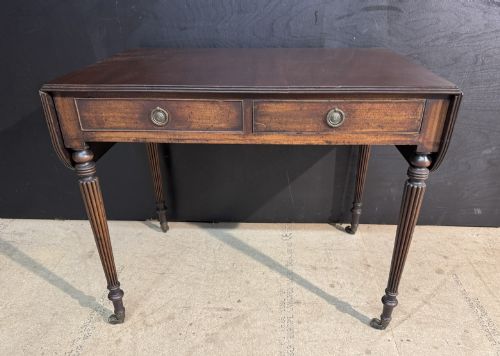
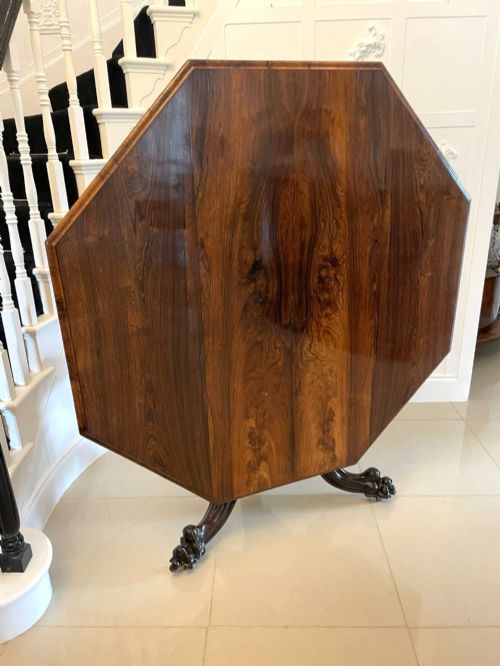
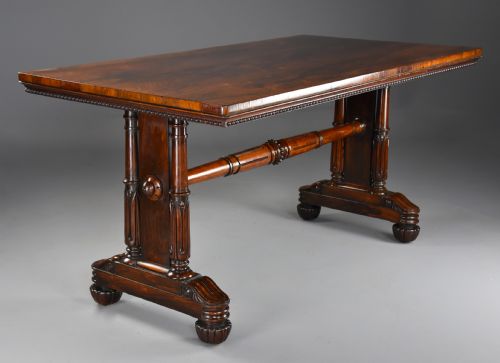


Gillows Style Hall Table
These pieces sold as a gillows style hall table bring refined Regency proportion and robust timber construction directly into the narrowest entrance spaces.
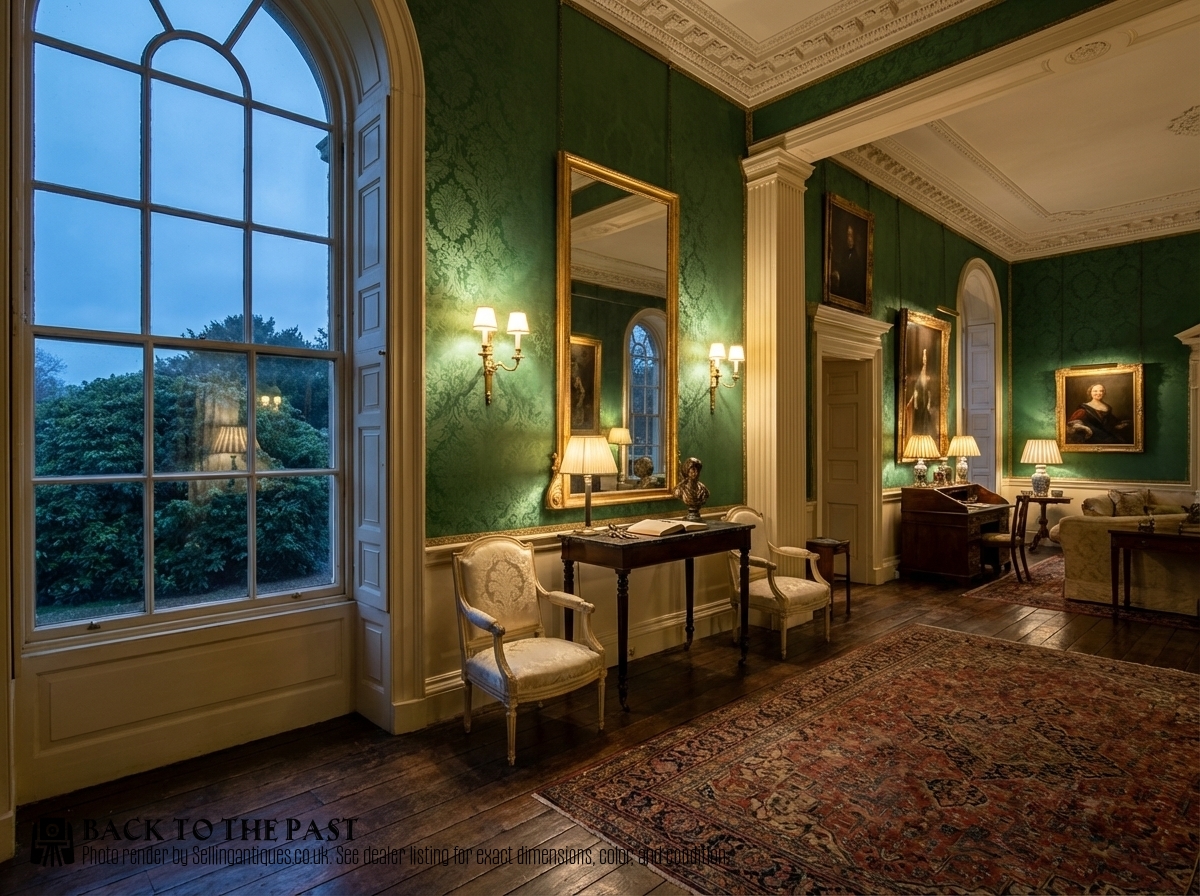
Gillows Style Hall Table
A gillows style hall table brings together the refined forms of the Regency, Georgian, and William IV periods. These pieces serve practical functions in narrow spaces, drawing upon classic console, side, and serving table forms.
The pieces appearing in this category span several decades of the nineteenth and late eighteenth centuries. Mahogany, rosewood, and yew feature prominently alongside painted wood surfaces and marble tops.
Makers working in this manner adopted the restrained elegance and functional design associated with the Lancaster and London workshops. Buyers encounter writing tables, library tables, and sofa tables adapted to the proportions required for a hallway.
Materials and construction methods
Timber selection forms the foundation of these pieces, with solid mahogany and figured rosewood providing both durability and rich surface grain. Workshops frequently utilised yew and other dense timbers to achieve specific colour depths and structural integrity.
Metal components such as brass enrich the design through cast mounts, handles, and sabots that protect vulnerable legs. Leather inserts appear on writing surfaces, while marble top options offer a cooler, more resilient landing surface for everyday items.
Listings feature mahogany, rosewood, and yew across Georgian and Victorian periods.
Distinguishing quality across the range
The refinement of the timber carving and the subtlety of the turned or reeded leg details set finer examples apart from simpler workshop output. Cabinetmaking precision in the joinery of drawers and the matching of veneer grains indicates the level of care invested in construction.
Proportion and the handling of secondary woods reveal the workshop hierarchy, where top-tier pieces maintain structural crispness and balanced design. Pieces bearing direct attribution or showing the distinct design traits of Lancaster and London production command greater attention.
Gillows of Lancaster and London
The Gillows Style Hall Table Glossary
- Regency
- A stylistic period spanning the early nineteenth century characterised by classical restraint and archaeological influence. Furniture from this era often incorporates clean lines and ancient Greek or Roman motifs.
- Sofa table
- A rectangular occasional table fitted with drop leaves at either end and usually two small drawers. These pieces were originally designed to stand in front of a sofa.
- Console table
- A wall-mounted or freestanding table designed to stand against a flat surface in a hallway or reception room. They typically feature shallow depths to suit circulation spaces.
- Library table
- A large freestanding table finished on all sides for use in the centre of a room rather than against a wall. These items frequently incorporate working drawers and leather-lined tops.
- Library bureau plat
- A flat-topped writing table fitted with drawers across the frieze. This form developed for formal study and administrative work in large country houses.
Gillows Style Hall Table: Frequently Asked Questions
How were these tables used originally?
Such pieces occupied grand entrance halls and reception rooms to receive incoming correspondence, visiting cards, and small daily items. Their narrow proportions allowed homeowners to furnish transitional spaces without blocking doorways or pathways.
In larger country houses, they matched the furniture of adjacent libraries and dining rooms, establishing a cohesive aesthetic throughout the primary public areas.
Where should I place one today?
A narrow hall or landing provides an ideal setting where the shallow depth of a console or side table preserves walking space. They function effectively beneath a wall mirror or painting to create an immediate visual focal point upon entering a home.
Living rooms and studies also accommodate these tables well as serving surfaces or alternative writing desks.
How do I distinguish Regency from Victorian pieces?
Regency items generally exhibit leaner proportions, sharper classical detailing, and a preference for architectural restraint. Brass inlay, reeded legs, and sabre supports frequently characterise this earlier phase.
Victorian pieces tend toward heavier dimensions, deeper wood tones, and more exuberant carved decoration while maintaining traditional cabinetmaking standards.