

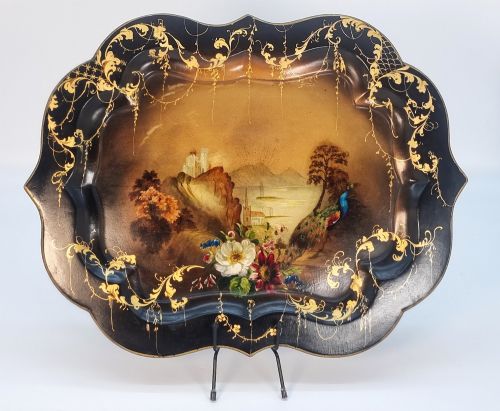
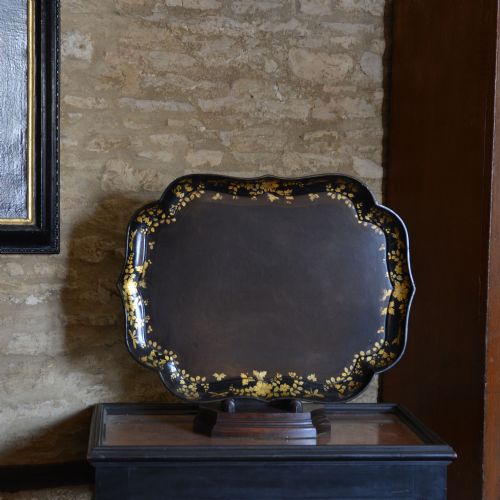
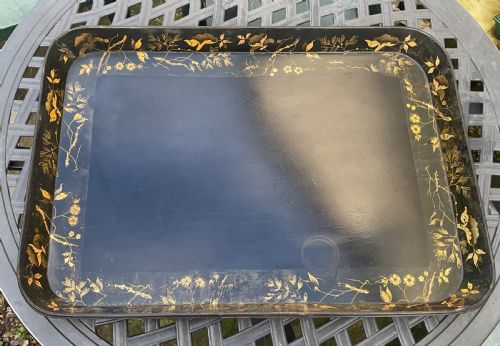


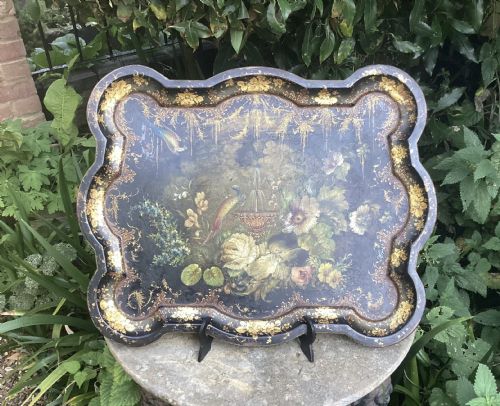
Gilded Lacquer Serving Tray
A gilded lacquer serving tray brings refined Regency and Victorian craftsmanship straight to your table, offering a striking display surface.
Gilded Lacquer Serving Tray
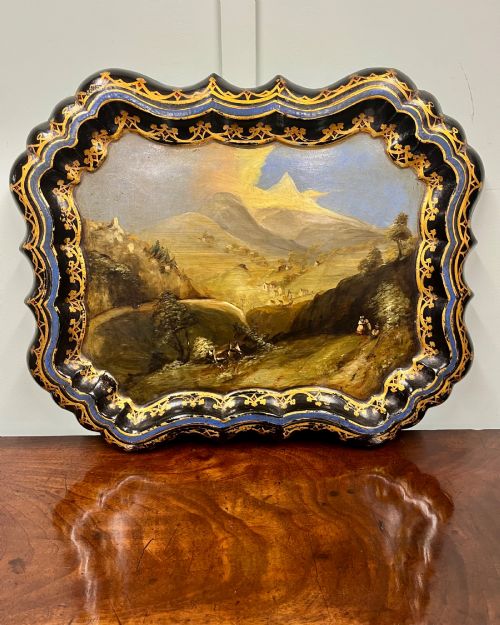
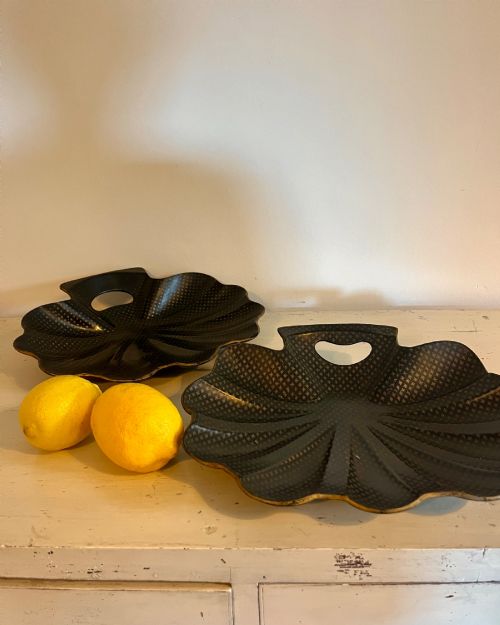
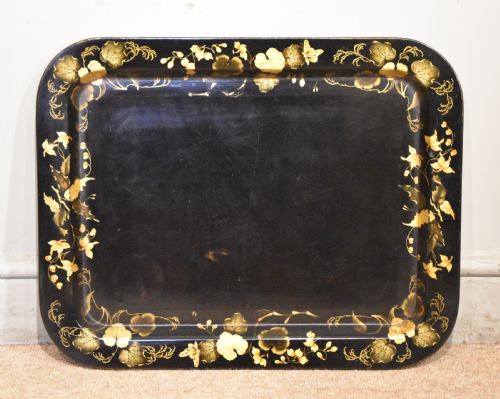
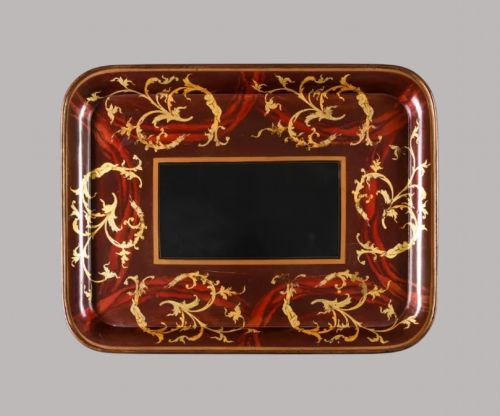
When you search for a gilded lacquer serving tray, you are looking at substantial papier-mâché and toleware surfaces shaped into ovals, rectangles, and kidney forms. The examples appearing here span the Georgian, Regency, and Victorian eras, carrying deep dark lacquers finished with hand-painted scenes and metallic borders.
Most pieces date from the nineteenth century, including specific variations like Chinoiserie designs, landscape hunting motifs, and scarlet-painted octagonal forms. You will also encounter trays mounted on stands to function as side tables or tray tables.
These items were originally utilised in wealthy households for serving drinks or displaying objects, combining robust papier-mâché construction with delicate decorative painting. Their enduring appeal lies in the contrast between the dark glossy lacquer and the bright metallic gilding.
How they were made
The foundation of the majority of these pieces is papier-mâché, built up from layers of paper pulp or sheets pressed together and dried to create a surprisingly rigid, lightweight board. Alternatively, makers utilised toleware, which involved shaping and enamelling sheet metal.
Once formed, the base received coats of dark lacquer that were rubbed down and polished to a smooth finish. Artisans then applied gold leaf, gilt, and paint by hand, sometimes incorporating mother-of-pearl inlay to catch the light.
Gilded Lacquer Serving Tray Retail Price Guide 2026
Typical asking prices for gilded lacquer serving tray among the pieces listed under this phrase on Sellingantiques today, from the lower quarter to the upper quarter. They describe what is for sale here now, not the wider market.
A fortunate few trays spent centuries doubling as side tables, resting quietly on folding stands until someone rediscovered their serving handles.
What varies in quality
The distinction between standard items and the finest work rests on the execution of the hand-painted decoration and the depth of the lacquer. Superior examples display intricate detailing in hunting scenes or Chinoiserie motifs rather than simple stenciled borders.
The reputation of the maker also dictates the standing of a piece, with established workshops achieving greater precision in the moulding of papier-mâché and the application of gold leaf. Preservation of the original painted surface and minimal restoration further elevate a piece.
Jennens & Bettridge·Clay
The Gilded Lacquer Serving Tray Glossary
- Papier-mâché
- A composite material made from paper pulp or reinforced paper layers, moulded and dried to form a durable base for lacquer. It allowed makers to create large, curved trays that remained remarkably light.
- Toleware
- Painted or lacquered sheet metal items produced throughout the Georgian and Victorian periods. This technique provided a sturdy alternative to papier-mâché for serving ware.
- Chinoiserie
- A European artistic style reflecting Chinese aesthetic motifs, commonly painted in gold onto dark lacquer surfaces. It remained popular across Regency and Victorian decorative arts.
- Gilding
- The application of gold leaf or gilt powder to surfaces to create metallic highlights. On these trays, it outlines borders and emphasises painted pictorial elements.
- Lacquer
- A durable varnish applied in multiple coats and polished to a high gloss finish. It protects the painted decoration beneath while creating a deep reflective surface.
Gilded Lacquer Serving Tray: Frequently Asked Questions
How do I clean a papier mache tray?
Dust the surface gently with a soft, dry cloth to remove particles.
Avoid using water, chemical cleaners, or polishes, as moisture damages both the lacquer and the underlying paper composition.
Can I use these trays for serving food?
While originally designed for service in domestic settings, antique trays are best used today for display or holding dry items.
Direct contact with moisture, alcohol, or hot dishes can soften the historic lacquer and ruin the delicate gilt finish.
How do I distinguish Regency from Victorian trays?
Regency pieces often feature restrained neoclassical motifs, clean painted lines, and specific maker signatures from the early nineteenth century.
Victorian examples frequently embrace bolder Chinoiserie themes, mother-of-pearl inlay, and more varied shapes like kidney forms and stands.
What is toleware compared to papier mache?
Toleware uses sheet metal as a base material, offering a heavier and more rigid structure than pressed paper pulp.
Both materials received similar dark lacquer finishes and hand-painted gilt decoration during the Georgian and nineteenth-century periods.