
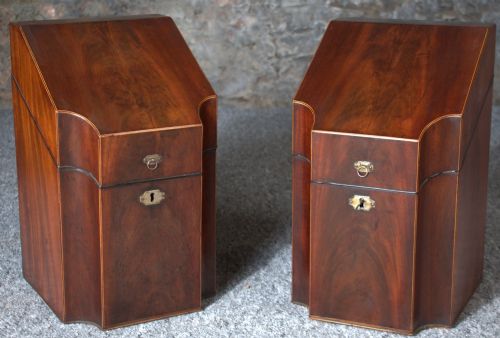
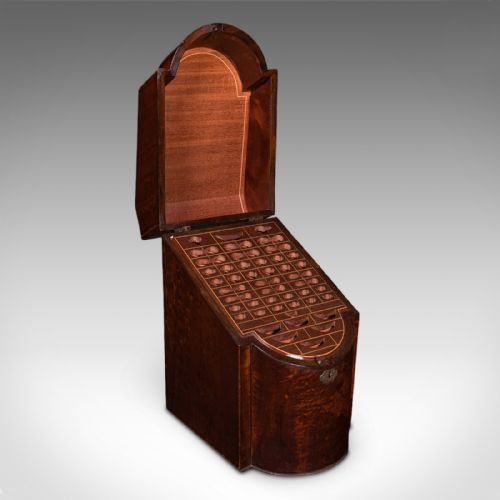


Georgian Slope Front Box
A georgian slope front box brings practical storage into daily life, offering sloping lids and fitted interiors designed for letters, cutlery, and desk supplies.

Georgian Slope Front Box
When searching for a georgian slope front box, buyers encounter several distinct forms including knife boxes, stationery holders, table top bureaus, and small desks. The selection spans the eighteenth century and the year 1800, capturing both formal serpentine items and robust vernacular pieces.
Most examples serve specific domestic tasks like cutlery storage, letter organisation, or miniature writing. The range includes items made in regional workshops as well as more polished George III urban examples.
Formations vary from upright knife storage to low table desks and miniature bureaus with internal drawers. Oak, elm, and mahogany dominate the choices, reflecting the timber available to makers of the period.
How They Were Made
Construction relies heavily on timbers such as mahogany, oak, and elm, often accented with boxwood stringing or decorative wood inlay. Makers shaped these dense woods into slanted lids and curved serpentine fronts designed to house documents or utensils securely.
Hardware plays a key functional and decorative role, with brass fittings, iron hinges, and metal escutcheons securing lids and compartments. Interior fittings frequently include fitted partitions, small drawers, and dedicated slots for cutlery or stationery.
What Varies in Quality
Quality reveals itself through the choice of timber figure, such as highly figured mahogany or well-selected regional oak and elm. The precision of the joinery around slanted lids and curved fronts marks the difference between standard utility items and finer pieces.
The sophistication of internal fittings dictates the overall standard of a piece. Simple partitioned spaces contrast with complex tiered interiors, multi-drawer arrangements, and the careful application of brass hardware.
The Georgian Slope Front Box Glossary
- Serpentine front
- A furniture front characterised by a wavy contour with a convex centre flanked by concave sides. This shape demands high skill from the woodworker.
- Knife box
- A specialised container designed to hold upright cutlery, usually featuring a sloping lid and a tapered vertical profile. They often double as stationery storage today.
- Stringing
- Thin lines of contrasting timber inlaid into the surface of a piece to create decorative borders. Boxwood is frequently utilised for this purpose against dark mahogany.
Georgian Slope Front Box: Frequently Asked Questions
What were knife boxes used for?
These boxes stored dining cutlery upright on sideboards within wealthy households during the Georgian period. Their sloping lids protected steel blades from damp air.
Today, many owners repurpose them as stationery holders or decorative desktop cabinets for letters and small items.
How do I distinguish oak from mahogany pieces?
Oak pieces generally exhibit visible grain patterns and a warmer, honeyed brown tone associated with vernacular or regional items. They often date to earlier eighteenth or seventeenth century traditions.
Mahogany offers a denser, finer grain with deep reddish-brown tones. It frequently appears in formal George III serpentine designs.
Where were table desks placed?
Table desks rested on top of existing tables, chests, or surfaces to provide a portable writing slope. Owners could move them around rooms as needed before dedicated writing tables became common.
They offered a compact workspace for handling correspondence and keeping personal documents secure.
How do I care for antique wood surfaces?
Keep wooden boxes away from direct sunlight and steady heat sources to prevent the timber from drying out or splitting. Gentle dusting and occasional wax application help maintain the finish.
Avoid using modern liquid polishes that can build up a residue over historic surfaces.