


Georgian Silver Mustard Pot
A georgian silver mustard pot brings sharp taste and bright metal to the dining table, combining practical tableware with fine silversmithing.
Georgian Silver Mustard Pot
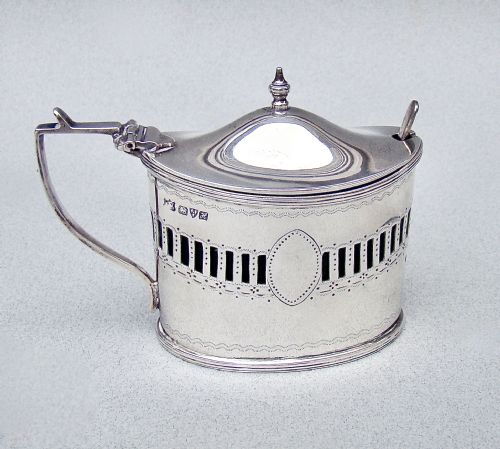
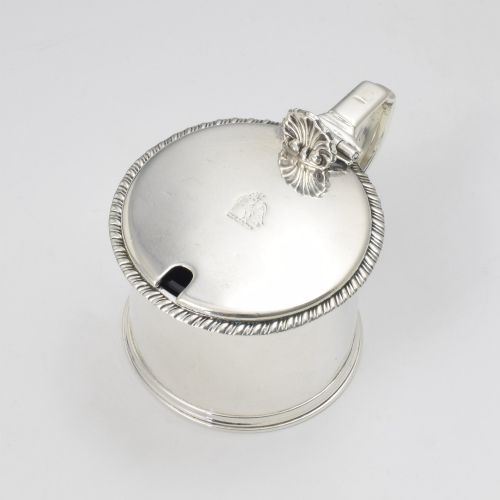
A georgian silver mustard pot sits on the dining table as a small condiment vessel, designed to hold prepared mustard alongside meat and fish dishes. These pieces include drum shapes, tankard forms, bombe bodies, and barrel outlines, often accompanied by a hinged lid and a fitted handle.
Most examples found in this range belong to the Georgian period or draw heavily upon its aesthetic through later revival styles. Makers produced these pots as single tableware items or as part of larger condiment sets and cruet sets alongside other vessels.
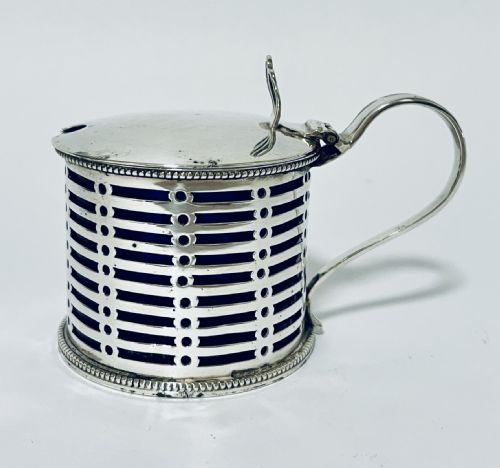
Buyers encounter variations in form that range from plain sterling silver cylinders to pierced openwork designs lined with coloured glass. The inclusion of a blue glass liner creates a striking contrast against the polished silver exterior.
Materials and construction
Silversmiths constructed these pots primarily from sterling silver and standard silver, shaping the bodies through hammering, casting, and piercing techniques. Many examples feature intricate pierced work that reveals a contrasting cobalt blue glass liner nestled inside.
Internal components frequently incorporate glass elements, while cased condiment sets occasionally utilise velvet and satin linings to secure the pieces within presentation boxes. Hinged lids demand precise metalwork to ensure a flush fit against the rim of the pot.
Georgian Silver Mustard Pot Retail Price Guide 2026
Typical asking prices for georgian silver mustard pot among the pieces listed under this phrase on Sellingantiques today, from the lower quarter to the upper quarter. They describe what is for sale here now, not the wider market.
Some tiny mustard spoons survived centuries of vigorous condiment stirring without getting lost down the back of the sideboard.
Judging the work
Quality rests heavily upon the crispness of the silversmith's work, particularly where pierced decoration or engraved crests define the exterior. Heavy gauge silver provides a reassuring weight in the hand, distinguishing superior vessels from lighter mass-produced alternatives.
The survival of original components, such as matching spoons and intact cobalt blue glass liners, elevates the completeness of the piece. Maker marks stamped clearly into the metal provide a reliable indicator of origin and standard.
Charles Fox II·Robert Hennell I·Charles Stuart Harris·Viners·Alfred Marston·Matthew Boulton·Sarah And John Blake·Alexander Field·Solomon Hougham·Crispin Fuller·Matthew Craw·Robert Hennell·George Fox I·Hennell I And Hennell II·Joseph Wyatt
The Georgian Silver Mustard Pot Glossary
- Drum mustard pot
- A cylindrical vessel with straight sides, flat lid, and right-angled handle, typical of eighteenth-century tableware design.
- Bombe mustard pot
- A piece featuring a swelling, rounded body that curves outward before tapering toward the base.
- Cobalt blue glass liner
- A deep blue removable glass insert placed inside pierced silver pots to hold the condiment securely.
- Cruet set
- A collection of matching condiment vessels arranged together on a stand or tray for the dining table.
- Pierced work
- A decorative technique involving the cutting or sawing of patterns through the silver wall to display the coloured glass beneath.
Georgian Silver Mustard Pot: Frequently Asked Questions
What is a georgian silver mustard pot used for?
These vessels served dining tables by holding prepared mustard securely within reach of diners.
They functioned as standalone tableware or formed part of larger cruet sets alongside salt cellars and pepper pots.
Why do some pots have blue glass inserts?
Cobalt blue glass liners protected the silver metal from corrosive mustard acids while adding vibrant colour.
Pierced silver designs relied on these coloured inserts to create visual contrast on the dining table.
Are all these pots from the Georgian period?
The selection includes genuine Georgian pieces alongside later Edwardian, Victorian, and revival items.
Revival pieces replicated earlier eighteenth-century styles during subsequent decades using similar silver and glass materials.