


Georgian Silver Bottle Coasters
Georgian silver bottle coasters protect mahogany dining tables while keeping port and claret within easy reach during dessert.
Georgian Silver Bottle Coasters
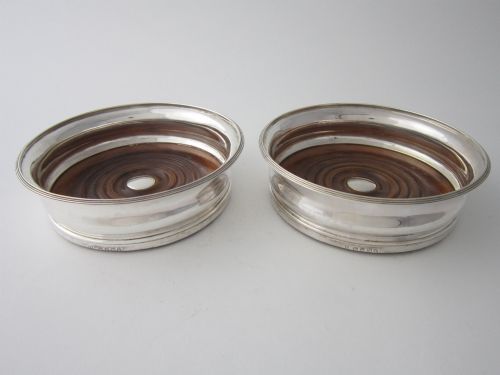
Georgian silver bottle coasters are circular table accessories designed to hold wine bottles and decanters. Buyers looking at this page will encounter pieces primarily from the nineteenth century and the Georgian period, alongside later twentieth-century interpretations.
The selection on this page centres on sterling silver, Old Sheffield plate and silver-plated forms, frequently paired with turned wood bases. Many examples survive in pairs or larger sets, originating from distinct periods including the Regency, George III, George V and Edwardian eras.
How they were made
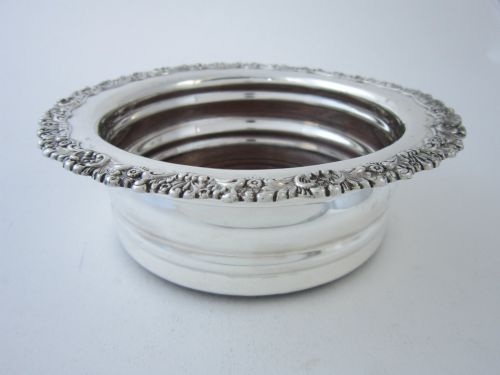
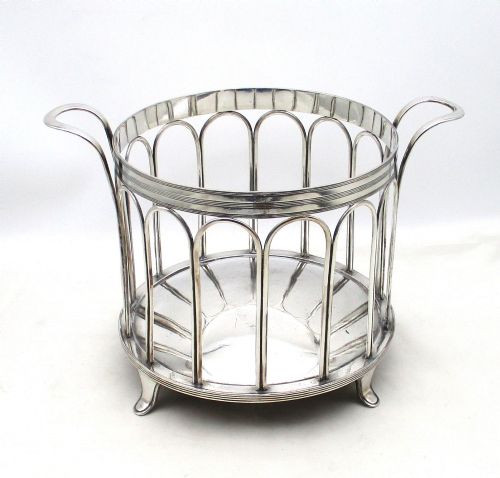
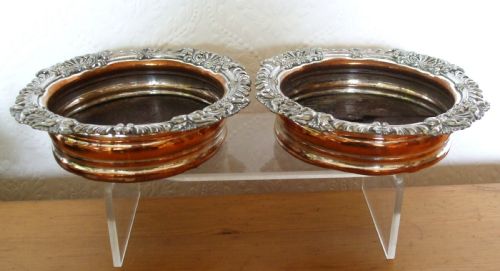
Silversmiths constructed sterling silver and Old Sheffield plate coasters using sheet metal, often employing piercing and embossing techniques to create decorative borders. Copper forms the base metal in Old Sheffield plate pieces, visible where the fused silver layer has worn thin over time.
Makers integrated turned wood bases, predominantly mahogany, into the centre of the metal frames, securing them with central metal studs. These wooden bases frequently featured baize or felt lining underneath to glide smoothly across dining surfaces.
Some coasters feature built-in wheels on their undersides so they could literally roll around the dining table.
What varies in quality
Quality in these coasters rests upon the weight of the metal, the crispness of pierced or embossed detail, and the integrity of the turned wooden insert. Substantial gauge silver and deep Old Sheffield plate demonstrate superior craftsmanship compared to lighter, purely utilitarian items.
The presence of crisp armorial engravings, maker marks and matched pairs elevates certain examples within the range. The harmony between the metal gallery and the fitted wooden base determines the overall finesse of the piece.
Asprey·Matthew Boulton·John and Thomas Settle·Eyre Family·Barnards·William Allen
The Georgian Silver Bottle Coasters Glossary
- Old Sheffield plate
- A fused composite metal made by heating a sheet of silver to a copper ingot, creating a rich surface that distinguishes early nineteenth-century barware. This method preceded modern electroplating.
- Sterling silver
- An alloy consisting of pure silver and other metals, standardised for strength and durability. It provides the solid metal standard found in many period wine coasters.
- Turned wood
- Timber shaped on a lathe to form the central base fitted inside the metal gallery. Mahogany is the predominant wood used for this purpose in the evidence.
- Pierced work
- Metal pierced with decorative patterns such as slats, trellis designs or geometric motifs. It lightened the weight of the coaster while adding visual ornamentation.
- Armorial
- A heraldic design or coat of arms engraved onto the silver gallery. These marks often denote the original owning family.
Georgian Silver Bottle Coasters: Frequently Asked Questions
How were bottle coasters used at the table?
Coasters circulated around the mahogany dining table after the servants withdrew, allowing guests to pass bottles of port and claret smoothly without scratching the polished wood surface.
The raised sides kept the bottles secure as the stands slid from guest to guest during post-dinner conversation.
What is the difference between sterling silver and Old Sheffield plate?
Sterling silver consists of solid precious metal throughout, marked with hallmarks indicating purity and origin. Old Sheffield plate uses a thin sheet of silver fused onto a copper base.
Old Sheffield plate pieces often reveal a warm copper tone along high points where the silver layer has worn down through generations of polishing.
Why do many coasters have wooden bases?
Turned wooden bases provided a sturdy, level platform to support heavy glass decanters and wine bottles. Mahogany was chosen for its durability and rich dark tone.
Green baize or felt was typically glued to the underside of the wood to protect fine dining tables from friction.
How can I tell a George III coaster from a later piece?
George III pieces date from the late eighteenth or early nineteenth century, typically featuring hand-piercing, gadrooned borders, and heavy Old Sheffield plate or solid silver construction. Later pieces from the twentieth century often display simpler machine-rolled rims.
Examining the construction methods underneath the wooden base helps distinguish period hand-assembly from later manufacturing techniques.