


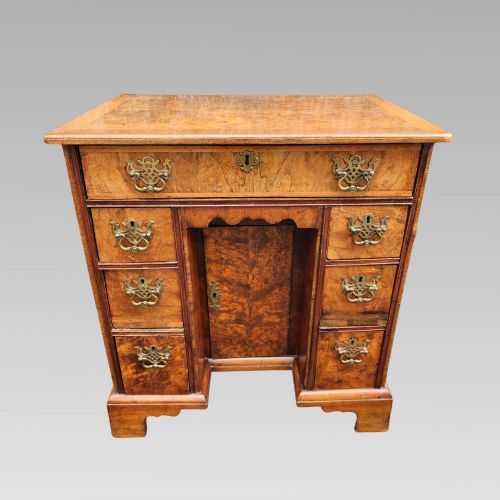


Georgian Pedestal Desk Small
A georgian pedestal desk small is a compact writing station built for tight spaces, offering drawers and a kneehole in mahogany or walnut.
Georgian Pedestal Desk Small
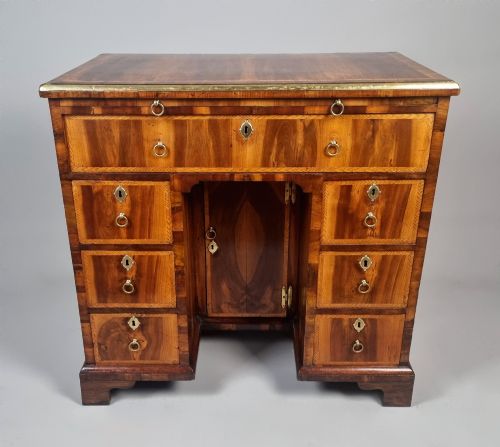
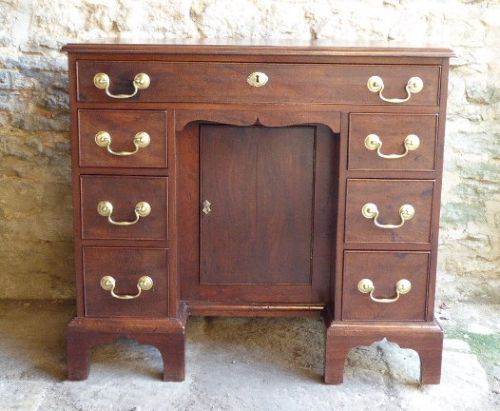
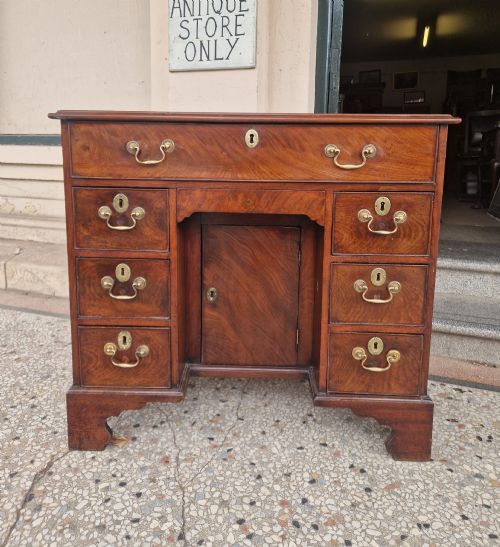
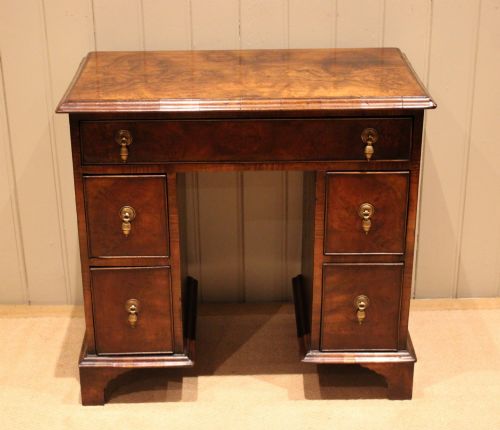
A georgian pedestal desk small brings eighteenth and nineteenth-century craftsmanship into smaller rooms without overwhelming the floor space. These pieces typically take the form of kneehole desks, partners desks, or writing tables fitted with banks of drawers flanking a central recess.
The materials span native and imported timbers, with mahogany and walnut predominating alongside yew wood and burr walnut veneers. Makers designed these compact workstations for domestic studies and private dressing rooms, maintaining the architectural proportions of larger desks in miniature dimensions.
Materials and construction methods
Cabinet makers built these desks using solid timbers and decorative veneers applied to secondary woods, often incorporating Cuban mahogany or figured walnut. Drawer construction relies on hand-cut dovetails, while writing surfaces frequently feature inset panels of tooled leather.
Brass hardware such as drop handles and escutcheons secure the drawer fronts, complementing the dark tones of the polished wood. Joinery techniques from the eighteenth and nineteenth centuries ensure structural rigidity across these compact proportions.
Secret compartments hidden within kneehole desks provided eighteenth-century writers a secure place for private letters and small valuables.
Factors determining quality
Quality rests upon the selection of timber figure, the crispness of any carved detailing, and the preservation of original hardware and drawer linings. Desks retaining their matching secondary woods and untouched patination stand apart from examples altered over later centuries.
The finesse of the dovetail joints and the integrity of the veneer work distinguish master cabinet work from regional output. Proportion and balance dictate the overall success of the piece, especially when scaling down architectural forms for domestic use.
Jewell's of Holborn, London
The Georgian Pedestal Desk Small Glossary
- Kneehole desk
- A compact desk featuring a central recessed space for the user's legs, flanked by two banks of smaller drawers.
- Cuban mahogany
- A dense, dark timber imported from the Caribbean, prized for its rich grain and deep colour during the eighteenth century.
- Dovetail
- A traditional wood joint formed by interlocking wedge-shaped fingers, used primarily in drawer construction for lasting strength.
- Escutcheon
- A protective plate surrounding a keyhole, usually cast in brass to match the drawer handles of the desk.
- Partners desk
- A double-sided writing table designed for two people to work opposite each other, featuring drawers on both faces.
Georgian Pedestal Desk Small: Frequently Asked Questions
Where were these small desks used?
These compact desks served private studies, bedrooms, and small chambers where full-sized library tables proved too large. Owners utilised them for correspondence, accounts, and personal administration.
Their reduced footprint allowed them to sit comfortably against walls or near windows in tighter domestic interiors.
How do I distinguish walnut from mahogany pieces?
Walnut surfaces display lighter honey tones with dark, flowing grain patterns, typical of pieces built through the eighteenth century and revival periods. Mahogany exhibits a reddish-brown hue that deepens over time.
Examining the grain under natural light reveals the distinct porous structure of each timber used by the cabinet maker.
Are these desks suitable for daily laptop work?
Many buyers place modern laptops and writing materials directly onto the original leather or wood top surfaces. The inset leather provides a stable base for writing and daily administrative tasks.
Care should be taken to protect antique finishes from moisture and heat using appropriate desk pads.
What defines a kneehole desk?
A kneehole configuration places a central recessed cupboard or open space beneath the writing surface, flanked by vertical stacks of drawers. This layout maximises storage while keeping the desk compact.
The arrangement allows the user to sit directly in the centre while keeping stationery within arm's reach.