


Georgian Natural History Art
Georgian natural history art brings birds, beasts and botanicals into the room through hand-coloured engravings and watercolours.
Georgian Natural History Art
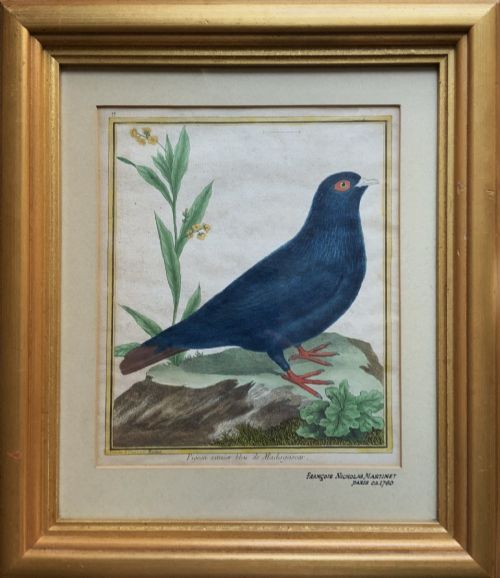
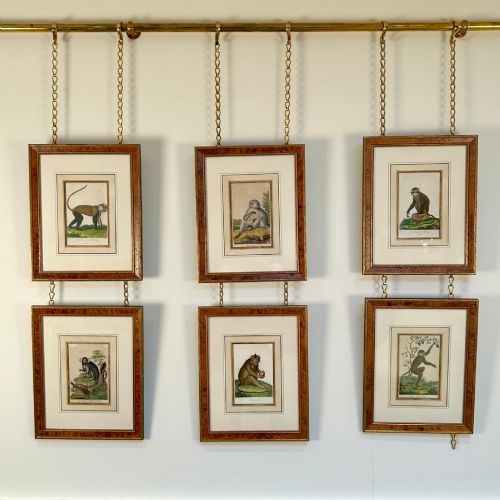
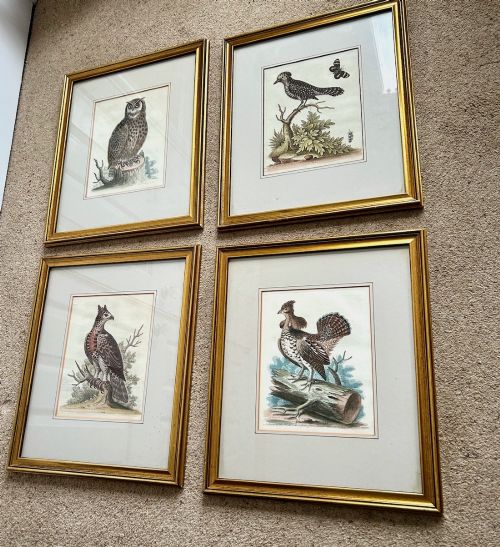
When you search for georgian natural history art, you encounter framed prints, wall art and watercolours from the eighteenth and nineteenth centuries. These pieces record birds, monkeys, serpents, hippos and botanicals with scientific intent and artistic precision. The versions most commonly met on this page are hand-coloured engravings presented in period frames of wood or gilt wood.
The selection ranges from individual plates to sets of framed prints depicting ornithology, angling and naturalism. Styles span the Georgian period, Regency, Neoclassical and Victorian natural history. Originating largely from British and French sources, the works combine documentary observation with decorative appeal for the interior.
How they were made
The foundation of these works is paper, marked by copperplate engraving or drawn in watercolour and ink. Artisans applied pigment by hand to monochrome prints, building up colour on subjects such as birds and botanical specimens. Framing materials include wood, gilt wood and brass, often accompanied by gold leaf detailing.
Techniques relied on precise lines etched into plates, followed by meticulous watercolour washes. This combination allowed workshops to produce accurate scientific illustrations that also functioned as finished works of art.
Object types include framed prints, wall art, framed art, prints and engravings, and framed artwork.
What varies in quality
Quality rests upon the crispness of the original impression and the skill of the hand-colouring. Finer examples retain vibrant pigment and sharp detail across the subject, whether an ornithological plate or an angling scene. The precision of the engraving work and the harmony of the added colour distinguish the superior pieces.
Framing and preservation also contribute to the distinction between works. Contemporary or period frames in wood and gilt wood enhance the presentation, while well-preserved paper maintains the integrity of the composition.
François-Nicolas Martinet·George Edwards·Buffon·William Andrews Nesfield·John Curtis·William Swainson·Eleazor Albin·Audebert
The Georgian Natural History Art Glossary
- Engraving
- A printmaking technique where an image is incised into a metal plate, usually copper, with a cutting tool. The resulting lines hold ink to be transferred onto paper.
- Hand Coloured
- The process of applying watercolour or pigment by hand to a printed monochrome engraving. This technique was standard for natural history plates to show accurate biological colours.
- Ornithology
- The branch of zoology focused on birds, which formed a major subject for natural history illustrators and printmakers of the eighteenth century.
- Regency
- A British stylistic period spanning the early nineteenth century, characterised by neoclassical elegance and refined decorative arts.
- Neoclassical
- A style drawing on classical antiquity, influencing the presentation and aesthetic of art and framing during the period.
Georgian Natural History Art: Frequently Asked Questions
What subjects appear in these works?
The subjects include birds, monkeys, serpents, hippos, fish and botanical specimens with insects.
Artists and naturalists documented these animals and plants for scientific study and decorative display.
How should I display them?
These framed prints and watercolours suit studies, libraries and living spaces where traditional decor predominates.
Pairing sets of engravings or hanging them in matching frames creates a cohesive wall arrangement.
How do I identify the period?
Period identification relies on paper quality, engraving style, framing materials and recorded dates from the eighteenth and nineteenth centuries.
Hand-written inscriptions and maker attribution on the print often provide exact years or decades.
Are the colours original?
Many plates received hand-colouring at the time of publication to record natural shades accurately.
Examination under magnification can reveal the brushwork characteristic of contemporary studio colouring.