


Pair of Natural History Prints
These pair of natural history prints bring the study of zoology and botany into domestic rooms as framed wall art.
Pair of Natural History Prints
A pair of natural history prints presents matching framed wall art depicting subjects from the natural world, spanning periods from the eighteenth century to the early twentieth century. Buyers seeking this phrase encounter framed engravings, lithographs, and watercolours covering birds, reptiles, mammals, and botanical specimens.
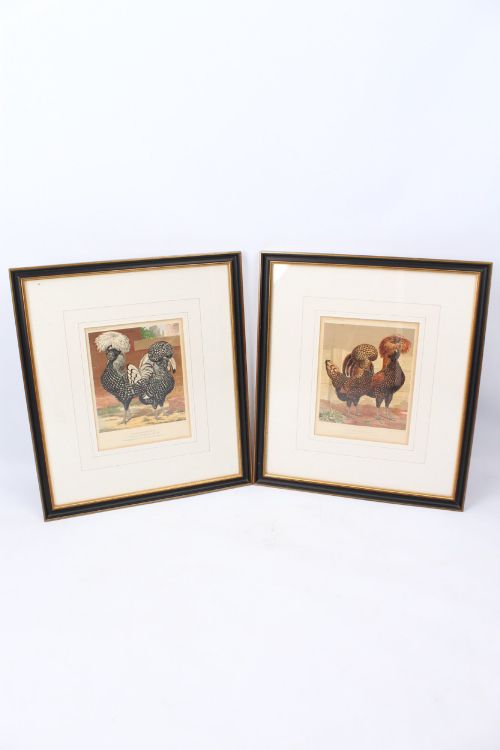
The selections on this page range from Georgian animal portraits and hand-coloured serpentine engravings to Victorian butterfly prints and Edwardian bird studies. Many pieces originate from notable scientific volumes and anatomical portfolios, preserved behind glass in wood, gold leaf, or giltwood frames.
How they were made
Makers produced these works using paper as the primary medium, applying ink for foundational lines and copperplate engraving techniques to render fine anatomical details. Hand-colouring and watercolour additions brought specific hues to feathers, scales, and botanical foliage.
Framing involved wood, gold leaf, and giltwood to enclose the works alongside protective glass, securing the paper sheets for domestic display as wall art.
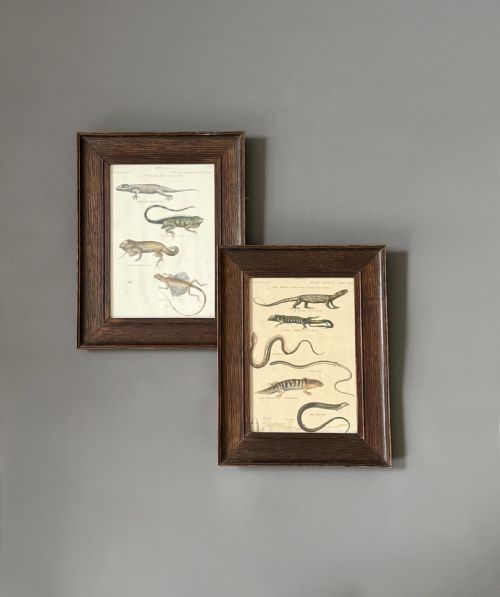
Rhinoceros skeletons share wall space here with colourful serpents and delicate butterflies.
What varies in quality
The standard of execution depends heavily on the precision of the initial engraving and the delicacy of any applied hand-colouring or watercolour work. Finer examples maintain crisp lines in anatomical and botanical subjects without blurring or fading across the paper surface.
The character of the framing material, whether simple wood or giltwood with gold leaf, contributes to the overall presentation and visual balance of the matched pair.
William Bird MD FLS·Buffon·Bernhard Siegfried Clara Rhinocerus·Georg Wolfgang Knorr
The Pair of Natural History Prints Glossary
- Engraving
- A printmaking technique where an artist cuts lines into a metal plate to hold ink for transfer onto paper. This method allows for exceptional fine detail in scientific illustrations.
- Lithography
- A planographic printing process based on the repulsion of oil and water, enabling accurate reproduction of tonal gradations in imagery. It became widely used for colour printing in the nineteenth century.
- Hand-coloured
- A finished monochrome print enhanced with watercolour or other pigments by hand. This technique adds individual vibrancy to each published sheet.
- Giltwood
- Wood carved and treated with a thin layer of gold leaf or gold paint. It provides a reflective, ornamental border for antique frames.
- Ornithological
- Pertaining to the scientific study and depiction of birds. These studies form a significant category within natural history artwork.
Pair of Natural History Prints: Frequently Asked Questions
How should I hang them?
Keep these framed works out of direct sunlight to protect the paper and any delicate watercolour pigments from fading over time.
Position them at eye level in dry interior spaces where temperature fluctuations remain minimal.
What periods do they cover?
The available selection spans from the eighteenth century through the nineteenth century, including Georgian, Victorian, and Edwardian examples.
Specific dates within the listings also point to pieces from around eighteen hundred and nineteen ten.
Are the frames original?
Frames utilise materials such as wood, gold leaf, and giltwood to house the paper prints beneath glass.
While many period frames survive with the artwork, framing styles often reflect the Victorian or Edwardian eras of subsequent mounting.
What subjects are included?
Subjects range widely across zoological and botanical themes, featuring birds, reptiles, serpents, hippos, rhinoceros skeletons, butterflies, and plants.
These depictions derive from historical scientific portfolios, anatomy books, and natural history studies.