


Georgian Music Caddy
A georgian music caddy is an uncommon form of stand, built to hold folios and sheets.
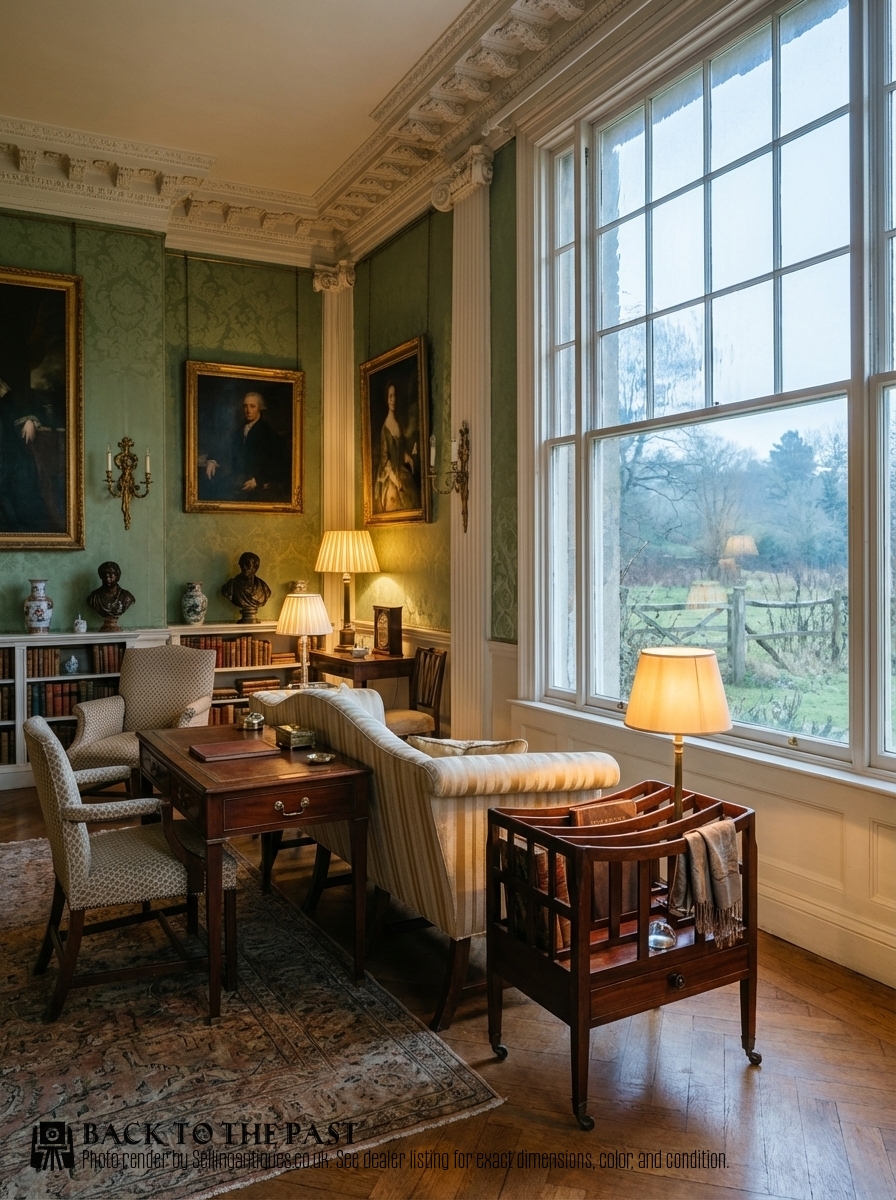
Georgian Music Caddy
Buyers searching for a georgian music caddy encounter pieces variously styled as canterburys, folio stands, and magazine racks from the Georgian, Regency, and Victorian periods. These pieces serve to store sheets and folios in domestic rooms.
The selections on this page span the late eighteenth century through the nineteenth century, showing divisions for upright storage and carrying handles.
Most examples found here take the form of mahogany or rosewood canterburys with three or four pierced scroll divisions.
Materials and Construction
Cabinetmakers constructed these stands primarily in solid and veneered timbers, selecting rich mahogany and figured rosewood for their dense grains and polished surfaces. Decorative inlay frequently accents the primary wood.
Brass fittings appear as castors and carrying handles, giving mobility and utility to the stands.
Georgian Music Caddy Retail Price Guide 2026
Typical asking prices for georgian music caddy among the pieces listed under this phrase on Sellingantiques today, from the lower quarter to the upper quarter. They describe what is for sale here now, not the wider market.
Listings span the Georgian, Regency, and Victorian periods, constructed in mahogany and rosewood.
Judging Quality
Quality rests upon the crispness of the pierced scroll work on the divisions and the selection of timber figures in the mahogany or rosewood. Stands with refined joinery and well-turned supports stand above utilitarian examples.
The presence of original brass castors and handles distinguishes finer pieces from those with later replacements.
The Georgian Music Caddy Glossary
- Canterbury
- A low stand with upright divisions, used for holding music sheets and folios. It originated in the late eighteenth century.
- Folio Stand
- A piece designed to hold large sheets of paper or bound volumes. These often feature adjustable supports.
- Regency
- A style period spanning the early nineteenth century, characterised by classical restraint and rich woods. It draws influence from ancient Greek and Roman forms.
- Inlay
- A technique of inserting contrasting materials into a wood surface to form decorative patterns. This adds visual texture to the primary timber.
Georgian Music Caddy: Frequently Asked Questions
What is a georgian music caddy used for?
These stands were designed to hold sheet music, folios, and books near a piano or seating area. The upright divisions kept papers sorted and upright for easy selection.
In modern rooms, they function well for organising magazines, newspapers, or portfolios of art.
How do I date a georgian music caddy?
Dating relies upon timber choice, hardware, and structural styling such as pierced scrollwork or Sheraton inlay details. Georgian and Regency examples often display distinct linear turning and selected mahogany veneers.
Victorian variations generally introduce heavier proportions and alternative handle fixings.
Where should I place a music stand in a room?
These stands fit beside armchairs, sofas, or desks where reading materials are kept. Their open divisions allow quick access to daily papers or music folios.
Keep them away from direct heat sources to protect the polished rosewood or mahogany surfaces.