
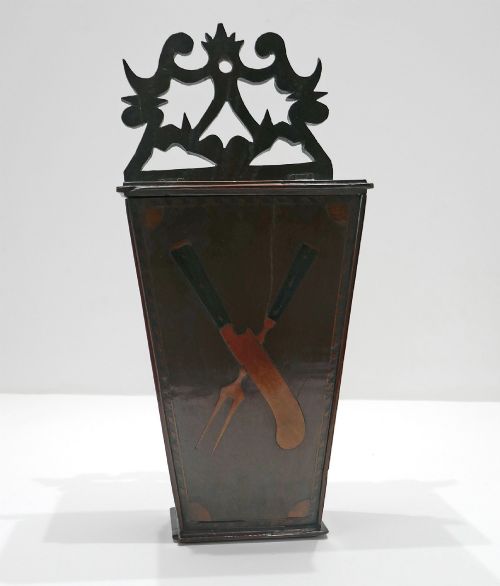
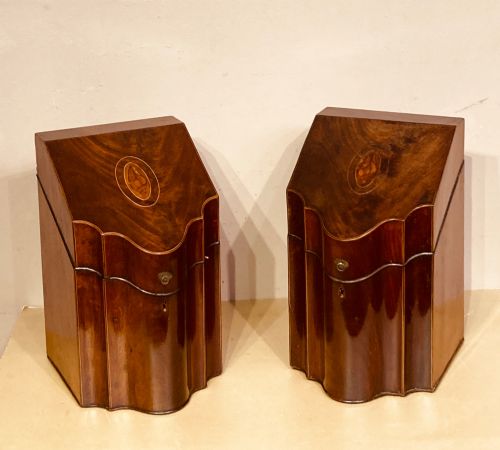


Georgian Marquetry Cutlery Box
These georgian marquetry cutlery box examples are practical desk and dining containers crafted for the orderly storage of cutlery.
Georgian Marquetry Cutlery Box
A georgian marquetry cutlery box is primarily a knife box or stationery cabinet originating from the eighteenth century and around eighteen hundred. These items appear as pairs of knife boxes, single knife boxes, letter holders, and larger stationery cabinets.
Makers designed these objects for dining rooms and writing spaces, utilising distinct forms like sloping lids and fitted interiors. The pieces frequently emerge in mahogany with contrasting boxwood, ebony, and satinwood inlay.
Collectors encounter walnut examples alongside the dominant mahogany constructions. The forms serve varied purposes today, transitioning from dining service containers to desk accessories and stationery storage.
Materials and construction
Craftsmen built these boxes predominantly from solid mahogany, frequently incorporating walnut or applying intricate satinwood and boxwood inlaid patterns. Inlaid wood and satinwood inlay supply the decorative surface detail across the sloping lids and fronts.
Makers fitted brass hardware, including hinges, escutcheons, and carrying handles, to complement the timber carcases. Internal partitions and fitted interiors utilise secondary woods to create structured compartments for cutlery and letters.
Some boxes proved so adaptable that past owners promoted them from holding carving knives to stashing love letters.
Distinctions in quality
Quality rests upon the precision of the satinwood, boxwood, and ebony inlay against the mahogany carcase. Sharp contrast in the marquetry and crisp execution of the inlaid pattern elevate the standing of a box.
Proportion and scale dictate the desirability of a piece, particularly in matched pairs of knife boxes or unusually large stationery cabinets. Retaining the original brass fittings and intact fitted interiors further separates superior examples from altered pieces.
The Georgian Marquetry Cutlery Box Glossary
- Marquetry
- Decorative veneer work formed by fitting together small pieces of wood to create pictorial or geometric patterns on a surface. This technique defines the ornate lids seen on many period boxes.
- Satinwood
- A durable, lustrous tropical timber yielding a golden-yellow hue, utilised extensively for contrasting inlay. Craftsmen favoured it for adding brightness to darker mahogany carcases.
- Escutcheon
- A protective plate surrounding a keyhole, usually cast in brass on these pieces. It serves both a functional and a decorative purpose on the front of the box.
- Canteen
- A fitted case or chest designed for holding a complete set of cutlery. Period versions keep individual utensils secure within custom internal compartments.
Georgian Marquetry Cutlery Box: Frequently Asked Questions
What is a georgian marquetry cutlery box?
These pieces are eighteenth-century and nineteenth-century wooden containers created to hold dining knives or stationery. Makers constructed them primarily in mahogany with decorative wood inlay.
They feature sloping lids and specific internal configurations designed for practical domestic use. Today, they function as decorative objects, letter holders, and storage boxes.
How were knife boxes used originally?
Households placed these containers on sideboards in the dining room to store flatware and cutlery securely between meals. The fitted interiors kept blades and handles organised and protected.
Over time, owners adapted many of these boxes to serve as stationery cabinets or letter holders on desks.
Are these boxes found as pairs?
Yes, matching pairs of knife boxes appear frequently alongside single examples. Dining rooms of the period often utilised symmetric arrangements on either side of a sideboard.
Pairs demand careful comparison of the wood grain and inlay patterns to confirm their original pairing.
What woods were used to make them?
Mahogany forms the primary structure for the majority of these pieces, complemented occasionally by walnut. Craftsmen applied boxwood, ebony, and satinwood inlay to create decorative patterns.
Brass hardware provides the hinges and escutcheons across the external surfaces.