
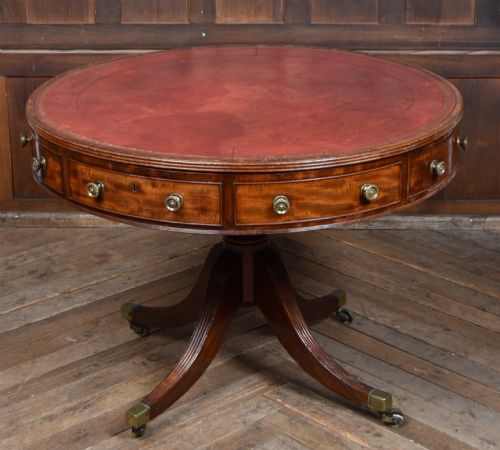


Georgian Mahogany Drum Table
A georgian mahogany drum table is a circular library piece designed to rotate on a central pedestal, offering multiple drawers and a leather writing surface.
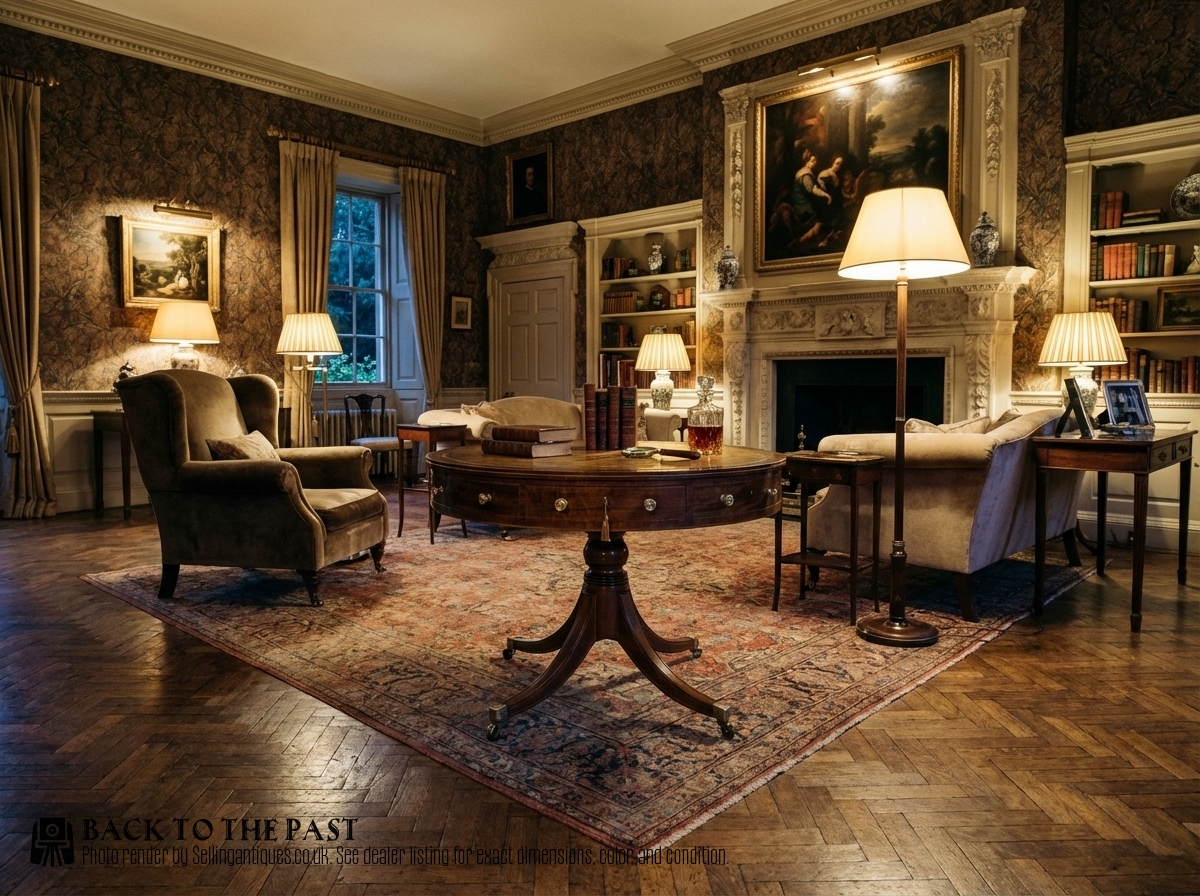
Georgian Mahogany Drum Table
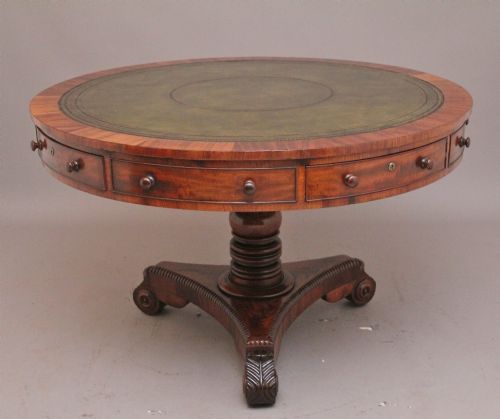
A georgian mahogany drum table is a substantial circular freestanding piece designed for the library or study, featuring a revolving top supported by a central pillar and branching legs. The form incorporates alternating frieze drawers and dummy drawers around the entire perimeter, allowing the table to sit centrally in a room rather than against a wall.
Most examples encountered on this page belong to the Georgian and Regency periods, alongside later revival interpretations from the Victorian and Edwardian eras. These pieces typically combine utility with elegance, serving as writing desks, centre tables, and occasional tables.
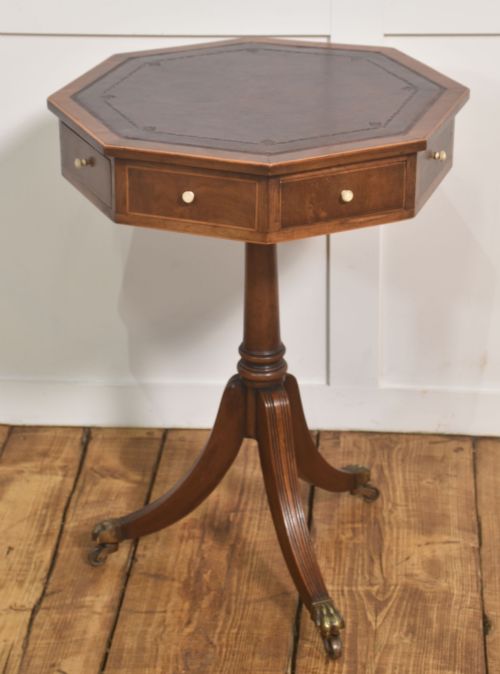
While the standard shape is strictly round, variations include octagonal and oval configurations, as well as occasional small proportions or campaign formats. Buyers select them for their combination of generous surface area, integrated storage, and balanced proportions.
How they were made
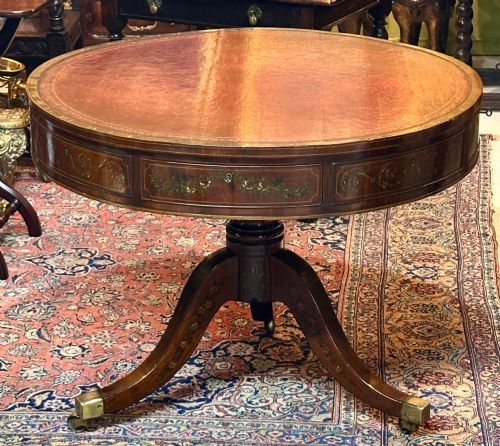
Makers utilised solid mahogany and flame mahogany veneer applied over secondary timbers, often accentuating the circular top with finely figured grain patterns. Leather inserts, frequently gold-tooled, provide the writing surface inset into the upper rim.
Structural hardware includes cast brass drawer pulls and occasionally brass inlay or brass paw feet fitted to the pillar supports. The revolving mechanism relies on a sturdy central pivot allowing the heavy circular top to turn smoothly on its base.
Listings feature mahogany, flame mahogany veneer, rosewood, brass, glass, and leather across pieces dated from the eighteenth to the twentieth century.
What varies in quality
The choice of timber creates a primary distinction between standard examples and the finest versions, particularly where dense flame mahogany veneers and crisp figurations are selected for the top. Detail in the brass fittings, from simple drop handles to complex brass inlay work, reflects the ambition of the original workshop.
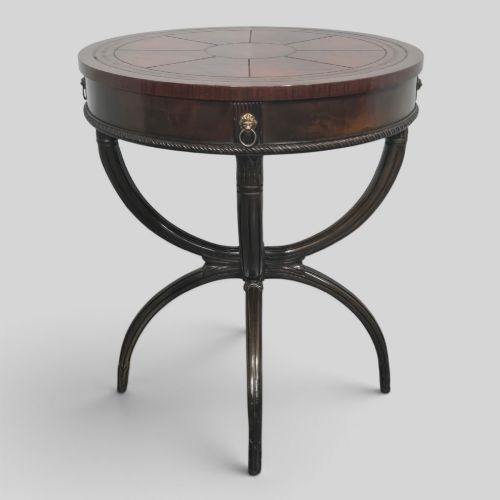
Proportion and execution of the pedestal base dictate the visual balance of the piece, with well-carved legs and stable revolving mechanisms separating superior examples from simpler furniture.
The Georgian Mahogany Drum Table Glossary
- Drum table
- A circular library table with a deep top containing drawers, mounted on a central pillar base. The name derives from its cylindrical silhouette.
- Flame mahogany
- A veneer cut from the fork of the mahogany tree where the branch meets the trunk. This creates a distinctive fiery, rippled grain pattern highly prized by cabinet makers.
- Frieze drawer
- A drawer fitted into the structural band beneath the table top. In drum tables, these alternate with dummy drawers to maintain a uniform appearance.
- Centre table
- A freestanding piece finished on all sides to be viewed from any angle in the middle of a room. These tables do not require placement against a wall.
- Regency
- An English design period spanning the early nineteenth century. Furniture from this era often incorporates classical revival motifs and darker woods.
Georgian Mahogany Drum Table: Frequently Asked Questions
What is a drum table used for?
Originally designed for libraries and studies, these pieces served as writing desks and sorting tables where books and papers could be kept close at hand. The revolving top allowed a seated reader to access different compartments without moving from the chair.
Today, they function effectively as centre tables in living spaces or as lamp tables, where their drawers provide useful concealed storage for everyday items.
How do I tell a Georgian drum table from a later revival?
Authentic Georgian and Regency pieces display construction methods appropriate to the eighteenth and early nineteenth centuries, including hand-cut dovetails in the drawer linings and timber aged through long use. Revival versions from the Victorian, Edwardian, or later periods often show different secondary woods and machine-cut elements.
Examining the underside and the interior of the drawers reveals the tool marks and ageing patterns characteristic of each specific period.
Are all drum tables round?
The traditional format is strictly circular, designed around a central drum housing the drawers. However, variations do exist within the tradition.
Listings occasionally include octagonal and oval versions, alongside pieces scaled down to small proportions or adapted for campaign use.
Why do some drawers not open?
Because these tables are designed to present a uniform appearance from every angle, only some of the drawer fronts conceal actual storage compartments. The remaining openings are dummy drawers fitted into the framing to preserve the symmetrical design around the circumference.
This arrangement ensures that the piece looks balanced whether it is viewed from the front or the side.