

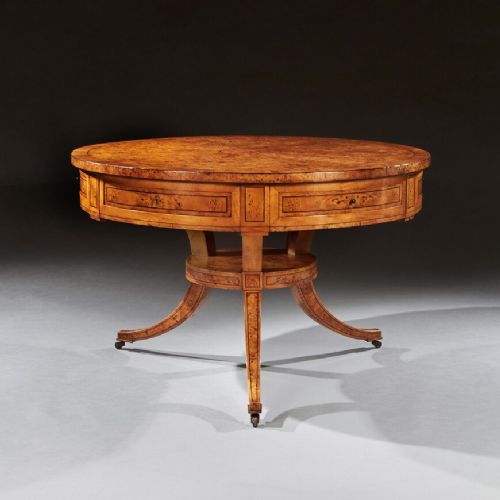
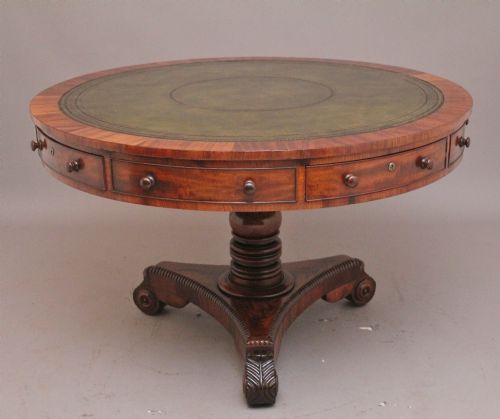
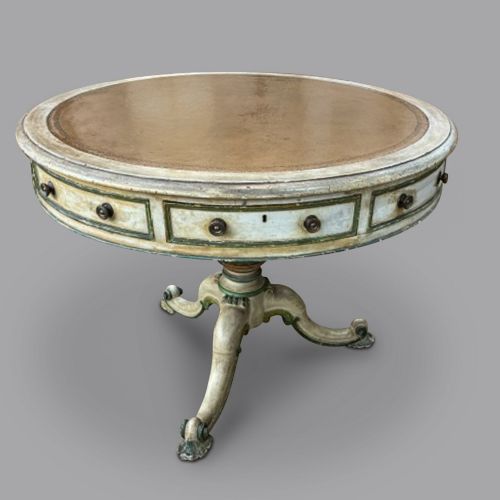


19th Century Drum Table
A 19th century drum table is a substantial circular library piece built with deep drawers, prized for both its stately presence and functional workspace.
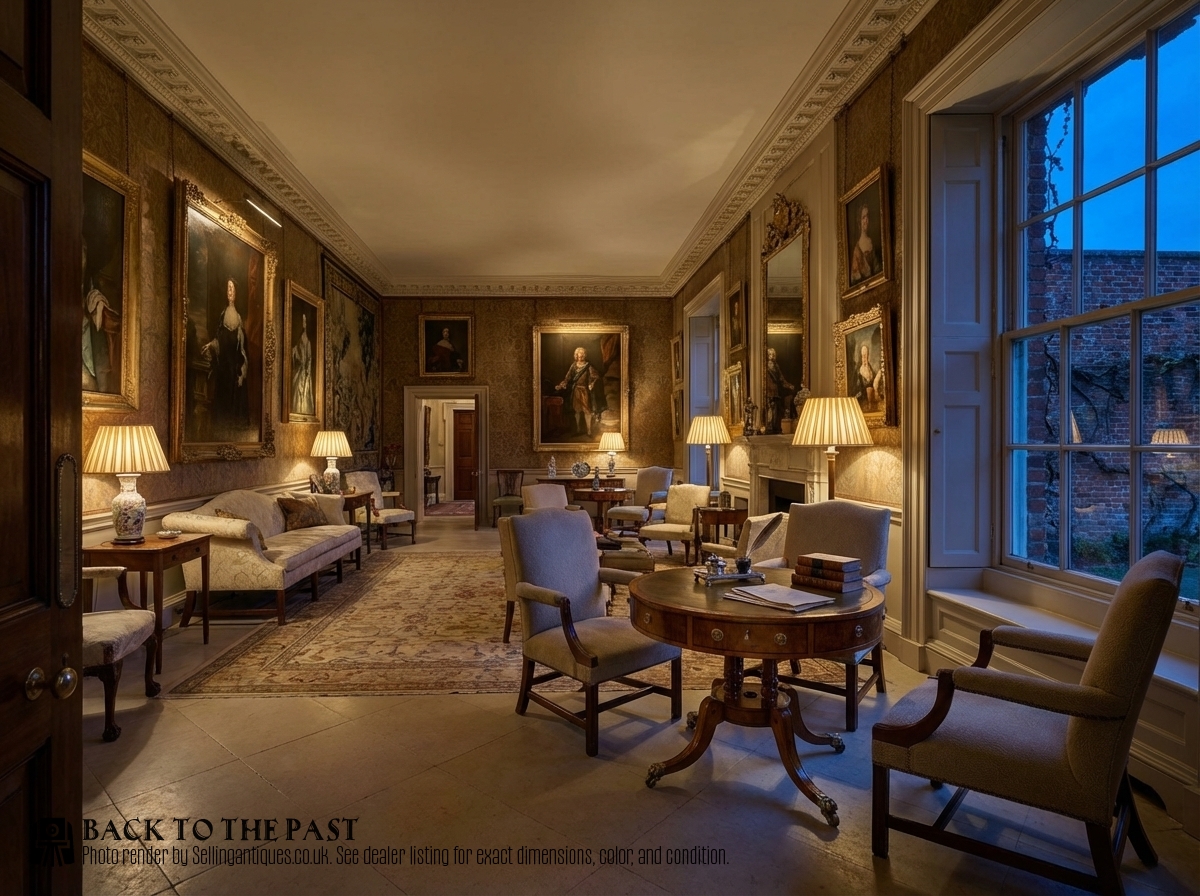
19th Century Drum Table
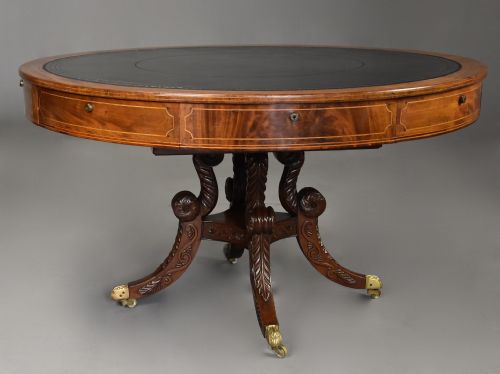
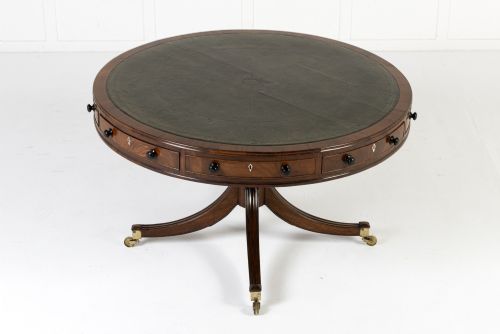
A 19th century drum table typically presents a circular top supported by a central pillar or a pedestal of three or four legs, often fitted with alternating functional and dummy drawers around the entire circumference. These pieces served as writing or library tables in period homes, designed to sit in the middle of a room rather than against a wall.
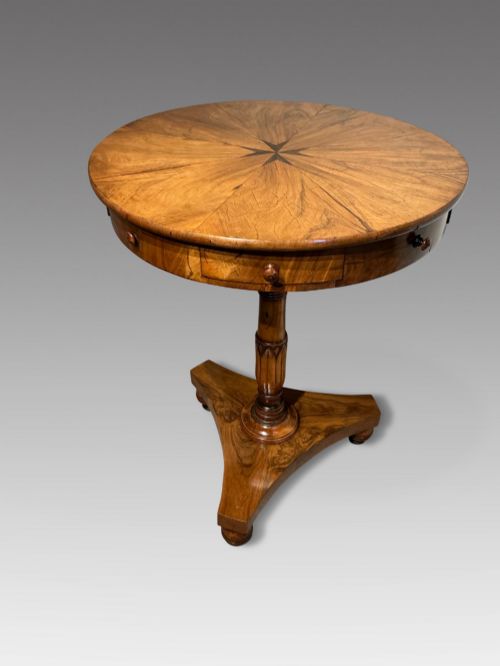
The versions most commonly met on this page date from the Regency and Victorian eras, frequently constructed from figured timbers like mahogany or rosewood. Alongside standard library tables, variations include pieces with leather inset tops, tilt tops, or variations originating from French and Scandinavian makers.
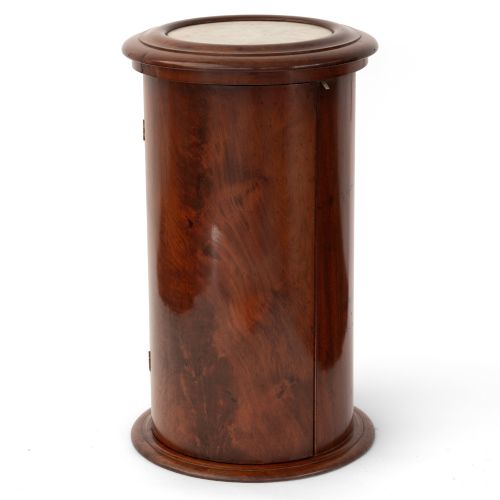
The category also encompasses occasional pieces, work tables, and distinct drum head mantle clocks utilising similar circular motifs and cabinetmaking techniques. While traditional English mahogany dominates, examples surface in oak, walnut, satinwood, and painted finishes.
Materials and construction
Cabinetmakers utilised dense hardwoods, predominantly solid and veneered mahogany, rosewood, and oak, often selecting flame or figured varieties for the primary surfaces to create dramatic grain patterns. Structural stability relied on heavy central pedestals, sometimes reinforced with brass or ormolu mounts.
Writing surfaces commonly incorporated inset tooled leather panels framed by timber borders, whilst finer examples integrated brass inlay, marquetry, or mother-of-pearl. Drawer construction involved hand-cut dovetailing, paired with turned wooden knobs or brass ring handles.
19th Century Drum Table Retail Price Guide 2026
Typical asking prices for 19th century drum table among the pieces listed under this phrase on Sellingantiques today, from the lower quarter to the upper quarter. They describe what is for sale here now, not the wider market.
Form variations include standard library drum tables, tilt-top versions, work tables, and occasional centre tables.
Assessing quality and execution
The grade of a 19th century drum table rests largely on the choice of timber veneer and the precision of the cabinetwork, particularly around the curved drawer fronts that must follow the circular perimeter seamlessly. Superior examples demonstrate continuous grain matching, robust pedestals with well-carved or reeded legs, and original brass castors.
Gillows·Howard and Sons·Charles Bevan·Japy Freres·D Robertson of Perth
The 19th Century Drum Table Glossary
- Drum table
- A circular library table with a deep top containing a ring of drawers around the circumference. They typically rest on a central pillar and platform base.
- Flame mahogany
- A veneer cut from the fork of the mahogany tree where the branch joins the trunk. It produces a distinctive flickering, flame-like pattern highly prized by period cabinetmakers.
- Library table
- A large freestanding table designed for professional or domestic studies, often fitted with drawers and a leather writing surface. Drum tables represent a specific circular sub-category of these.
- Ormolu
- Gilded bronze used for decorative mounts, feet, and clock bezels during the 18th and 19th centuries. It provides a bright golden finish that contrasts with dark woods.
- Pedestal base
- A central supporting column rising from a weighted platform or scrolled feet. This structure allows unhindered seating access around the circular top.
19th Century Drum Table: Frequently Asked Questions
Where were drum tables placed?
These tables were designed to stand freestanding in the middle of a library, study, or drawing room rather than against a wall. Their circular format allowed access to drawers from any angle.
Because they are finished on all sides, they functioned effectively as central centre tables where books and writing materials could be kept close at hand.
Are all the drawers functional?
On most traditional examples, the outer ring alternates between functional drawers and dummy drawer fronts to maintain a symmetrical appearance around the circumference.
Cabinetmakers engineered the internal structure so that only a proportion of the pulls open into usable storage spaces, while others conceal solid framing.
How do I tell Regency from Victorian examples?
Regency pieces tend to feature cleaner architectural lines, restrained brass inlay, and rich rosewood or flame mahogany timbers dating from the early decades of the century. They often rely on classic classical proportions and subtle reeding.
Victorian versions frequently display heavier proportions, darker walnut or oak woods, and more exuberant carved detail or marquetry reflecting later revival styles.
Can I use a drum table for writing?
Many period examples were specifically built for this purpose and feature flat tops lined with tooled leather or morocco hide. The height and knee clearance beneath the frieze accommodate a chair comfortably.
However, some decorative or tilt-top variants are better suited as occasional tables for display rather than heavy daily desk work.