
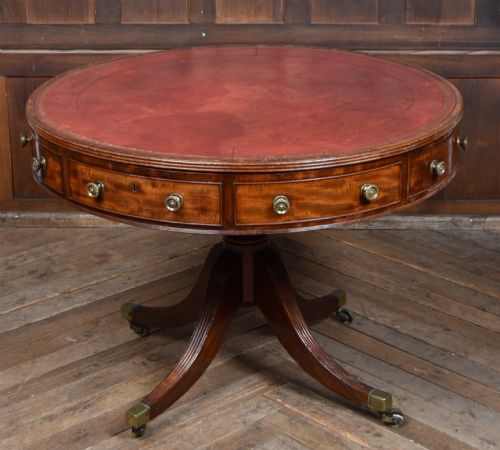
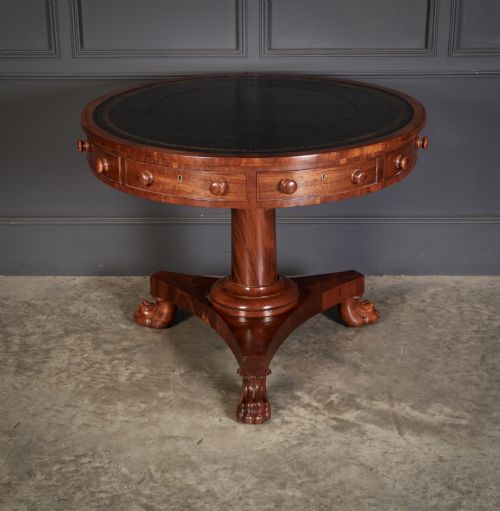


Regency Mahogany Drum Table
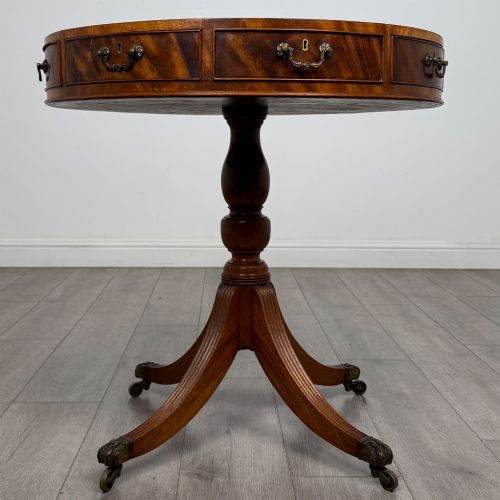
A regency mahogany drum table is a circular library piece designed for centring in a room, offering multiple drawers and a rotating top.
Regency Mahogany Drum Table
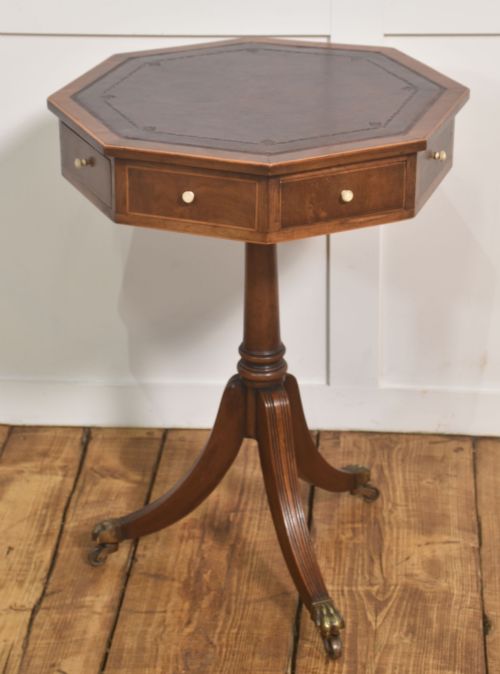
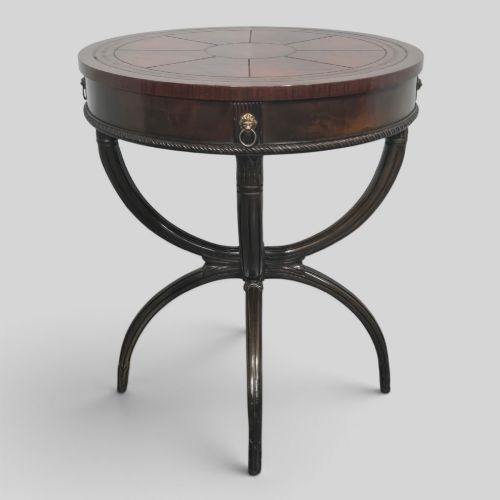
Most examples found on this page date from the nineteenth century, spanning the Georgian, Regency, and William IV periods, alongside later revival pieces from around nineteen hundred. They appear in circular and occasionally octagonal or oval formats, often finished with inset leather surfaces.
Origin variations include English workshops alongside occasional Irish pieces attributed to makers such as Williams and Gibton. Dimensions range from small proportions suitable for occasional use to large library tables designed for grander interiors.
Materials and Construction
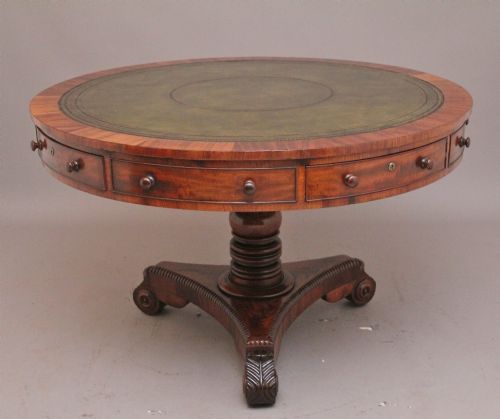
Makers built these pieces using solid mahogany and flame mahogany veneer applied to a sturdy timber carcase, sometimes incorporating rosewood or ebony details. Tops frequently integrate inset leather writing surfaces framed by delicate brass inlay.
The underlying engineering relies on a central pedestal column supported by sabre legs or a platform base, often resting on brass castors to facilitate movement. Drawers feature mahogany linings and small turned knobs or brass handles.
Listings feature mahogany, flame mahogany veneer, rosewood, brass, glass, and leather across nineteenth-century and twentieth-century periods.
Evaluating Quality and Detail
Quality rests upon the choice of timber, distinguishing plain mahogany from highly figured flame mahogany veneer selected for the top surface. The crispness of brass inlay and the fidelity of turning on the central pedestal column indicate workshop proficiency.
Proportion and mechanism determine the standing of an example, notably the smooth action of the rotating top and the precise flush fit of the drawers. Later revival pieces differ from period ones in timber density, patination, and construction depth.
Gillows·Williams and Gibton
The Regency Mahogany Drum Table Glossary
- Drum Table
- A circular library table with a deep top containing drawers, supported by a central pedestal. The shape resembles a drum sitting on a column.
- Flame Mahogany
- A veneer cut from timber fork joints, displaying a distinctive flamy, light-reflecting grain pattern. It provides rich visual movement across large table tops.
- Dummy Drawer
- A drawer front attached to the carcase without an internal box, used to maintain visual symmetry around a circular table. These alternate with working drawers.
- Centre Table
- A piece finished on all sides to stand free in the middle of a room rather than against a wall. Drum tables serve this function naturally due to their round form.
- Pedestal Base
- A central support column rising from a plinth or diverging legs. This configuration allows seated users to rotate the table top without interference from corner legs.
Regency Mahogany Drum Table: Frequently Asked Questions
How do I use a drum table today?
A regency mahogany drum table functions well as a centre table in a living room or as a writing desk in a home study. The rotating top allows easy access to books and papers from any seated position.
The deep drawers provide practical storage for stationery and small items, keeping surfaces clear. Their compact circular footprint helps them fit into spaces where rectangular desks dominate.
How do I distinguish Regency from revival pieces?
Period pieces from the early nineteenth century display natural timber patination, hand-cut dovetails in the drawer linings, and older secondary woods. Revival pieces from around nineteen hundred often show machine-made precision and different finishing techniques.
Examining the underside and drawer interiors reveals construction methods typical of earlier workshops compared to later manufacturing processes.
What is the difference between circular and octagonal tops?
While the standard form is entirely round, some workshops produced octagonal variations with straight edge segments. These remain functionally identical as drum tables but introduce geometric angles to the room.
Both shapes utilise the same pedestal support and perimeter drawer configuration.
Did these tables always have leather tops?
Many examples feature a leather writing surface inset into the mahogany top, often decorated with gold tooling. Plain wood tops also occur across various periods depending on the intended room use.
Leather surfaces provided a softer, non-reflective plane suitable for reading and writing under candlelight.