
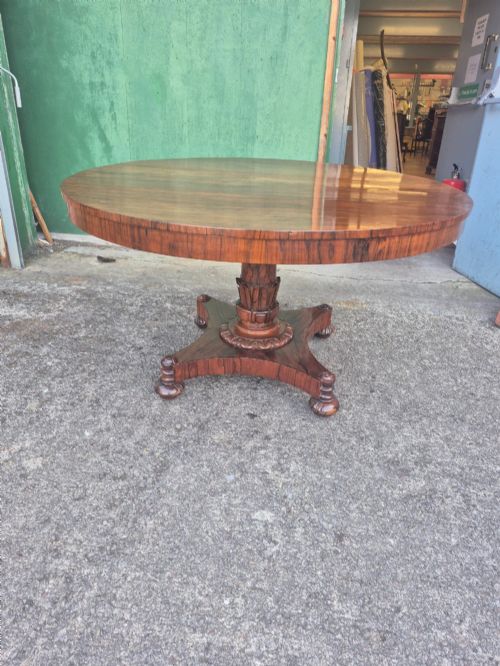
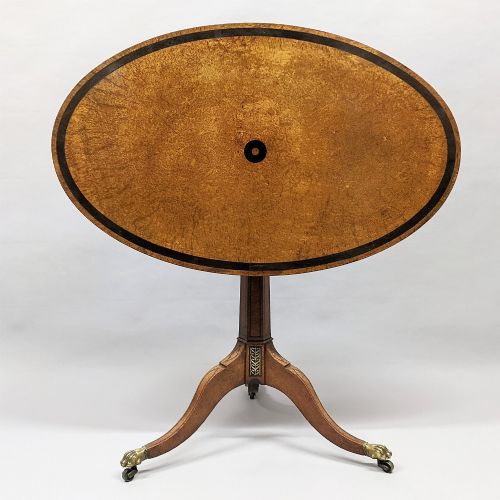


Regency Period Centre Table
A regency period centre table commands a room with architectural confidence, offering rich timbers and balanced classical proportions.
Regency Period Centre Table
A regency period centre table stands independently in an interior, designed to be viewed from all sides rather than pushed against a wall. The pieces on this page span the Regency, Georgian, and William IV eras, capturing an era of bold design and exceptional cabinet making.
Rosewood and mahogany dominate the selection, frequently enhanced by satinwood banding, brass inlay, or tilt-top mechanisms. Forms range from circular breakfast and dining tables to drum tables, library tables, and occasional pieces originating from British and Anglo-Indian workshops.
How They Were Made
Cabinet makers utilised dense exotic timbers such as rosewood, mahogany, and goncalo alves, often cut as veneers over sturdy secondary woods to create dramatic grain patterns. Circular tops frequently utilised tilt mechanisms supported by central pedestals with carved or reeded columns.
Brass inlay, parcel gilding, and marble or specimen marble inserts demanded meticulous precision from artisans. Crossbanding in satinwood or ebony framed the primary wood fields, while elaborate bases featured brass mounts and castors for mobility.
Listings feature rosewood, mahogany, goncalo alves, and marble materials across Regency, Georgian, and Victorian periods.
What Varies in Quality
The distinction between tiers rests upon the choice of timber and the ambition of the marquetry or brass inlay. Selecting finely figured flame mahogany or richly grained rosewood elevates a piece, as does the integration of specialist elements like micro-mosaic specimen marble tops.
Proportion and execution of the carved pedestals and brass mounts signal the workshop's standing. Pieces bearing attribution to recognised makers like Gillows show superior structural joinery and refined carving that mark them out from provincial production.
Gillows of Lancaster·William Trotter·Scott & Pasley·Thomas Hope
The Regency Period Centre Table Glossary
- Tilt top
- A table top hinged to the pedestal so it can be stored vertically against a wall when not in use. This mechanism requires a secure brass catch to lock the surface firmly horizontal.
- Drum table
- A circular library or writing table with a deep frieze containing drawers, usually supported by a single central pillar and tripod base. The top is frequently lined with tooled leather.
- Sofa table
- A rectangular occasional table designed to stand in front of a sofa, featuring drop leaves at either end and typically two small drawers. They often incorporate double pedestal or trestle supports.
- Crossbanding
- A strip of veneer applied to the border of a table top where the grain runs at right angles to the central panel. This technique frames the primary wood and adds visual contrast.
- Specimen marble
- A table top composed of numerous geometric or pictorial pieces of different coloured marbles assembled together. These tops often reflect Grand Tour influences of the period.
Regency Period Centre Table: Frequently Asked Questions
Where should a centre table go?
These tables are designed to sit freestanding in the middle of a room, allowing access from every side. They anchor open spaces such as entrance halls or large drawing rooms.
Because they lack a designated front or back, they create a natural focal point around which seating or circulation paths can be arranged.
Can I use a breakfast table for dining?
Circular breakfast tables were historically used for informal morning meals or as general gathering surfaces. Their sturdy pedestal bases provide ample legroom for seated guests.
Many examples feature tilt mechanisms, which originally allowed the top to be stowed away to clear the floor space when dining had finished.
How do I care for rosewood surfaces?
Polished rosewood and mahogany benefit from simple dusting with a soft, dry cloth to protect the historic finish. Direct sunlight should be avoided to prevent fading of the natural timber colours.
Occasional application of traditional beeswax helps maintain the moisture and sheen of the wood without building up heavy chemical layers.
How do I distinguish Regency from William IV?
Regency pieces generally display refined classical restraint, featuring slender reeded legs, delicate brass inlay, and crisp carving derived from ancient Greek and Roman motifs. Proportions tend to be lighter and more linear.
William IV furniture, emerging into the 1830s, shifts towards heavier, more massive forms with bolder architectural mouldings, thicker pedestals, and less reliance on intricate brass marquetry.