
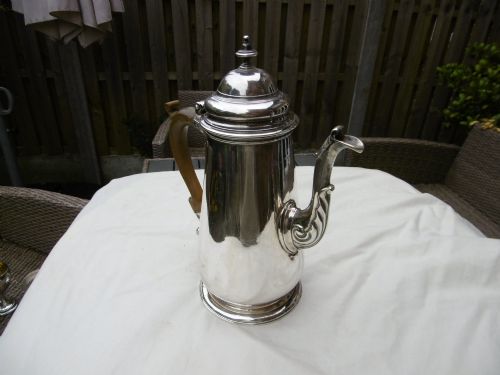
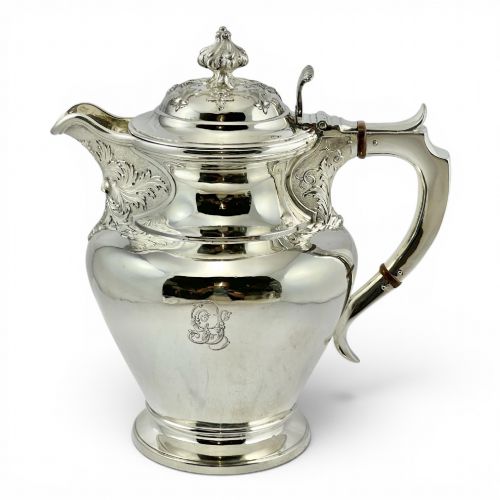
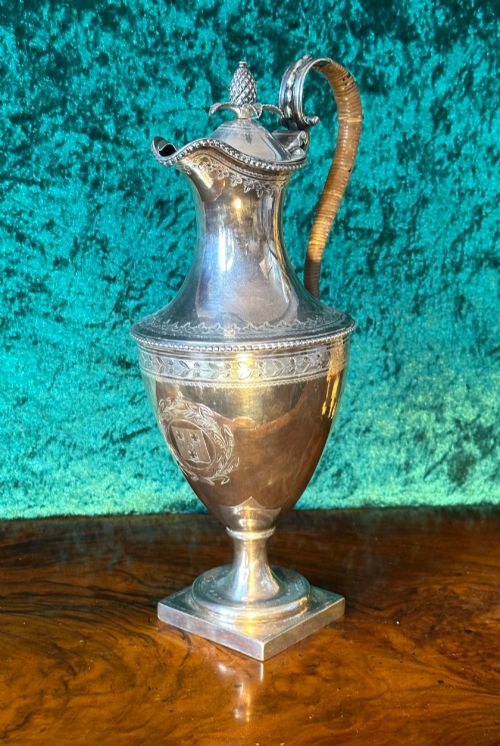

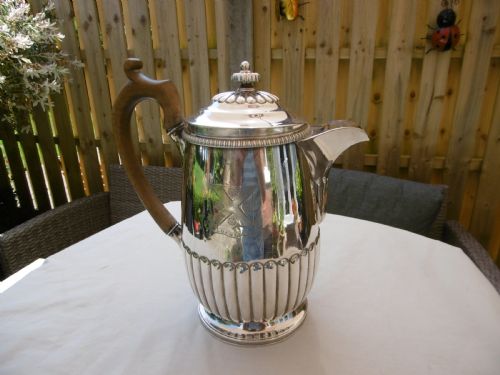


Georgian Hot Water Jug
A georgian hot water jug is a refined metal vessel for serving boiling water at the tea or coffee table, prized for its elegant neoclassical or regency lines.
Georgian Hot Water Jug
When you search for a georgian hot water jug, you encounter formal serving vessels intended to supply hot water alongside tea and coffee services. These pieces predominantly date from the georgian, regency, and william iv periods, spanning the eighteenth and nineteenth centuries.
The forms on this page include tall pots, ewers, and pitchers designed with sturdy handles and secure lids for handling boiling liquid. Many examples bridge the categories of coffee pots, water jugs, and ewers, reflecting the fluid terminology of eighteenth and nineteenth-century dining tables.
Materials and construction
Silversmiths constructed these vessels from heavy sterling silver or copper fused with silver plating known as old sheffield plate. These metals were shaped through raising and hammering, creating robust holloware bodies capable of containing boiling water safely.
Handles frequently incorporated insulating spacers made of hardwood or wrapped wicker to protect the hand from heat. Lids and spouts were securely soldered or riveted, while crests and armorials were often hand-engraved onto the body.
Listings feature sterling silver, old sheffield plate, and copper, paired with insulating elements like hardwood and wicker across georgian, regency, and william iv styles.
Distinctions in quality
The caliber of a georgian hot water jug rests upon the crispness of its hand-engraved crests, the weight of the silver or plate, and the integrity of its original insulating handle materials. Superior pieces display harmonious proportions and clear hallmarks from notable silversmiths.
Lesser examples show excessive wear to the silver plating revealing the base copper beneath, or replacement handles that disrupt the historical silhouette. The retention of early marks and original maker attribution significantly elevates the standing of an individual piece.
Richard Gurney·Matthew Boulton·John Hoyland·John Scofield
The Georgian Hot Water Jug Glossary
- Old Sheffield Plate
- A composite material made by fusing a thin sheet of silver to a thicker copper base. This technique was widely utilised before the invention of electroplating.
- Ewer
- A large jug with a wide spout and a looped handle, traditionally used for holding water. In this category, it often functions interchangeably with a water jug or tall coffee pot.
- Hallmark
- An official stamp applied to precious metals indicating the standard of purity, the assay office, and the year of manufacture. These marks help historians date sterling silver pieces precisely.
- Neoclassical
- A dominant design style inspired by classical antiquity, characterised by symmetrical geometry, urn shapes, and restrained ornamentation. It appears frequently on metalware from the later eighteenth century.
Georgian Hot Water Jug: Frequently Asked Questions
What was a georgian hot water jug used for?
These jugs held boiling water at the dining or drawing-room table to top up tea teapots or dilute strong brews. They were an essential part of formal beverage service.
Servants or hosts used them to maintain the desired temperature and strength of hot drinks during long social gatherings.
How do I clean antique silver plate?
Cleaning requires a soft cloth and a gentle, non-abrasive silver polish formulated specifically for antique metals. Avoid harsh scrubbing that might wear away thin plating.
Regular, careful dusting and minimal washing help preserve the underlying metal and any historic surface patination.
What is old sheffield plate?
Old sheffield plate is an early fusion material created by melting a sheet of sterling silver onto a copper ingot. The combined metals were then rolled into sheets for smithing.
This method differs entirely from later nineteenth-century electroplating by offering a thick, durable layer of genuine silver fused to copper.
Can I use these jugs daily?
While structurally sound, antique silver and plated vessels require careful handling if used for actual service today. Thermal shock from boiling water should be approached with caution on fragile antique seams.
Many collectors prefer to display them as decorative art objects rather than risking damage to delicate historic materials.
How do I identify the date?
Dating relies heavily upon stamped hallmarks, maker marks, and stylistic clues such as neoclassical shapes or regency mounts. Assay office symbols point directly to specific cities and years.
Unmarked old sheffield plated items are dated by their construction methods, weight, and decorative motifs compared against documented examples.