







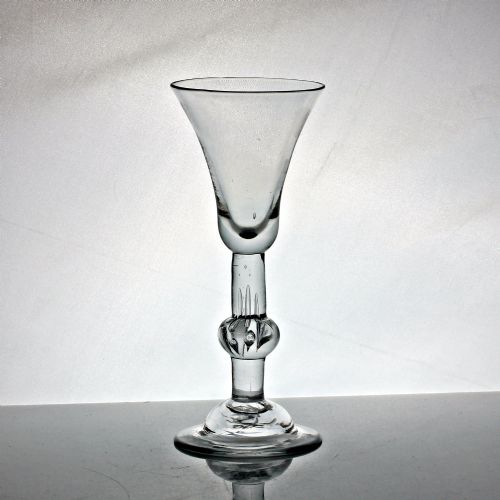








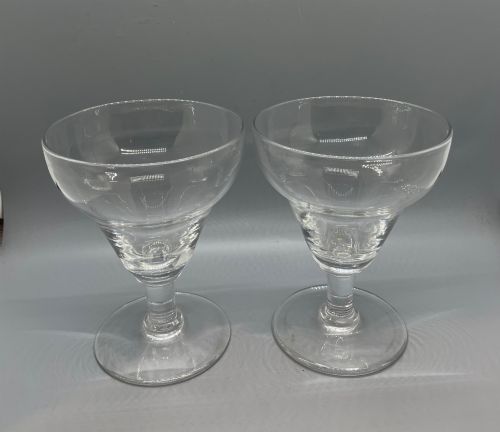
Georgian Glass Stem
A georgian glass stem brings eighteenth-century craftsmanship to the table, offering tactile drinking vessels shaped by lead crystal and twisting air or enamel threads inside the glass.
Georgian Glass Stem
A georgian glass stem represents the drinking vessels and serveware produced across the eighteenth century and into the nineteenth century, including wine glasses, ale glasses, gin glasses, rummers, and goblets. These drinking vessels often feature distinct structural forms such as balustroid stems, plain stems, or twisted internal threads.
The selection on this page centres primarily upon eighteenth-century examples alongside later Georgian revival pieces from the twentieth century. Buyers encounter forms ranging from trumpet bowls and bell bowls to ogee and rounded funnel shapes resting upon folded or domed feet.
How they were made
Maker operations relied principally on lead glass, clear glass, and flint glass, utilising lead crystal to achieve weight and clarity in the final object. Artisans incorporated white enamel threads and clear air bubbles within the stems to create optical twists during glassblowing.
Vessels took shape through free-blowing and tooling, occasionally incorporating engraved or gilded decoration upon the bowls. Workers formed folded feet by turning the rim of the base underneath to provide extra stability and strength.
Georgian Glass Stem Retail Price Guide 2026
Typical asking prices for georgian glass stem among the pieces listed under this phrase on Sellingantiques today, from the lower quarter to the upper quarter. They describe what is for sale here now, not the wider market.
What varies in quality
The sophistication of the internal twist formation dictates much of the distinction between standard and superior examples, particularly in the precision of single and double series opaque twists. Finely drawn air threads and clean metal without heavy cloudiness mark the upper tier of production.
Engraving detail and surface finishing also separate pieces, where crisp hop and barley motifs or armorial decorations demonstrate superior handwork by skilled glass cutters. The proportion between the bowl, stem, and foot influences the visual balance of the object.
The Georgian Glass Stem Glossary
- Air twist
- A stem containing elongated internal air bubbles drawn into spiral threads. This technique creates a delicate optical pattern within clear glass.
- Opaque twist
- A stem enclosing white enamel glass threads twisted into spiral patterns. These threads stand out sharply against the clear lead metal.
- Folded foot
- A base whose outer edge is doubled over underneath to form a smooth rim. This adds weight to the base and strengthens the lower edge.
- Ogee bowl
- A drinking vessel bowl with a distinctive S-curve profile that flares outward at the rim. This shape helps release the aromas of the drink.
Georgian Glass Stem: Frequently Asked Questions
What is a georgian glass stem?
A georgian glass stem is a drinking vessel produced during the eighteenth century featuring a shaped support between the bowl and the foot. These include wine glasses, ale glasses, and cordials.
Such vessels often display internal air bubbles or white enamel threads formed into twists. They reflect the evolution of English lead crystal production.
How were air twist stems made?
Glassmakers trapped air inside a gathering of molten metal before pulling and twisting the glass to form internal spirals. The stem was then shaped and joined to the bowl and foot.
This technique required precise temperature control to maintain even thread patterns throughout the clear lead crystal.
How do I care for antique glass?
Wash antique drinking vessels by hand using warm water and mild soap, avoiding sudden temperature changes that can crack the glass. Dry them gently with a soft linen cloth.
Store the pieces securely on a flat surface away from vibrations and edge impacts.
What is an opaque twist?
An opaque twist is a decorative stem containing white enamel glass threads arranged in single or double spiral formations. These threads create a striking contrast inside the clear metal.
Such stems became popular in English drinking glasses during the mid-eighteenth century.