
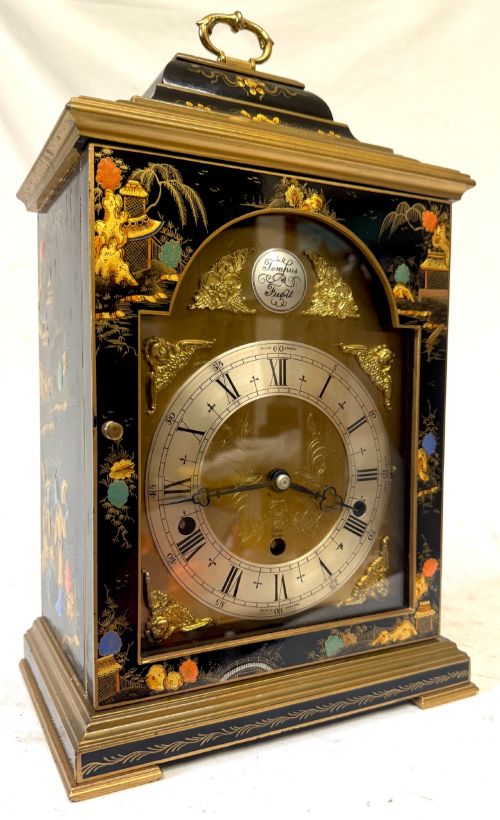


Georgian Gilt Bracket Clock
A georgian gilt bracket clock sits with quiet authority, marking hours through centuries of meticulous craft.
Georgian Gilt Bracket Clock
A georgian gilt bracket clock represents a pinnacle of domestic horology, designed to sit on a desk, table, or dedicated wall bracket. These pieces unite precise mechanical movements with striking decorative cases, capturing the refined tastes of their periods.
The objects on this page span several eras, including the eighteenth century, Regency period, and Victorian era, alongside later interpretations. Forms range from traditional bracket clock silhouettes to balloon clocks and carriage timepieces.
Materials vary widely across the selection, featuring ormolu, brass, silvered metal, and glass alongside wood finishes such as ebonised, lacquered, and burr walnut. Styles stretch from classic Georgian and George III to Chinoiserie and grand Regency.
Materials and construction
Cases rely on substantial wooden foundations, frequently finished with lacquered surfaces, tortoiseshell, or ebonised treatments. Metal embellishments in ormolu and gilt bronze add architectural definition and decorative contrast to the timber bodies.
Internal engineering utilises intricate fusee movements, chain drives, and striking mechanisms requiring exceptional mechanical skill. Dials frequently combine silvered metal chapters with brass bezels and protective glass covers.
Listings feature movements ranging from simple timepieces to complex triple fusee musical systems housed in lacquered wood.
Assessing quality and execution
Quality reveals itself in the crispness of the gilt bronze or ormolu mounts and the depth of the lacquer work. Finer examples display meticulous hand-painted Chinoiserie details and perfectly fitted bezels that align precisely with the glass and dial.
The sophistication of the internal movement dictates distinction, particularly regarding twin or triple fusee systems, quarter striking capabilities, and musical trains. Maker attribution also elevates a piece, with signed dials carrying particular historical weight.
Arnold and Frodsham·James Smith London·Chater And Son London·John Leroux London·Elliott London
The Georgian Gilt Bracket Clock Glossary
- Fusee
- A conical pulley used in clock movements to maintain an even pull as the mainspring unwinds. This mechanism ensures consistent timekeeping power throughout the duration of the wind.
- Ormolu
- Gilded bronze used extensively for decorative mounts on furniture and clock cases during the eighteenth and nineteenth centuries. The technique involves applying a mercury and gold amalgam to bronze.
- Chinoiserie
- European decorative art influenced by Chinese artistic traditions, featuring motifs such as pagodas, landscapes, and figures. It appears frequently on lacquered clock cases.
- Bracket clock
- A portable table clock originally designed to be placed upon a matching wall bracket to project sound more effectively. Over time, the term came to describe the specific tabletop case shape regardless of placement.
Georgian Gilt Bracket Clock: Frequently Asked Questions
What is a bracket clock?
A bracket clock is a portable spring-driven timepiece designed for domestic interiors, traditionally placed on a wooden wall bracket or a table.
These pieces combine complex mechanical movements with decorative outer cases made from wood, lacquer, and metal mounts.
How do fusee movements work?
A fusee movement uses a conical pulley connected to the mainspring via a cord or chain to regulate power delivery.
As the spring unwinds and loses tension, the chain moves to a wider part of the cone, maintaining consistent torque for accurate timekeeping.
Where should I place a bracket clock?
These clocks suit stable surfaces away from direct sunlight, excessive moisture, and temperature fluctuations.
Placing them on a firm mantelpiece or a dedicated wall bracket allows the mechanical beat to resonate properly through the room.
How do I identify a Georgian clock?
Georgian pieces generally display classical proportions, restrained architectural detailing, and high-quality materials such as mahogany, ebonised wood, or gilt bronze.
Examining the dial signature and the complexity of the internal movement often helps confirm the period of origin.