



Georgian Flintlock Firearm
A georgian flintlock firearm delivers mechanical history through iron, walnut, and brass, offering collectors a tangible link to eighteenth-century craftsmanship.
Georgian Flintlock Firearm
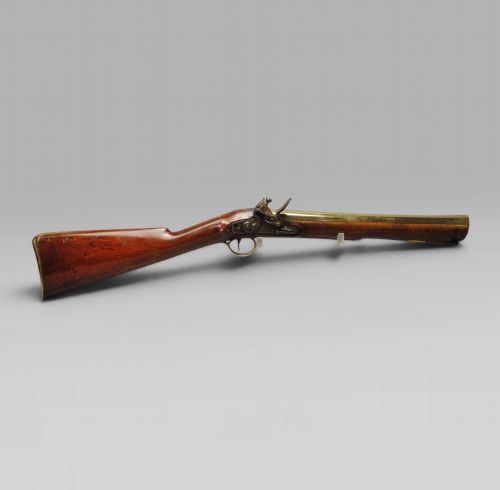
A georgian flintlock firearm encompasses muzzle-loading pistols, muskets, and blunderbusses produced primarily during the eighteenth and early nineteenth centuries. These pieces span military service arms, private duelling pairs, and pocket-sized self-defence tools.
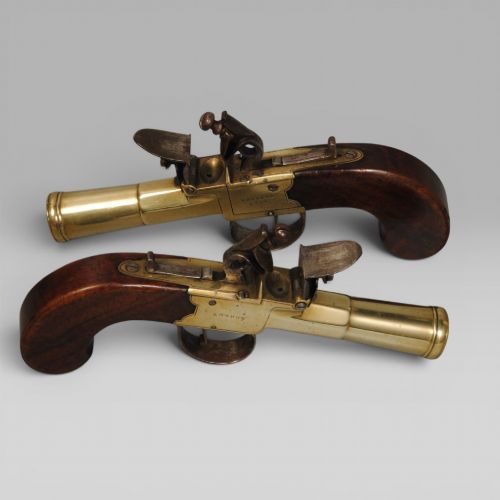
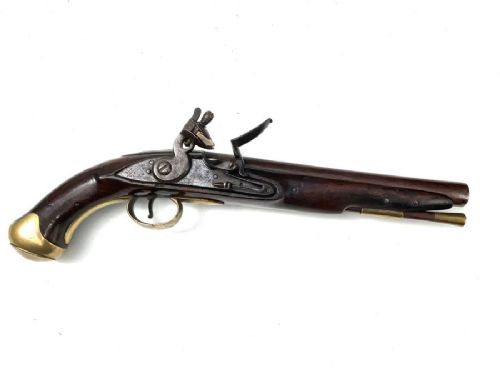
The versions most commonly encountered on this page originate from English, Scottish, and Irish makers working in styles such as Queen Anne, Regency, and Georgian Military. Formats range from large cavalry holster pistols to compact turn-off pocket models.
How They Were Made
Makers shaped stocks from dense hardwoods like walnut and mahogany, frequently incorporating brass or iron furniture to reinforce the mechanism. Stocks on finer pieces receive detailed silver wire inlay or cast silver butt caps.
Barrels and lockplates utilise forged steel, iron, or cast brass, with some examples featuring engraved detailing or gilt inlay. Flintlock mechanisms rely on precise spring tension to strike a spark against the frizzen and ignite the powder charge.
Mail coach inspectors carried specialised flintlock overcoat pistols, ensuring highwaymen received a prompt and fiery postal delivery.
What Varies in Quality
The distinction between standard service arms and high-grade civilian pieces lies in the crispness of lock engraving and the integration of precious metals. Master London and provincial gunsmiths invested greater labour into sculpted furniture and refined stock contours.
Overall preservation and structural integrity govern the standing of individual examples. Original matching components and legible maker signatures elevate pieces far above heavily altered or composite items.
Harrison of London·John Campbell of Doune·T. Potts·Twigg·Sargant and Son·James Barber·Thomas Henshaw·Timothy Hughes·R. Willoughby·Dumarest·I Parr·John Rimes·Meyer and Mortimer·J. Robinson·Barber of Newark·Dutton·Wilson
The Georgian Flintlock Firearm Glossary
- Flintlock
- An ignition mechanism that uses a flint held in a cock to strike a steel frizzen, creating sparks to fire the main charge. This system dominated personal and military arms throughout the eighteenth century.
- Turn-off barrel
- A barrel that unscrews from the breech for easier loading without a ramrod. This design appears frequently on pocket and Queen Anne type pistols.
- Frizzen
- The vertical steel plate struck by the flint to produce sparks. It pivots upward to expose the priming powder in the pan.
- Blunderbuss
- A muzzle-loading firearm with a flared muzzle designed to scatter lead shot at close range. These pieces were utilised by coach guards and naval officers.
- Proof marks
- Official stamps applied to barrels after testing for structural strength. These marks verify the origin and safety standard of the arm.
Georgian Flintlock Firearm: Frequently Asked Questions
How do I care for a flintlock firearm?
Keep the metal components lightly oiled to prevent active corrosion and store the piece in a dry environment away from extreme temperature shifts.
Inspect the internal springs periodically to ensure they remain uncompromised, and avoid dry-firing the lock mechanism to protect the original flint and frizzen surfaces.
Were these arms used in actual combat?
Many examples on this page served military forces during the Napoleonic and Revolutionary Wars, while others protected private citizens on stagecoaches or in homes.
Service pistols bear government inspection stamps and broader tolerances, whereas civilian arms exhibit finer decorative engraving and lighter framing.
How can I identify the maker?
Gunsmiths routinely engraved their surnames and working locations directly onto the lockplate or along the top flat of the barrel. Additional verification comes from regional proof marks stamped near the breech.
Matching these names with historical trade records helps establish the specific decade of production and the workshop origin.