
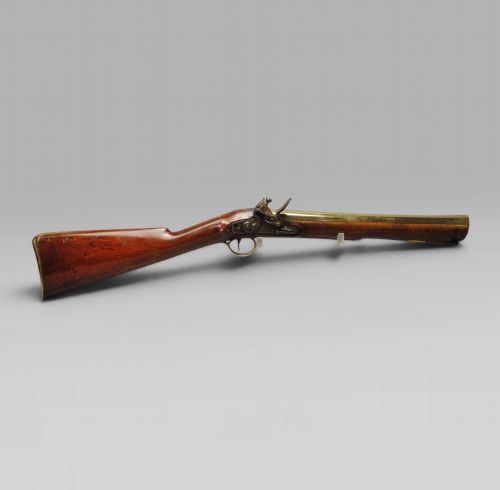


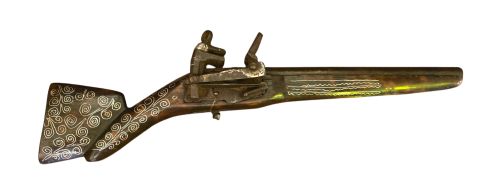

Flintlock Long Gun
These flintlock long gun examples span the eighteenth and nineteenth centuries, offering collectors authentic arms shaped by Georgian, Ottoman, and colonial workshops.

Flintlock Long Gun
A flintlock long gun is a muzzle-loading firearm relying on a flint striking a steel frizzen to ignite gunpowder. Buyers searching this phrase look for functional or decorative arms from the eighteenth and nineteenth centuries.
The selections on this page encompass military muskets, blunderbusses, and regional variants such as Afghan jezails, Indo-Persian muskets, and North African toe-lock arms. Most pieces belong to the Georgian era or the late eighteenth century.
Forms vary from standard military issues like the Brown Bess to ornate wall pieces and rifles decorated with bone, brass, and silver inlay. These items serve as historic military artefacts and decorative wall art.
How they were made
Maker workshops built these arms using timber stocks fashioned from walnut or other dense woods, paired with heavy iron and steel barrels. Brass components frequently appear on mounts, trigger guards, and blunderbuss barrels.
Decoration required meticulous handwork, incorporating bone, mother-of-pearl, and silver wire inlays into the wooden stocks. Mechanisms utilise traditional flintlock, miquelet, or snaphaunce ignition systems developed across Europe, Asia, and North Africa.
Listings feature materials including walnut, brass, steel, bone, silver, and mother-of-pearl across Georgian and nineteenth-century periods.
What varies in quality
Quality depends upon the originality of the lock mechanism and the precision of the metal and woodwork. Examples bearing clear maker signatures from recognised firms command greater interest than unsigned items.
The intricacy and survival of decorative inlays, such as bone and mother-of-pearl, separate standard military issue arms from highly ornamented regional variations. The structural integrity of the wooden stock and the condition of the steel barrel also influence the standing of each piece.
Sargant and Son
The Flintlock Long Gun Glossary
- Flintlock
- A firearm ignition mechanism that uses a piece of flint held in a cock to strike a steel frizzen, creating sparks to ignite the priming powder. This system dominated military and civilian arms for centuries.
- Blunderbuss
- A muzzle-loading firearm with a flared barrel designed to scatter shot at close range. These weapons often feature brass barrels and were utilised by coach guards and military units.
- Miquelet
- A form of snaplock ignition common in Spain, Italy, and parts of the Ottoman Empire. The mechanism places the mainspring outside the lockplate.
- Frizzen
- The vertical steel plate struck by the flint to create sparks and expose the priming powder in the pan. A grooved frizzen helps direct the spark downward.
- Musket
- A smoothbore long gun carried by infantry infantry soldiers during the eighteenth and nineteenth centuries. Models such as the Brown Bess formed the backbone of British military forces.
Flintlock Long Gun: Frequently Asked Questions
What is a flintlock long gun?
A flintlock long gun is a shoulder-fired muzzle-loading weapon utilising a flint and steel ignition system. These arms date primarily from the eighteenth and nineteenth centuries.
They encompass military muskets, blunderbusses, and regional long arms from Ottoman, Afghan, and Indo-Persian makers.
How do I identify the period?
Dating relies on mechanical characteristics, stock design, and regional styling typical of Georgian or late eighteenth-century armory. Maker marks and proof stamps also provide specific manufacturing eras.
Materials like brass barrels and bone inlay often reflect the fashion and military standards of particular decades.
Were these used in combat?
Many examples on this page served active military roles during the Georgian period, the Napoleonic Wars, and revolutionary conflicts. Standard muskets were standard issue for infantry regiments.
Other regional arms served tribal or protective functions, while some pieces functioned primarily as wall art or decorative items.
How should I display them?
These long guns suit wall mounting using secure brackets that support the weight of the wood and metal barrel. Stable indoor humidity protects the timber stock and prevents metal corrosion.
Keeping the pieces away from direct heat sources preserves the original wood finish and any bone or silver inlay.