





Flintlock Musket
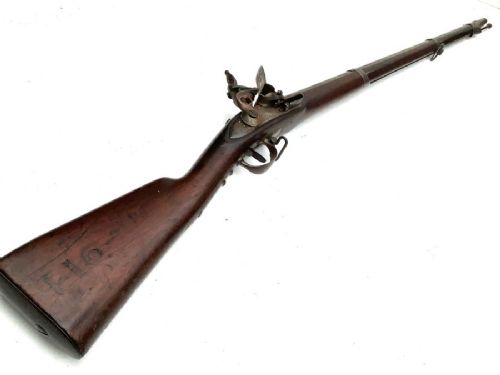
A flintlock musket is a historic shoulder arm relying on a flint and steel ignition mechanism, prized by collectors for its tactical heritage and mechanical ingenuity.
Flintlock Musket
A flintlock musket represents the standard infantry firearm of the Georgian and Napoleonic eras, designed for massed engagements and field operations. Buyers exploring this category encounter military arms from British, French, and American arsenals alongside regional variations from the Ottoman Empire, Indo-Persian territories, and North Africa.
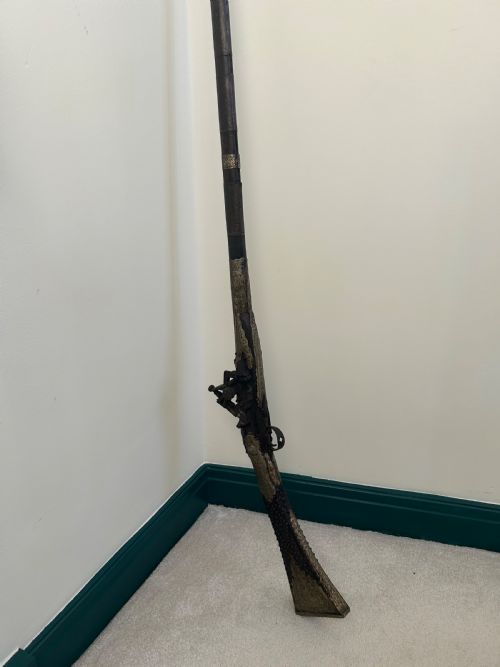
The inventory on this page spans the mid-18th century through the 19th century, incorporating standard-issue service pieces like the British Brown Bess and French Charleville models. Alongside these government contracts appear specialised carbines, blunderbusses with sprung bayonets, and tribal variants such as the Jezail rifle.
Regional diversity heavily shapes the selection, showing how different cultures adapted the flintlock mechanism to local warfare. Buyers often find domestic military pieces alongside ornate frontier arms featuring distinct regional stocks and lock mechanisms.
Materials and Construction
Stocks on these arms rely predominantly on dense hardwoods like walnut or general timber, shaped to house the barrel and lock mechanism securely. Metal components utilise forged steel for barrels and lockplates, complemented by brass furniture such as trigger guards, butt plates, and ramrod pipes.
Decorative enhancements incorporate regional artistry, utilising bone, mother-of-pearl inlay, and brass wire to embellish the wooden stocks. Ignition relies on the flintlock or miquelet mechanism, where a flint-holding cock strikes a steel frizzen to generate sparks into the priming powder.
Flintlock Musket Retail Price Guide 2026
Typical asking prices for flintlock musket among the pieces listed under this phrase on Sellingantiques today, from the lower quarter to the upper quarter. They describe what is for sale here now, not the wider market.
Listings feature 18th-century and 19th-century military and tribal long arms utilising walnut, steel, brass, and mother-of-pearl.
Assessing Quality and Execution
Quality in a flintlock musket rests on the crispness of the lock mechanism's action and the originality of its components. Government contract pieces from recognised makers exhibit standardised uniformity, whereas regional arms display the individual skill of local gunsmiths through hand-carved stocks and decorated metalwork.
The survival of distinct markings, proof stamps, and matching barrel and lock numbers elevates a piece's integrity. Condition also hinges on the retention of original wood contours and metal surfaces free from aggressive over-cleaning or structural replacement.
Sargant & Son
The Flintlock Musket Glossary
- Flintlock
- A firearm ignition mechanism using a flint clamped in a cock to strike a steel frizzen, creating sparks to ignite the powder charge. This system dominated military and civilian arms for centuries.
- Brown Bess
- The colloquial name for the standard British muzzle-loading smoothbore flintlock musket used by the British Empire. It served infantry forces across global conflicts for over a century.
- Miquelet
- A form of snaplock ignition featuring an external mainspring and a combined steel and pan cover. It is commonly found on Mediterranean, Spanish, and North African firearms.
- Blunderbuss
- A muzzle-loading firearm with a flared barrel designed to scatter shot at close range. These weapons were frequently carried by coaches, naval personnel, and guards.
- Frizzen
- The vertical steel plate struck by the flint to produce sparks and expose the priming powder in the pan. Its geometry directly influences the reliability of the ignition.
Flintlock Musket: Frequently Asked Questions
What is a flintlock musket?
A flintlock musket is a smoothbore shoulder weapon that uses a flint-and-steel mechanism to ignite gunpowder for firing a lead ball.
These arms served as the primary infantry weapon for European and colonial militaries throughout the eighteenth and early nineteenth centuries.
How do I identify the period?
Dating relies on inspecting lock markings, government acceptance stamps, architectural design, and the overall configuration of the brass and iron furniture.
Military contracts often bear regimental stamps or maker signatures that anchor the piece to a specific conflict or decade.
Were these used in combat?
The majority of these pieces served active military roles in major global conflicts, including the Napoleonic Wars and the Revolutionary Era.
Regional variations also saw extensive service in tribal skirmishes and frontier defence across the Balkans, North Africa, and the Middle East.
How should I display one?
Displaying a historic firearm requires a stable indoor environment away from direct sunlight, excessive humidity, and temperature fluctuations to protect the wood and metal.
Secure wall mounts or enclosed cabinets allow the piece to be viewed safely while supporting its substantial length and weight.