


Georgian Facet Stem Glass
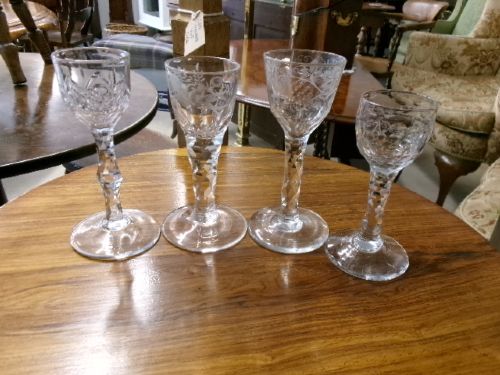
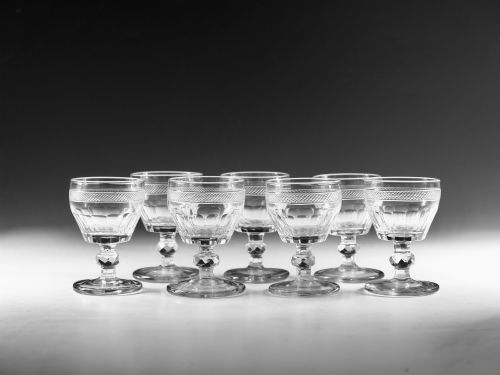
These georgian facet stem glass pieces are drinking vessels shaped by wheel-cutting and optical clarity, prized by collectors for their brilliant stems and period engraving.
Georgian Facet Stem Glass
You are most likely to meet English examples originating from around 1770 to 1800, often displaying faceted stems joined to wide foot bases. These forms encompass simple plain bowls as well as pieces adorned with hops, barley, or political symbols.
Alongside standard wine glasses, the grouping extends to taller ale flutes and cordial glasses designed for specific tavern and parlour uses. Each piece demonstrates the transition from earlier heavy baluster forms to lighter, more reflective cut crystal silhouettes.
How they were made
The makers utilised heavy lead glass and lead crystal, which provided the high refractive index necessary for sharp, clean wheel-cutting. This dense material allowed artisans to grind flat planes onto the stems without compromising the structural integrity of the drinking vessel.
Surface decoration was achieved through diamond-point engraving, copper-wheel engraving, and occasionally gilding with gold leaf applied to the bowl. Craftsmen such as James Giles added elaborate painted and gilded ornamentation to enhance the luxury appeal of the glassware.
Listings here feature eighteenth-century and Regency pieces in clear lead glass, cut glass, and lead crystal.
What varies in quality
The distinction between ordinary and exceptional examples rests upon the precision and depth of the facet cutting on the stem. Sharply defined, symmetrical planes catch the light far more effectively than softly rounded or uneven grinding.
Engraved ornamentation further elevates a piece, particularly when executed with the fine detail seen in Jacobite symbology or classical motifs like bucrania and paterae. The clarity of the lead metal and the proportion between bowl, stem, and foot dictate the overall visual balance.
James Giles
The Georgian Facet Stem Glass Glossary
- Facet cut
- A surface decorated by grinding flat planes into the glass using a rotating wheel. This technique maximises the sparkle of lead crystal.
- Ale flute
- A tall, slender drinking glass designed for consuming ale or beer. These vessels often feature engraved motifs relating to hops and barley.
- Jacobite engraving
- Political decoration applied to eighteenth-century glassware supporting the exiled Stuart dynasty. Such designs frequently incorporate roses and oak leaves.
- Medial knop
- A prominent raised swelling or bulbous section positioned midway along the stem of a drinking glass. It adds tactile grip and visual weight.
- Rummer
- A large, wide-bowled drinking glass developed in the late eighteenth and early nineteenth centuries. They were used for punch, wine, or ale.
Georgian Facet Stem Glass: Frequently Asked Questions
What is a facet stem glass?
A facet stem glass is a drinking vessel featuring a stem shaped by grinding flat geometric planes into the glass. These cuts catch the light and create a brilliant sparkling effect.
Most examples date from the Georgian period and include wine glasses, cordials, and ales made from heavy lead crystal.
How do I identify Georgian glass?
Georgian glass is generally identified by its heavy lead content, darker grey-blue tint in certain lights, and tactile pontil mark on the underside of the foot. The forms reflect eighteenth-century dining habits and decorative styles.
Examining the manufacturing techniques and wear marks helps confirm the period of origin.
What were rummers used for?
Rummers were large, wide-bowled drinking glasses used in the eighteenth and nineteenth centuries for hearty portions of wine, punch, or ale. Their robust construction suited communal taverns and domestic dining tables alike.
They often sit on a short, sturdy foot and occasionally feature cut or engraved decoration.
Are these glasses safe to use?
While these are antique drinking vessels, many collectors prefer to display them rather than use them for daily dining. Hand washing in lukewarm water is essential if you choose to use them.
Sudden temperature changes can crack historic lead glass, so hot liquids must be avoided.