


Facet Cut Stemware
Facet cut stemware comprises drinking vessels shaped with geometric stem facets, prized for how the cuts catch candlelight and daylight alike.
Facet Cut Stemware
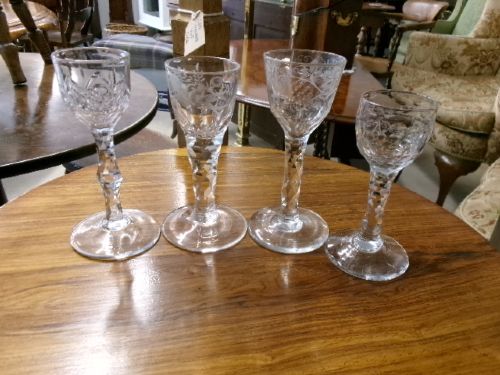
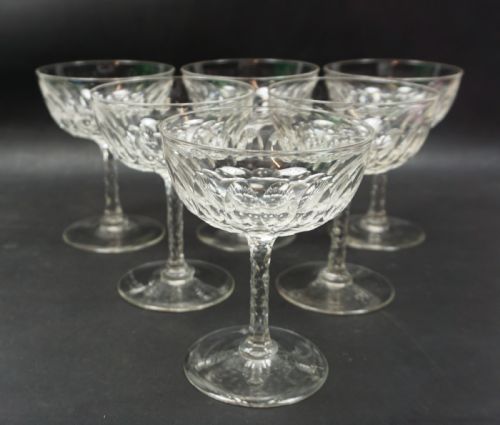
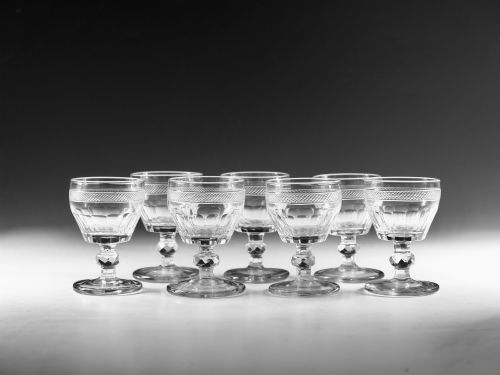
Facet cut stemware encompasses drinking glasses and goblets characterised by stems shaped into flat polished planes rather than smooth or baluster profiles. These pieces emerge primarily from Georgian, Victorian, and Edwardian periods, crossing forms such as wine glasses, champagne coupes, ale flutes, and cordial glasses.
Buyers frequently encounter English and Bohemian examples spanning the eighteenth and nineteenth centuries. The selection includes commemorative glassware and decorated bowls alongside plain drinking vessels, reflecting the broad utility of cut glass across dining and celebratory tables.
How they were made
Maker operations rely principally on lead crystal, lead glass, and clear glass shaped by blowing before artisans apply surface grinding and polishing wheels to generate the characteristic facets. Lead content provides the necessary weight and refractive clarity required for sharp, crisp stem facets.
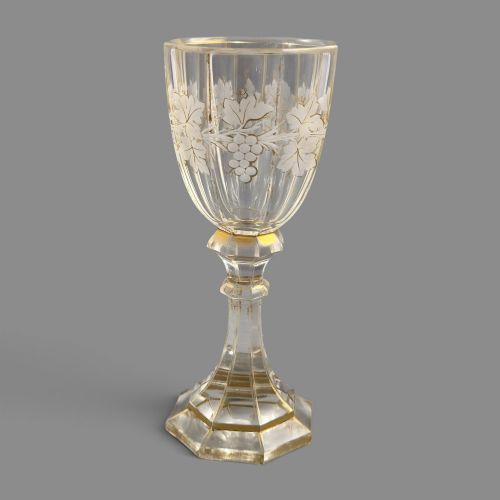
Decoration extends beyond the stem through engraving, gilding, and gold leaf applied to the bowls. Workshops in regions like Bohemia combine these decorative techniques with coloured or clear glass bodies, while English makers focus on clear lead metal.
Listings feature lead crystal, clear glass, and gold leaf across Georgian, Victorian, and Edwardian periods.
What varies in quality
Quality differentiates itself through the precision of the facet geometry and the optical clarity of the glass metal. Sharp, evenly spaced stem cuts that meet cleanly indicate superior wheel work, whereas soft or irregular facets suggest hurried finishing.
The sophistication of bowl decoration, such as detailed hop and barley engraving or careful gilding, elevates a piece above standard utility items. The balance between bowl proportions and the faceted stem governs the overall tactile success of the vessel.
Moser Bohemian·James Giles
The Facet Cut Stemware Glossary
- Facet cut
- A surface ground into flat planes on glassware to refract light and improve grip. This technique defines the stems of the glassware featured here.
- Lead crystal
- Glass containing lead oxide which increases density, weight, and light dispersion. It forms the heavy material base for many eighteenth and nineteenth-century pieces.
- Römer goblet
- A traditional large drinking chalice, often associated with continental production. Examples from Bohemian makers feature elaborate engraving and gilding.
- Ale flute
- A tall, narrow drinking glass designed for carbonated beverages. Eighteenth-century versions frequently incorporate faceted stems beneath decorated bowls.
Facet Cut Stemware: Frequently Asked Questions
How do I identify a Georgian facet cut stem?
Georgian facet cut stems display hand-ground flat planes running down the stem, often accompanied by pontil marks on the underside of the wide foot base. The glass itself typically exhibits the darker tone and weight characteristic of early lead metal.
Close inspection under natural light reveals the slight irregularities typical of eighteenth-century hand-polishing compared to later machine-cut equivalents.
What is the difference between wine and cordial glasses here?
Cordial glasses feature smaller bowls designed for concentrated spirits, paired with the same faceted stems found on larger wine vessels. Wine glasses provide more capacious bowls suited to table consumption during the Georgian and Victorian eras.
Both forms utilise the light-catching properties of stem facets to brighten formal dining settings.
Can I use antique facet cut stemware today?
These drinking vessels serve liquids perfectly well, though hand washing remains essential to protect fragile gilding and historic glass surfaces. Storing them securely prevents rim chips on the wide foot bases and delicate bowls.
Careful handling ensures these eighteenth and nineteenth-century objects continue to function in modern settings.
How do I tell English and Bohemian pieces apart?
English pieces from the Georgian and Regency periods generally rely on clear lead glass with restrained engraving like hop and barley motifs. Bohemian production frequently introduces coloured glass bodies, heavier gilding, and elaborate engraved scenes.
Makers such as Moser brought distinct continental decorative styles that contrast with traditional English drinking glass forms.