


Georgian Ebonised Clock
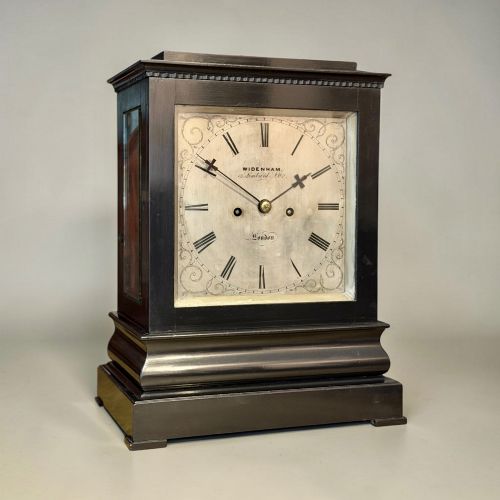
A georgian ebonised clock brings architectural presence and precision engineering into a room, combining dark timber cases with brass dialwork.

Understanding georgian ebonised clock pieces
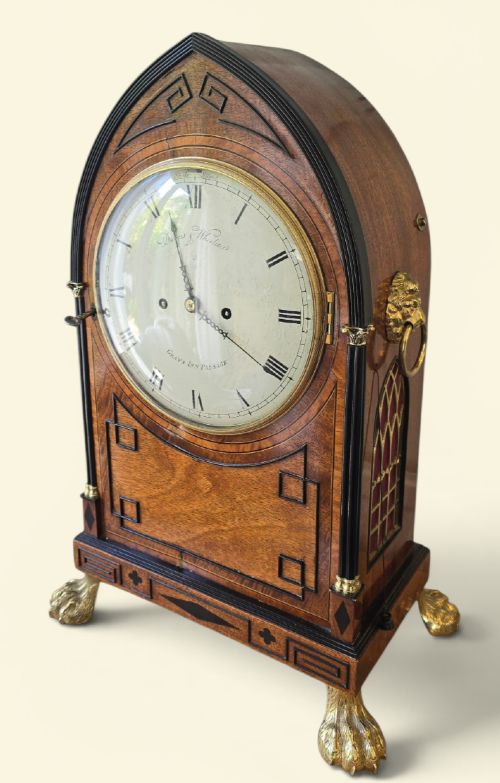
A georgian ebonised clock most commonly appears on this page in the form of a bracket clock or a longcase clock, housed in dark wood. These timepieces span the Georgian and Regency periods, alongside later 19th century examples sharing the same aesthetic.
Makers working in London and regional towns such as Hereford, Worcester, and Stowmarket produced these objects. Buyers encounter diverse formats, from miniature bracket timepieces to grand longcases and quarter-striking mantel clocks.
The aesthetic relies on dark finishes applied to timber, creating a sharp contrast against bright metal dials and bezels. Break-arch cases and traditional proportions define the visual character of the objects available here.
Materials and construction methods
Cases utilise timber treated with an ebonised finish to mimic the appearance of costly ebony wood. Glass panels protect the dial face while allowing a clear view of the hands and chapter rings.
Internal movements incorporate brass components, featuring mechanisms such as verge escapements and fusee drives. Makers fitted intricate gear trains to power quarter-striking functions and hour timekeeping.
Retail Price Guide 2026
Typical UK retail prices for georgian ebonised clock, calculated from the Sellingantiques database of over a million retail prices indexed since 2003. This retail price guide relies exclusively on Sellingantiques data; no external sources or auction records are used, so the figures do not describe the wider market.
Clockmakers often signed their brass dials so thoroughly that future generations could trace every repair spanning three centuries.
Distinctions in craftsmanship and design
The hierarchy of quality rests upon the fidelity of the ebonised finish and the crispness of the brass mountings and dial engravings. Finer examples display meticulous attention to case proportions, particularly around break-arch mouldings and dial apertures.
Mechanical complexity and the reputation of the horologist dictate the standing of an individual piece. Clocks signed by notable London makers or featuring specialised strike trains demonstrate superior workshop standards.
John Witherston of Hereford·Grimaldi and Johnson·William Tomlinson·George Cooper·Richard Young·George Borrett·Bartholowmew Devis·John Scandrett
The Georgian Ebonised Clock Glossary
- Ebonised wood
- Timber treated to achieve a dense, black polished finish resembling ebony. This technique provided a formal and dramatic appearance for domestic timepieces.
- Bracket clock
- A portable household clock designed to sit on a bracket or table. These pieces often feature intricate striking mechanisms and glazed side panels.
- Longcase clock
- A tall pendulum clock housed in a wooden tower case. This form protects the weighted movement while serving as a prominent architectural furnishing.
- Fusee
- A conical pulley used in clock movements to maintain even driving force as the mainspring unwinds. This mechanism improves timekeeping accuracy across the power reserve.
- Verge escapement
- An early type of clock escapement mechanism controlling the release of power to the pendulum or balance. It produces a distinctive and rapid ticking action.
Frequently Asked Questions
Where were these clocks placed?
Bracket clocks sat upon tables, shelves, or dedicated wall brackets in principal rooms. Their portable nature allowed owners to move them between chambers as needed.
Longcase clocks stood directly on the floor in hallways, stairwells, or formal reception rooms. Their height demanded a stable, upright position to keep the pendulum swinging truly.
How do fusee movements work?
A fusee movement uses a conical pulley connected to the mainspring via a cord or chain. As the spring loses tension, the cord rides higher on the cone to maintain consistent torque.
This clever mechanical adjustment ensures the clock exerts even pressure on the gear train from a full wind down to the final turn.
How do I identify a Regency piece?
Regency timepieces often display cleaner lines and restraint in surface ornamentation compared to earlier Georgian designs. Miniature bracket timepieces became particularly refined during this phase.
Materials remained focused on ebonised timber, paired with polished brass bezels and understated dial layouts.