


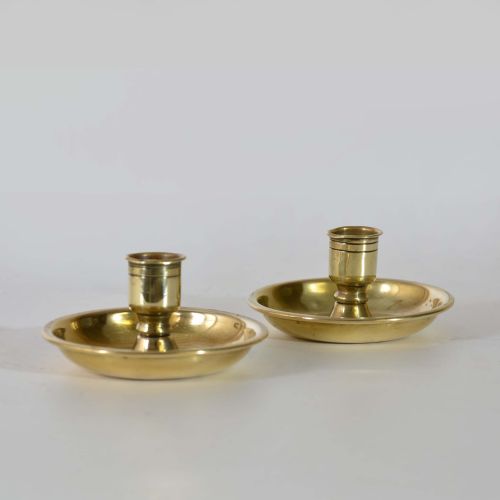


Georgian Chamber Candlestick
These georgian chamber candlestick examples bring practical lighting from past centuries straight to modern rooms with genuine historic character.
Georgian Chamber Candlestick
A georgian chamber candlestick is a low-profile lighting device designed to be carried by hand around a house after dark. Most pieces found here belong to the nineteenth century or the Georgian and Regency periods, spanning silver, metal, and porcelain forms.
Makers produced these objects as single sticks or in matched pairs and sets, often including a shallow drip pan and a small socket for the candle. Many examples incorporate a conical extinguisher or a small snuffer resting on the saucer base.
The selections range from utilitarian travel designs like Brighton buns in cast brass to decorative porcelain wares from factories such as Spode. Silver-plated copper items using the Old Sheffield technique also appear frequently across these listings.
Materials and construction methods
Metal chambersticks rely heavily on Old Sheffield plate, copper, paktong, and cast brass, reflecting the metalworking techniques of eighteenth and nineteenth-century workshops. Silversmiths hammered or cast precious metals like solid silver into sturdy sockets and saucers.
Ceramic pieces utilise fine porcelain decorated with hand-applied patterns underglaze or overglaze, requiring careful kiln firing by skilled potters. Enamel and gold leaf sometimes add decorative highlights to the finished surfaces.
Georgian Chamber Candlestick Retail Price Guide 2026
Typical asking prices for georgian chamber candlestick among the pieces listed under this phrase on Sellingantiques today, from the lower quarter to the upper quarter. They describe what is for sale here now, not the wider market.
Distinctions in quality and execution
Superior examples show crisp casting in brass or bronze, clean hallmarks on silver pieces, and well-preserved plating that retains its underlying copper sheen evenly. Lesser pieces often exhibit heavy wear, smoothed details from excessive cleaning, or mismatched components accumulated over time.
Completeness dictates much of the desirability, particularly the presence of matching snuffers, original wick trimmers, and detachable nozzle inserts that simplify cleaning wax residue.
Spode·John Lias
The Georgian Chamber Candlestick Glossary
- Chamber candlestick
- A portable candle holder featuring a wide drip pan and a loop handle for carrying room to room.
- Old Sheffield plate
- A composite material made by fusing a thin layer of silver onto a thicker copper base, common in eighteenth and nineteenth-century metalware.
- Paktong
- A strong copper-nickel-zinc alloy imported from China, prized for its bright silvery appearance and durability.
- Taper holder
- A small vertical tube attached to the side of a chamberstick designed to hold thin wax tapers for lighting fires or sealing letters.
- Brighton bun
- A compact, two-part travelling chamber candlestick that screws together into a neat rounded shape resembling a bun.
Georgian Chamber Candlestick: Frequently Asked Questions
What is a chamber candlestick?
A chamber candlestick is a low candle holder equipped with a saucer base to catch melting wax and a loop handle for carrying. People used them to light their way through dark corridors before electric lighting.
Today they function as decorative table accents or mantel pieces, retaining their historic charm while requiring only standard taper candles for display.
How do I clean an old silver plated stick?
Cleaning requires a soft cloth and mild, non-abrasive polish formulated specifically for plated metals. Vigorous scrubbing removes the thin silver layer entirely, especially on Old Sheffield pieces where the underlying copper shows through.
Gentle maintenance preserves the patina built up over centuries of use, keeping the surface stable and bright without harming the historic finish.
What is a Brighton bun?
A Brighton bun is a clever portable chamberstick that unscrews and packs down into a compact metal sphere for travelling. Eighteenth and nineteenth-century travellers packed them in luggage for use in inns and coaching houses.
Their unusual shape and clever engineering make them particularly sought after by collectors of small domestic metalware.
Did these sticks always include snuffers?
Many chambersticks came equipped with small conical snuffers or scissor-like trimmers designed to cut the burning wick. These tools kept the flame steady and reduced smoke in enclosed bedchambers.
Over the decades, many snuffers became separated from their base plates, so finding a set with its original matching extinguisher is uncommon.