
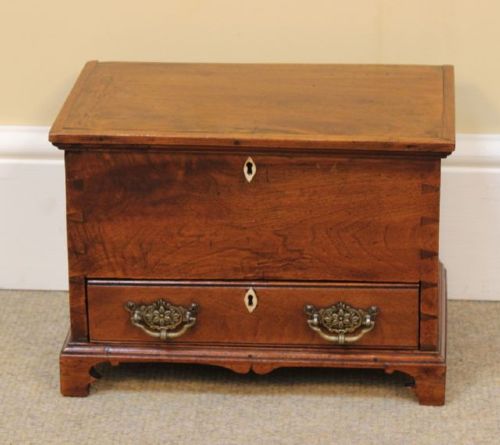


Georgian Apprentice Box
These georgian apprentice box pieces are miniature chests and cabinets made to demonstrate a maker's skill.
Georgian Apprentice Box
When you search for a georgian apprentice box, you encounter miniature chests of drawers, mule chests, and small cabinets produced across the eighteenth and nineteenth centuries. These small-scale pieces mirror the full-size furniture of their day, taking forms such as bow-front chests, blanket boxes, and tabletop cabinets.
The pieces on this page span the Georgian, Regency, and Victorian periods, with mahogany and oak appearing frequently alongside elm, walnut, and burr oak. Alongside standard chests, you find specialised tabletop items like spice boxes, tea caddies, and miniature bureaus.
Makers constructed these miniature items to prove their capability before entering a guild or trade, resulting in scaled-down versions of domestic furniture. They served practical uses on tabletops and desks while displaying the maker's proficiency in cabinet-making.
Materials and construction
Cabinet-makers relied on dense hardwoods like mahogany and oak, often enhancing surfaces with wood inlay, bone details, or brass handles and escutcheons. Secondary timbers such as pine appear in concealed areas like drawer linings.
Construction techniques mirrored standard domestic furniture scaled down, utilising dovetailed drawer construction and framed panels. Artisans shaped elm, walnut, and amboyna to achieve specific grain patterns and colour variations across small surfaces.
Apprentice chests often possess secret compartments designed to test the ingenuity of anyone attempting to open them.
Distinguishing quality
Quality rests on the precision of the scaling and the choice of timber, where well-figured burr oak or rich mahogany elevates a piece above simpler pine and oak examples. The execution of dovetailing and the retention of original brass hardware indicate the maker's level of skill.
Surface depth and timber patination distinguish superior examples, particularly where wood grain has matured over centuries. Finer items maintain proportional harmony that mimics full-sized furniture rather than appearing clumsy in miniature.
The Georgian Apprentice Box Glossary
- Mule chest
- A storage chest featuring one or more drawers beneath the main lifting lid. They combine the storage of a coffer with the accessibility of a chest of drawers.
- Bow-front
- A convex, curved cabinet front popular during the Georgian and Regency periods. This shape softens the corners of miniature chests and sideboards.
- Escutcheon
- A protective plate surrounding a keyhole, frequently cast in brass on these boxes. They add a decorative metallic accent to the timber surface.
Georgian Apprentice Box: Frequently Asked Questions
What is a georgian apprentice box?
A georgian apprentice box is a miniature furniture piece created by a trainee woodworker to showcase their technical skill. These items include small chests of drawers, mule chests, and tabletop cabinets.
Craftsmen built them using the same joinery techniques found in full-sized furniture. They served as desktop storage or decorative display items.
How were apprentice pieces used?
Apprentice pieces originally functioned as portfolio items for woodworkers seeking admission to trade guilds. They demonstrated a maker's ability to handle fine details and complex joints.
Over time, owners utilised them on tabletops and desks to store small valuables, spices, or documents. Their compact scale suited domestic desktop organisation.
What woods were used for these boxes?
Makers utilised hardwoods such as mahogany, oak, walnut, elm, and amboyna for visible exterior surfaces. Secondary timbers like pine often appear inside drawer boxes.
Some pieces incorporate decorative wood inlay, bone accents, and brass hardware to enhance their appearance. The choice of timber frequently reflects the prevailing style of the period.
How do I date a miniature chest?
Dating relies on observing the timber species, construction methods, and stylistic cues associated with specific eras like the Georgian or Regency periods. Bow-front shapes and specific brass hardware designs help narrow the timeline.
Comparing the dovetailing and secondary woods to dated examples provides further context. Patina and wear patterns also indicate the age of the piece.