


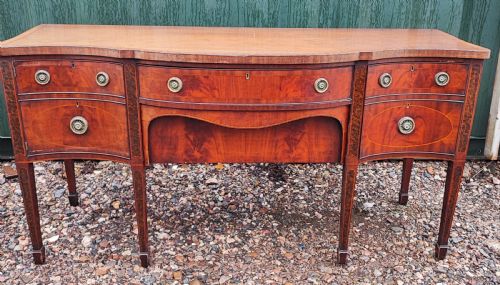


George III Style Sideboard
A george iii style sideboard brings architectural dignity and disciplined timber figure to a dining room, uniting formal proportion with storage.
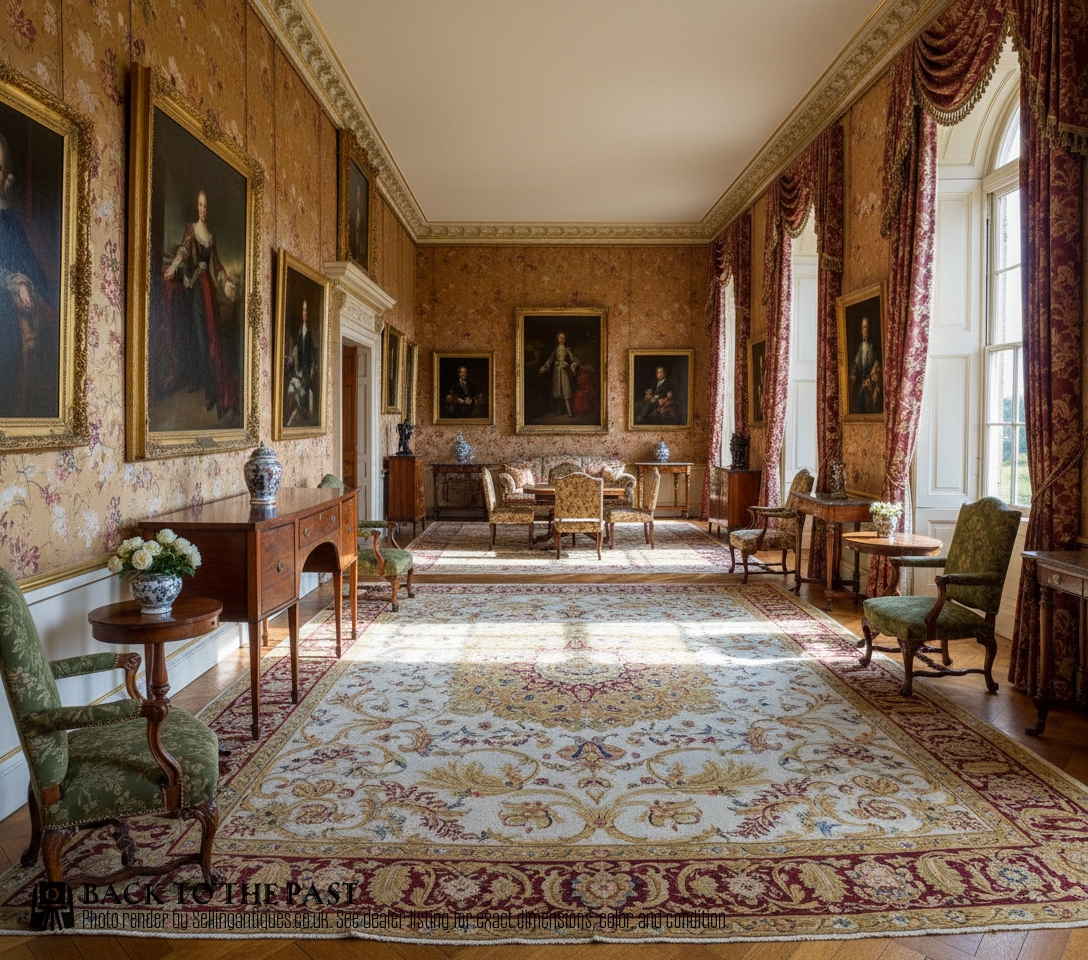
George III Style Sideboard
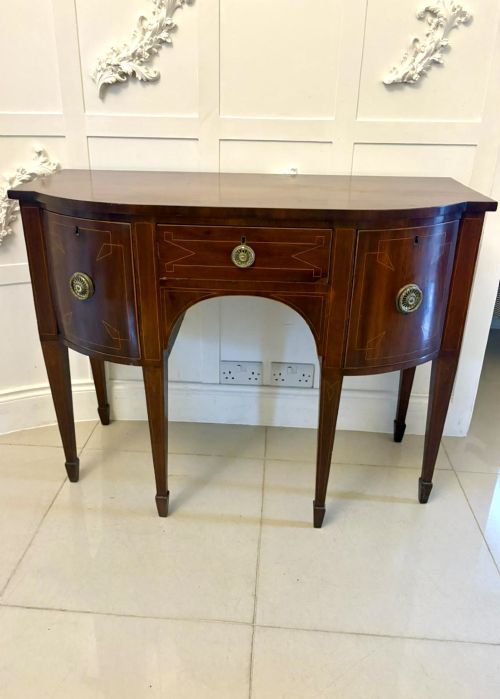
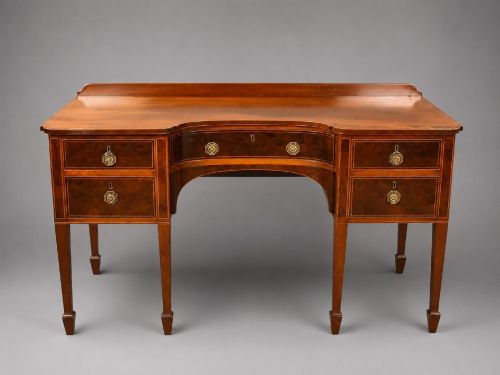
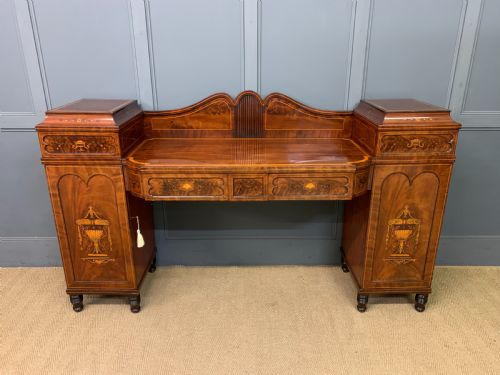
A george iii style sideboard is a dining room storage piece defined by classical proportion, tapering legs, and balanced cabinetry. When you search this phrase, you encounter pieces spanning the late eighteenth century through to twentieth-century revivals.
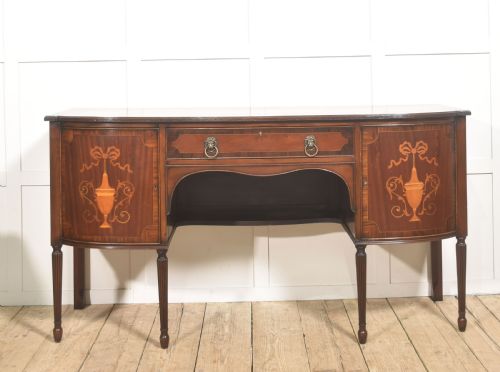
The most common form on this page is the serpentine or bowfront sideboard in mahogany, often accented with contrasting stringing. These examples echo the classical restraint and refined cabinet work associated with the Georgian period and later revivals.
Construction and Materials
Cabinet makers relied primarily on mahogany, selected for its rich grain and structural stability, often paired with secondary woods for internal framing. Surfaces were frequently enriched with delicate satinwood, boxwood, and ebony inlay to create contrasting geometric borders and paterae.
Hardware played an integral role, utilising cast brass handles and backplates that complemented the linear geometry of the timber. Joinery techniques such as dovetailed drawers and pegged frames ensured durability across decades of daily use.
Many of these sideboards retain deep cellarer drawers designed specifically to store wine bottles on their sides beneath the serving surface.
Assessing Quality
Quality rests in the selection of timber figures, such as flame or figured mahogany, matched symmetrically across drawer fronts and top surfaces. Superior examples display crisp, hand-cut inlay rather than printed decoration, with precise mitres and tight joints.
Proportion and execution of complex shapes, particularly sweeping serpentine fronts and neatly tapered spade feet, separate standard production from masterwork pieces. The finish should retain a warm, polished depth that highlights the natural grain without masking it.
The George III Style Sideboard Glossary
- Serpentine
- A front profile curving outward in the centre and inward at the sides. This fluid shape requires immense skill from the cabinet maker to fit drawers and doors accurately.
- Bowfront
- A convex, outwardly curved front elevation popular in late eighteenth-century case furniture. It softens the rigidity of straight-line dining room interiors.
- Inlay
- The technique of embedding contrasting woods, such as boxwood and satinwood, into the primary timber surface. It creates ornamental borders and classical motifs.
- Flame mahogany
- A veneer cut from the fork of the mahogany tree where branches meet the trunk. This produces a distinctive, flickering flame pattern prized for principal display surfaces.
- Spade foot
- A rectilinear foot that tapers downward to a flat, rectangular base resembling a spade. It is a hallmark of late eighteenth-century neoclassical furniture design.
George III Style Sideboard: Frequently Asked Questions
How do I spot a revival piece?
Revival pieces, often dating from the Edwardian era or the early twentieth century, employ machine-sawn timbers and standardised hardware fittings. They frequently exhibit cleaner secondary wood linings and standardised internal construction.
Examining the underside, drawer linings, and backboards reveals the subtle tool marks and wood ageing typical of earlier periods compared to later interpretations.
Where were sideboards placed?
These pieces stood against the dining room wall to hold serving dishes, cutlery, and decanters during formal meals. They functioned as the central staging area for hospitality before serving utensils were brought to the table.
Their substantial top surfaces also allowed hosts to display silver tableware and porcelain service collections.
How should I clean the wood?
Maintain the finish by dusting with a dry, soft cloth and applying a traditional beeswax polish sparingly when the wood appears dry. Avoid silicone-based sprays that can penetrate the grain and degrade the polish over time.
Keep the piece away from direct heat sources and strong sunlight to prevent the mahogany and inlay veneers from drying and cracking.