



Half Moon Mahogany Cabinet
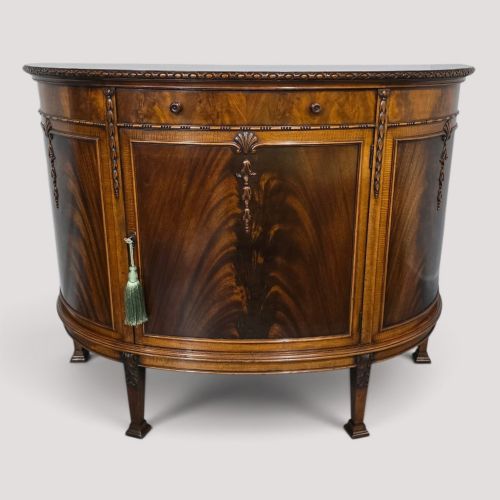
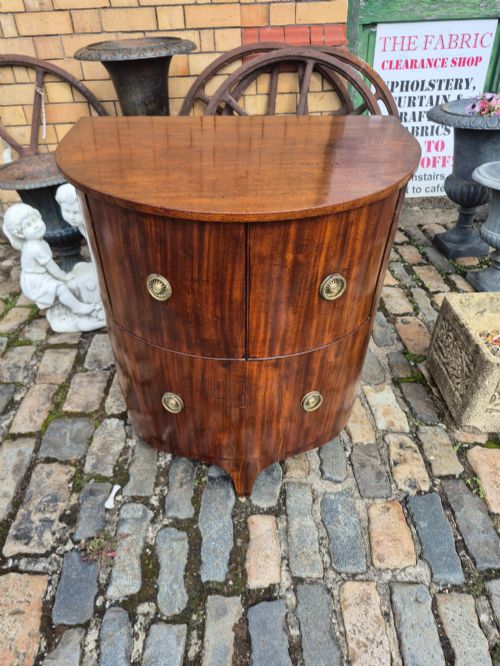
A half moon mahogany cabinet brings restrained curved elegance to a room, offering practical surface space and concealed storage without dominating the floor.
Half Moon Mahogany Cabinet
A half moon mahogany cabinet is a curved piece of furniture designed to fit flush against a wall, combining utility with refined geometry. These pieces draw on eighteenth-century origins and later revivals, offering shallow profiles suitable for hallways, drawing rooms and alcoves.
The versions most commonly encountered on this page range from George III originals to Edwardian and later twentieth-century interpretations. They appear in forms such as side cabinets, commodes, display cabinets and console tables.
Materials and Construction
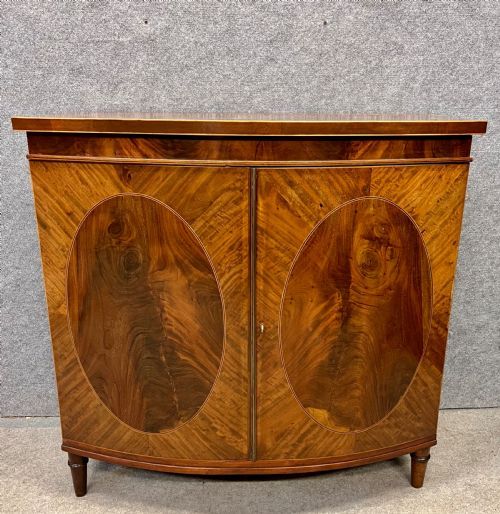
Construction relies heavily on solid and veneered mahogany, often enriched with contrasting stringing and banding in satinwood and boxwood. Carpenter techniques include curved framing and shaped drawer linings designed to follow the precise half-round radius.
Surface decoration frequently incorporates marquetry inlay depicting neoclassical motifs, urns and swags. Selected pieces integrate marble tops or glass panels alongside brass hardware such as key escutcheon plates and cast feet.
Half Moon Mahogany Cabinet Retail Price Guide 2026
Typical asking prices for half moon mahogany cabinet among the pieces listed under this phrase on Sellingantiques today, from the lower quarter to the upper quarter. They describe what is for sale here now, not the wider market.
Listings feature pieces spanning the eighteenth century through to the Edwardian period and the 1930s, constructed in mahogany, satinwood and marble.
Factors That Distinguish Quality
Quality reveals itself in the choice of timber figure, such as flame mahogany, and the precision of the contrasting inlay work. Finer examples display tight, seamless joints along the curved frame and crisp hand-cut botanical or classical marquetry.
The refinement of internal carcase work, original brass fittings and the fluid movement of curved doors or drawers separate superior cabinet-making from simpler production.
The Half Moon Mahogany Cabinet Glossary
- Demi-lune
- A half-moon shape used to describe furniture with a flat back and a curved front. This profile defines the classic commode and console formats.
- Marquetry
- Decorative patterns formed by fitting together thin veneers of different woods and materials. It creates pictorial or geometric surfaces on cabinet doors and tops.
- Tambour
- A flexible shutter made of narrow vertical strips of wood glued to canvas, allowing doors to slide around a curved track. It provides concealed access to internal shelving.
- Stringing
- Thin inlaid lines of contrasting timber used to outline panels, drawers and tabletops. It highlights the structural geometry of the piece.
- Commode
- A decorative chest of drawers or cabinet originating in France. In this context, it refers to high-status formal storage furniture.
Half Moon Mahogany Cabinet: Frequently Asked Questions
Where should I place a half moon cabinet?
These cabinets sit flat against a wall, making them well suited for narrow hallways, landings, or dining room perimeters where depth is restricted. Their shallow curved profile provides a display surface without obstructing walkways.
They also function effectively beneath mirrors or large artwork in reception rooms, anchoring vertical wall space with their distinct geometric footprint.
How do I tell an 18th-century piece from a revival piece?
Eighteenth-century examples typically exhibit hand-cut dovetails, older timber shrinkage characteristics, and subtle signs of hand tool work inside the carcase. Revival pieces from the Edwardian era or the twentieth century often utilise more uniform machine-cut construction methods and cleaner interior secondary timbers.
Examining the underside, drawer construction linings, and the ageing of the mahogany helps determine the period of manufacture.
What is the difference between a commode and a side cabinet?
A commode in this context generally denotes a formal piece with drawers or cupboard doors built during the Georgian or continental periods. Side cabinets and display cabinets often feature glazed doors or interior shelving designed for china and decorative objects.
Both share the same semi-circular plan but serve different functional roles within a room.
Are marble-top cabinets original?
Many continental and neoclassical console or commode forms incorporated inset marble slabs to provide a durable, cool surface. On period pieces, the marble is fitted directly into a rebated wooden frame designed specifically to support its weight.
Checking the fit and the edge moulding helps confirm whether the stone top belongs to the original construction.
How do I care for mahogany and marquetry?
Mahogany benefits from occasional dusting with a soft, dry cloth and minimal exposure to direct sunlight or sudden temperature shifts. Excessive heat can dry out veneers and cause fine inlay work to lift from the carcase.
Applying traditional wax polish sparingly helps nourish the timber grain and maintains the natural lustre of the polished surface.