


George III Satinwood Desk
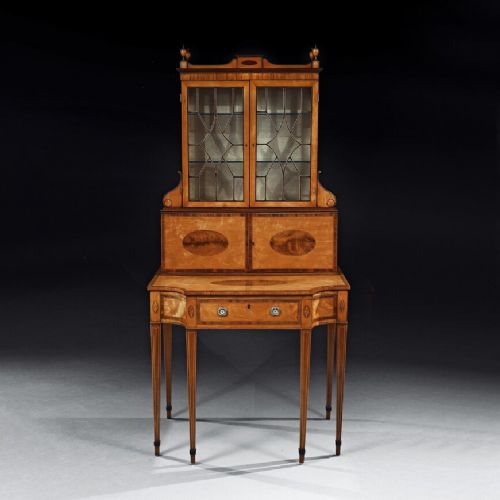
A george iii satinwood desk brings luminous timber and refined writing forms together, offering both workspace and decorative elegance.

George III Satinwood Desk
When you search for a george iii satinwood desk, you enter a field defined by late eighteenth-century cabinet-making where figured timbers take centre stage. The examples on this page range from compact writing cabinets and bonheurs du jour to larger bureau bookcases and cylinder desks, mostly originating from the Georgian period alongside later revival interpretations.
Makers of this era utilised the pale, golden-yellow grain of satinwood to create striking contrast against darker woods like mahogany and rosewood. These pieces served the refined writing and correspondence needs of Georgian households, combining functional drawers and pigeonholes with polished decorative surfaces.
Materials and Construction
Cabinet-makers built these pieces using solid and veneered satinwood, often banded or inlaid with contrasting timbers such as mahogany and rosewood. Brass handles, escutcheons and sometimes castors completed the construction, while leather writing inserts provided a durable surface for daily correspondence.
Internal engineering often included secret rising compartments, sliding cylinders and fitted pigeonholes that demonstrate sophisticated joinery. Secondary timbers like oak appeared in drawer construction, supporting the primary decorative veneers with stable internal framing.
Several ladies worktables on this page conceal multiple secret rising compartments designed for confidential letters and trinkets.
Assessing Quality
Quality rests upon the choice of timber and the precision of the marquetry and banding. Pieces featuring highly figured satinwood matched symmetrically across drawers and tabletops demonstrate superior craftsmanship from the workshop.
The sophistication of the internal mechanism distinguishes finer writing cabinets and cylinder desks from simpler tables. Original brass hardware, crisp inlay work and intact secondary timbers elevate the standing of a piece within the Georgian range.
The George III Satinwood Desk Glossary
- Satinwood
- A dense, lustrous tropical timber with a natural golden sheen. It takes a high polish and forms the primary decorative surface for late eighteenth-century neoclassical furniture.
- Bonheur du Jour
- A light ladies writing desk featuring a small cabinet or set of drawers on top of the writing surface. This form became popular during the second half of the eighteenth century.
- Cylinder Desk
- A writing desk enclosed by a quarter-cylinder rolling shutter that conceals the writing slide and internal pigeonholes. When closed, it protects the correspondence and keeps the surface tidy.
- Cheveret
- A small movable writing table fitted with a small bookshelf or tier of drawers on top. It often includes a pull-out slide and simple compartment layout.
- Marquetry
- The art of applying pieces of veneer to a structure to form decorative patterns and pictures. Craftsmen used various tinted woods to achieve pictorial depth.
George III Satinwood Desk: Frequently Asked Questions
What is a bonheur du jour?
A bonheur du jour is a small, light writing table featuring a raised cabinet or tier of pigeonholes upon the top surface. These tables were designed primarily for female correspondents in late Georgian drawing rooms.
They offer compact workspace combined with decorative display capacity, making them suitable for smaller residential spaces today.
How do I care for satinwood?
Satinwood requires stable indoor humidity and protection from direct sunlight to preserve its pale golden colour and prevent veneer shrinkage. Regular dusting with a soft, dry cloth maintains the polished finish.
Avoid placing these desks near heat sources or using modern silicone polishes that can damage the historical surface.
What is a cylinder desk?
A cylinder desk encloses the writing surface beneath a rolling quarter-circle wooden shutter. Pulling out the sliding desktop automatically retracts the cylinder to reveal the fitted interior.
This mechanism allowed eighteenth-century users to secure their papers quickly without clearing the desk surface.
Are these desks practical for daily work?
Many smaller writing tables and cylinder desks provide suitable surfaces for laptop use or correspondence. Their historical drawer layouts accommodate modern stationery efficiently.
Care should be taken with leather writing inserts, which benefit from gentle maintenance rather than heavy daily friction.