
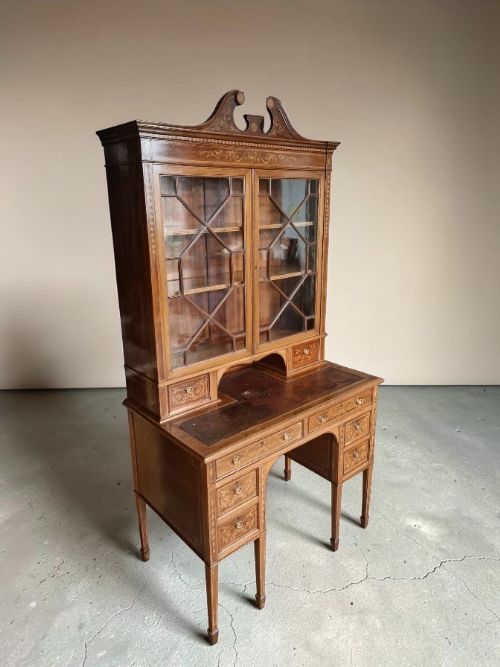
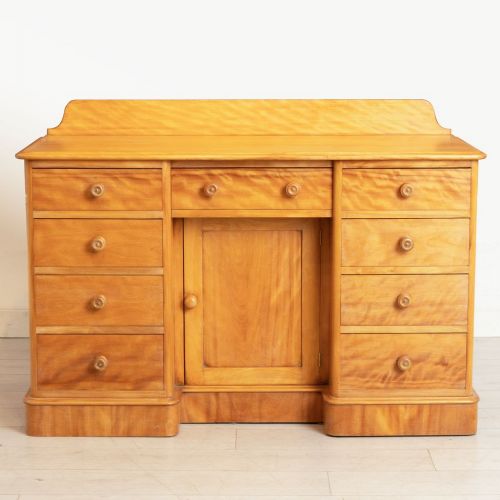


Satinwood Kneehole Desk
These satinwood kneehole desks combine figured timber with neat proportions, offering a dedicated writing surface that fits neatly against a wall.

Satinwood Kneehole Desk
A satinwood kneehole desk is a fitted writing table featuring a central recess flanked by banks of drawers, constructed predominantly during the Victorian and Edwardian periods. The pieces appearing here span the late nineteenth century through to the early twentieth century, taking influence from George III and Sheraton Revival design.
While many examples utilise solid or veneered satinwood, buyers will also encounter pieces rendered in mahogany, satin birch, and satin walnut with satinwood inlay or banding. Forms range from dedicated writing desks to pieces sharing characteristics with dressing tables and pedestal desks.
Surviving examples showcase various stylistic movements, including Aesthetic Movement pieces and Sheraton Revival interpretations. The proportion remains consistent, designed to sit comfortably within a morning room, study, or bedroom.
Materials and construction
Cabinet makers constructed the carcases using primary timbers such as mahogany, pine, and satin birch, applying satinwood veneers and intricate inlay to the visible surfaces. Brass fittings, leather writing surfaces, and glass tops appear across the selection.
The decorative surfaces frequently incorporate contrasting stringing, banding, and painted details. Drawers utilise traditional dovetail joints, housed within single or multi-part pedestals depending on the scale of the desk.
Listings feature satinwood kneehole desks alongside related forms like dressing tables and pedestal desks, spanning the Victorian and Edwardian eras.
Evaluating craftsmanship and condition
Quality rests in the selection of the timber and the precision of the cabinetwork, particularly the alignment of drawers and the crispness of any inlaid banding. Finer examples display carefully matched veneer grains across the top and drawer fronts rather than simple painted effects.
The integrity of the structural joints and the retention of original brass hardware elevate an example. Pieces bearing maker stamps from prominent cabinet makers reflect workshop standards of the nineteenth and twentieth centuries.
Edwards and Roberts·James Shoolbred of London·Maple & Co.
The Satinwood Kneehole Desk Glossary
- Kneehole desk
- A writing table with a central recessed space for the legs, flanked by pedestals containing drawers. This configuration provides a compact footprint while offering substantial storage.
- Satinwood
- A lustrous hardwood native to Ceylon and India, prized for its golden yellow colour and reflective grain. It appears both as solid timber and as a fine veneer.
- Pedestal desk
- A heavy writing table built on two vertical columns of drawers, with a central space for the user. These pieces often separate into modular sections for transport.
- Aesthetic Movement
- A late Victorian design approach that prioritised visual beauty over moral narrative. Pieces from this movement often display clean lines and simplified ornament.
Satinwood Kneehole Desk: Frequently Asked Questions
What is a kneehole desk?
A kneehole desk is a compact form of writing furniture featuring a central recessed space for seating, surrounded by banks of drawers. This layout allows for storage without requiring the massive footprint of a full partner's desk.
They gained popularity in various forms throughout the nineteenth and twentieth centuries, serving as writing tables, dressing pieces, and morning room desks.
How do I date a satinwood desk?
Dating relies on examining the construction methods, timber choices, and stylistic cues present in the piece. Victorian examples often feature mahogany or satin birch carcases with substantial drawer linings, while Edwardian pieces frequently lean into Sheraton Revival lightness.
Makers' stamps, hardware styles, and the application of veneers also provide clear indicators of whether a desk originates from the 1870s or the early 1900s.
Are these desks suitable for daily work?
Many of these desks function well for contemporary writing and laptop use, provided the writing height matches your seating. The presence of leather inserts on several examples offers a durable surface for writing.
Consider the depth and knee clearance before committing a desk to daily clerical tasks, as nineteenth-century proportions can occasionally sit lower than modern standards.
What is the difference between satinwood and satin birch?
Satinwood is a dense, exotic hardwood known for its natural golden sheen and smooth texture, while satin birch is a domestic or European timber finished to mimic that golden appearance. Both woods create a reflective, light-catching surface on antique furniture.
Cabinet makers frequently utilised satin birch as a more accessible alternative to solid satinwood during the Victorian period.