



Geometric Octagonal Rug
A geometric octagonal rug brings grounded pattern and rich tribal history straight to your floorboards.
Geometric Octagonal Rug
A geometric octagonal rug spans nomadic and village weaving traditions from the nineteenth and early twentieth centuries, featuring distinct angular motifs across wool foundations. Buyers searching for a geometric octagonal rug typically encounter traditional Afghan, Caucasian, and Turkmen tribal pieces alongside Baluch and Kurdish works.
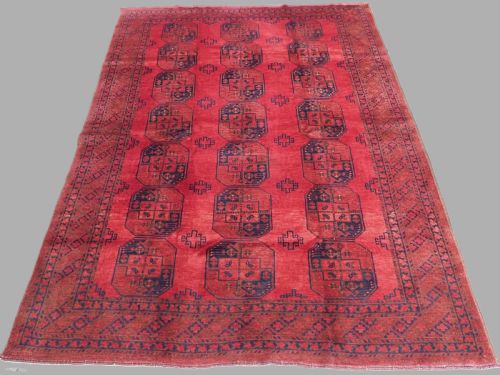
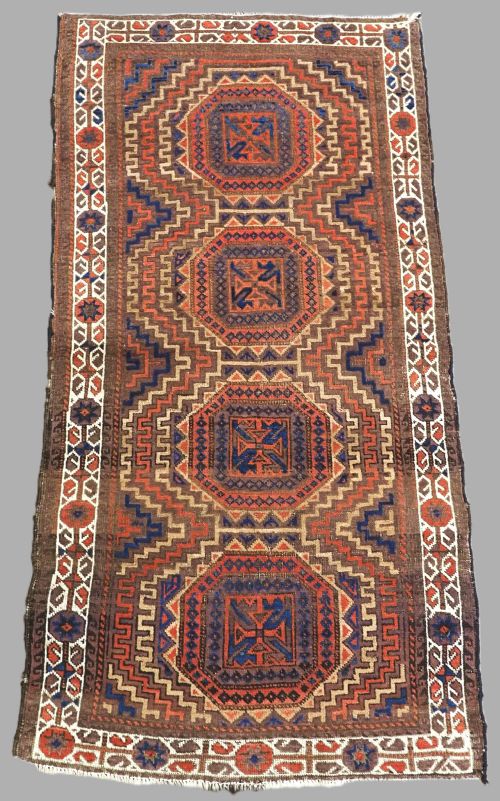
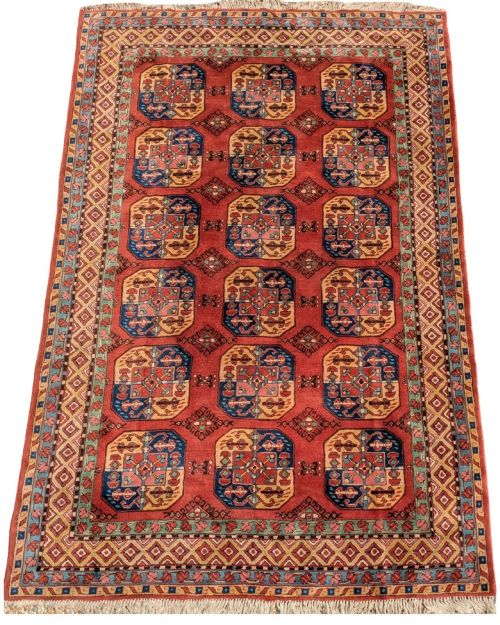
The selections on this page range from compact village runners to large country house carpets. Pieces display repeating guls, octogen layouts, and central medallions set against grounds of red, green, gold, and aubergine.
How they were made
These carpets and runners are constructed using natural wool for both the pile and the foundational warps and wefts. Weavers knotted thick wool yarn by hand to build dense, durable floor coverings designed for heavy use.
Dyes derived from natural sources provide the deep red, gold, and dark ground colours recorded in the evidence. The resulting textiles exhibit tactile depth through wool pile and varied structural weaves.
One piece carries a precise date from the Islamic calendar, noting the exact historical moment a weaver finished their wool knots.
What varies in quality
Quality in these tribal rugs rests upon the precision of the wool knotting and the crispness of the angular design work. Finer examples display tightly packed pile and well-defined octagonal guls that maintain structural integrity.
The handling of natural colour, from soft faded patinas to rich saturated grounds, distinguishes regional workshops. Better pieces show balanced proportions between the central field and outer borders.
The Geometric Octagonal Rug Glossary
- Gul
- A medallion motif commonly found in Turkmen and Afghan tribal rugs. It often repeats in rows across the field.
- Pile
- The raised surface of a rug formed by the cut ends of knotted yarn. Thicker pile provides more cushioning underfoot.
- Warp
- The vertical threads stretched on the loom that carry the weight of the rug. Weft threads cross horizontally to lock the knots in place.
- Runner
- A long, narrow carpet format suited for hallways and corridors. Shirvan examples appear frequently in this shape.
Geometric Octagonal Rug: Frequently Asked Questions
Where should I place a tribal rug?
These runners and carpets suit hallways, living spaces, and studies where foot traffic is moderate. Their durable wool construction handles everyday movement well.
Keep them away from damp areas and direct sunlight to preserve the natural wool pile and traditional dyed ground colours.
How do I clean an old wool rug?
Gentle surface brushing and careful vacuuming without a rotating beater bar remove loose dust from the wool pile. Professional specialist cleaning is advised for deeper maintenance.
Avoid soaking the cotton and wool foundations with excessive water during any spot cleaning.
What is an octagonal gul?
A gul is a repeating geometric medallion woven into tribal carpets. Octagonal versions form the central visual rhythm in many Turkmen and Baluch pieces.
These motifs often indicate the specific tribal group or region where the rug was knotted.
How do I identify a Baluch rug?
Baluch rugs often feature deep aubergine or dark grounds paired with geometric repeat patterns and small octagons. They originate from nomadic groups bridging regions of Iran and Afghanistan.
Look for thick wool pile and traditional village proportions when examining these pieces.