
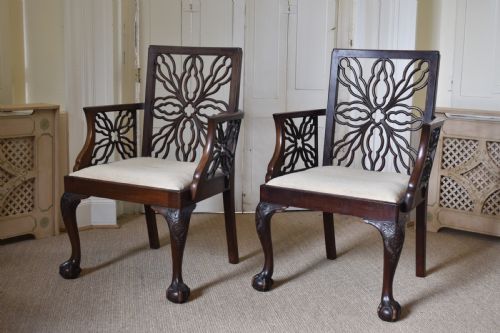

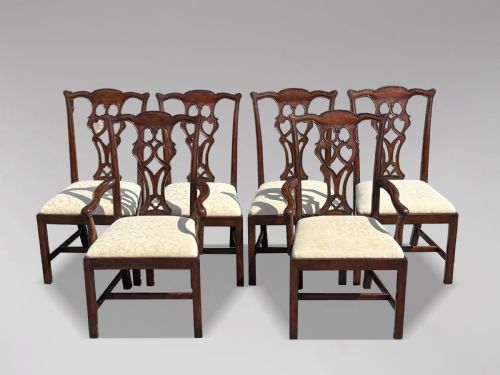
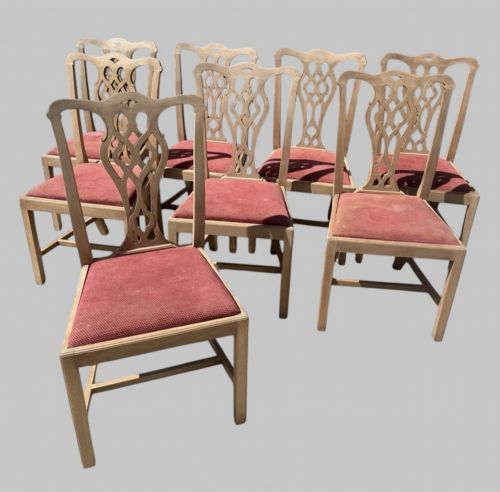

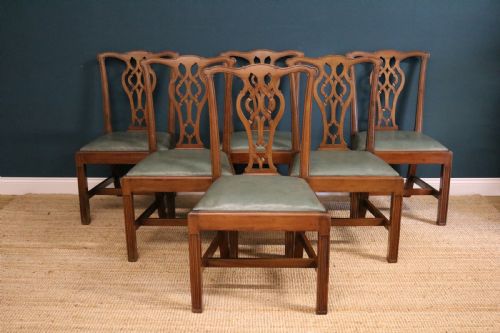


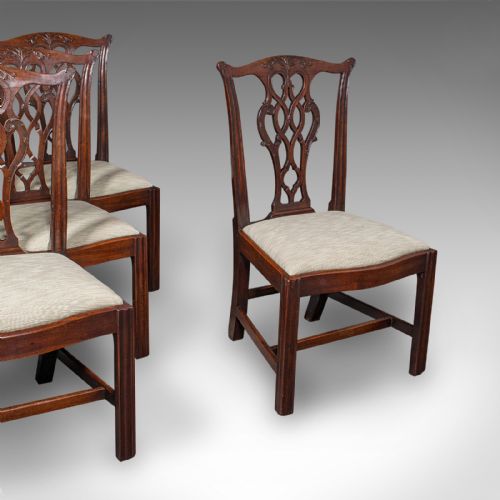


Fretwork Back Dining Chairs
These fretwork back dining chairs combine intricate pierced splats with sturdy timber frames, offering genuine period character for a traditional dining room.
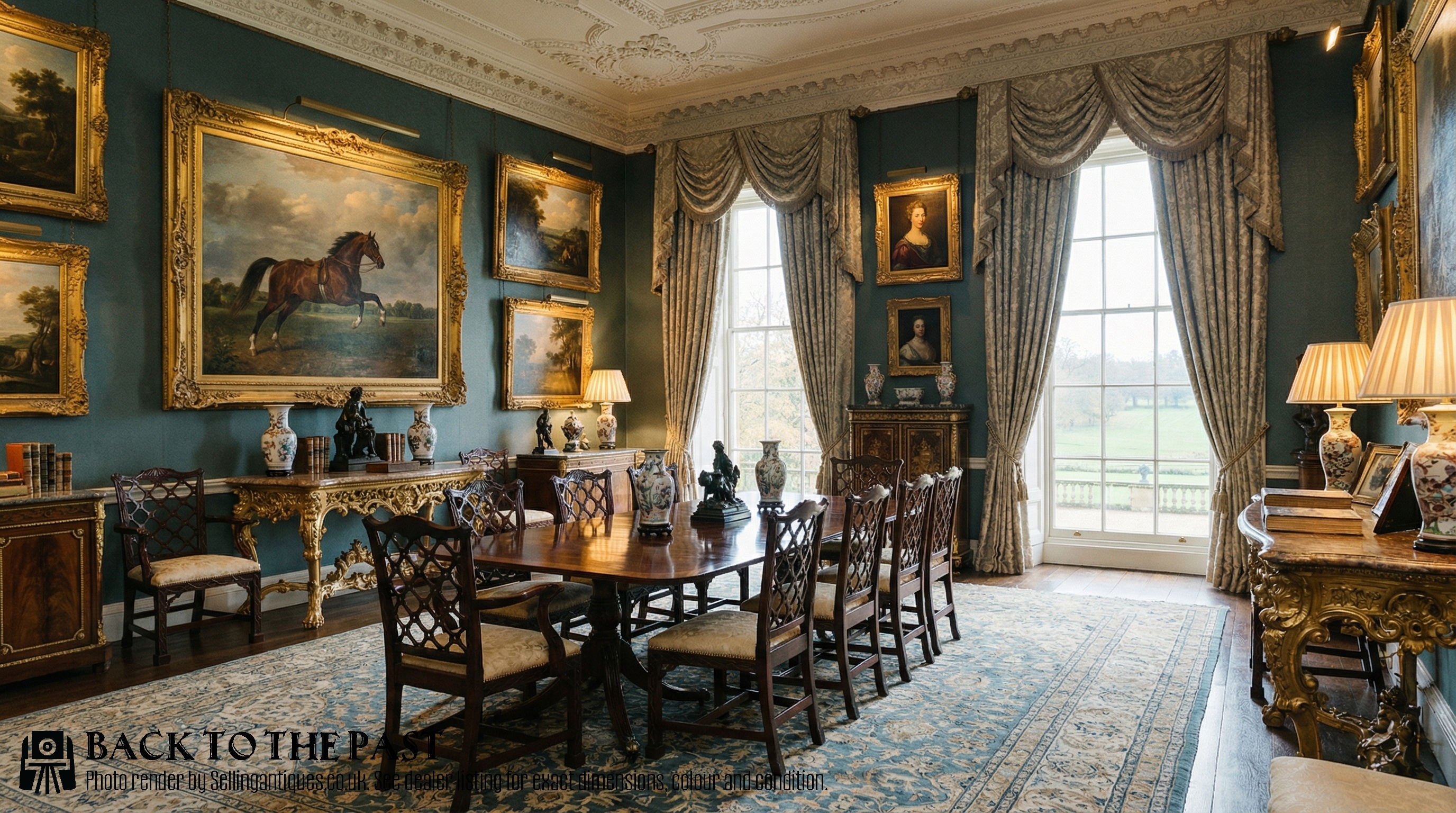
Fretwork Back Dining Chairs
When you search for fretwork back dining chairs, you encounter seating built around openwork wooden splats derived from 18th-century cabinetmaking traditions. The versions you meet most frequently on this page span the Georgian period, the 19th century, and revival eras up to the 1930s, taking the form of both side chairs and open armchairs.
The evidence shows these pieces appear in mahogany, bleached mahogany, Chinese hardwood, and oak, often paired with seats in leather, velvet, fabric, cane, or standard upholstery. They serve primarily as dining chairs, though single armchairs and specialised forms such as masonic or porters' chairs also emerge.
Makers drew heavily on Chippendale, George II, George III, Regency, and Jacobean styles, producing side chairs and armchairs that range from understated Georgian designs to elaborate Chinese Chippendale interpretations. A buyer finds everything from single pairs to large sets spanning six, eight, fourteen, or even more chairs.
Assessing quality and craftsmanship
Quality rests in the crispness and depth of the carved pierced work within the splat, where superior examples display sharp edges and careful symmetry. The handling of timber grain, particularly in mahogany and bleached mahogany variations, distinguishes standard production from more ambitious workshop output.
Structural cohesion across large sets indicates the skill level of the original maker, as matching fourteen or six chairs requires rigorous consistency. The integration of seating materials, whether cane, leather, or woven fabric, reflects the overall standard of the finished piece.
Fretwork Back Dining Chairs Retail Price Guide 2026
Typical asking prices for fretwork back dining chairs among the pieces listed under this phrase on Sellingantiques today, from the lower quarter to the upper quarter. They describe what is for sale here now, not the wider market.
One remarkably niche survivor on record is a late Georgian masonic chair, proving that fretwork backs occasionally served secret societies rather than dinner parties.
The Fretwork Back Dining Chairs Glossary
- Fretwork
- Openwork ornamentation carved or pierced from a flat piece of wood. It forms the defining decorative feature of the back splats on these chairs.
- Splat
- The vertical wooden strip down the centre of a chair back. In these pieces, it is pierced and shaped into intricate patterns.
- Chippendale Revival
- A later stylistic movement reproducing or adapting the 18th-century designs associated with Thomas Chippendale. It appears frequently in 19th-century and Edwardian furniture.
- Klismos Chair
- An ancient Greek chair form with curved legs and a concave backrest. The evidence includes mid-19th-century interpretations of this classical shape.
- Bergere Seat
- An upholstered seat frame, often enclosing a cane panel or drop-in cushion. It provides a distinct textural contrast to the carved wooden back.
Fretwork Back Dining Chairs: Frequently Asked Questions
How do I clean the carved fretwork?
Dust the pierced wooden sections gently with a soft, dry brush to prevent dirt accumulation in the carved recesses.
Avoid liquid polishes that can pool inside the intricate fretwork and damage the timber finish over time.
Are these chairs suitable for daily use?
Solid mahogany and oak frames provide the structural strength needed for regular seating at a dining table.
Checking the joints and the security of the back splats ensures safe everyday use in a modern household.
How do I spot a revival piece?
Revival pieces often display manufacturing traits and timber patination characteristic of the late 19th or early 20th century.
Comparing the carving style and secondary woods helps differentiate an Edwardian or 1920s interpretation from an 18th-century original.
Can I mix armchairs with side chairs?
Pairing open armchairs at the table heads with matching side chairs along the sides follows historical dining room conventions.
Matching timber tones and fretwork motifs helps unify a mixed set around a single dining table.