


Yellow Velvet Dining Chairs
Yellow velvet dining chairs bring warmth and tactile richness to a room, offering striking seating rooted in historic revival styles.
Yellow Velvet Dining Chairs
Yellow velvet dining chairs combine historic timber frames with plush textile upholstery, spanning periods from the Victorian era into the nineteen twenties. These seats frequently appear as matched sets of dining chairs or smaller pairings of armchairs.
The timber structures draw on diverse historic designs, including George II style, Queen Anne revival, Sheraton revival, and Regency revival forms. Walnut and mahogany dominate the wooden frameworks, while the velvet upholstery introduces colour and soft texture.
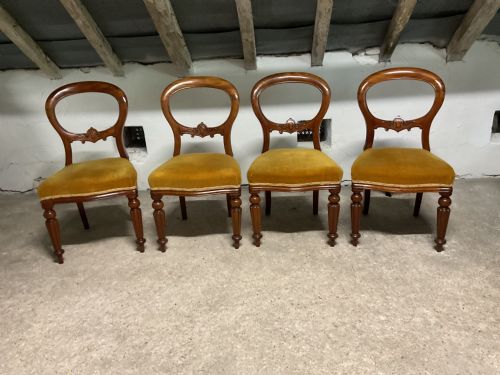
Makers such as Blyth and Sons contributed to this tradition, producing upholstered seating during the Victorian period. Buyers encounter both side chairs and carver armchairs featuring details like balloon backs and inlaid decoration.
How they were made
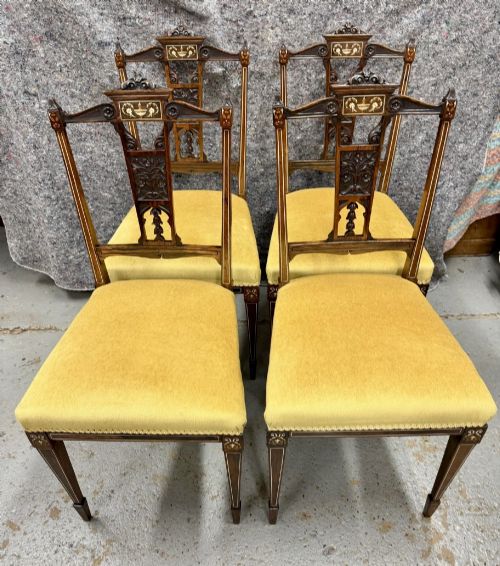
Makers utilised dense timbers such as mahogany, walnut, rosewood, and oak to construct sturdy dining chair frames. Cabinetmakers shaped these hardwoods into traditional forms, sometimes incorporating boxwood inlay or barley twist turnings.
Upholstery techniques applied velvet fabric over padded seats and backs to deliver comfort alongside visual presence. Brass details occasionally appear as accents on the framework or castors.
Yellow Velvet Dining Chairs Retail Price Guide 2026
Typical asking prices for yellow velvet dining chairs among the pieces listed under this phrase on Sellingantiques today, from the lower quarter to the upper quarter. They describe what is for sale here now, not the wider market.
Site listings feature Victorian, Edwardian, and nineteen-twenties pieces constructed from mahogany, walnut, rosewood, and oak.
What varies in quality
The refinement of the timber carving and the precision of revival styling distinguish finer sets from standard examples. Pieces exhibiting crisp George II or Hepplewhite revival details demonstrate superior craftsmanship compared to plainer interpretations.
The integrity of the wooden frame and the quality of the upholstery application determine the durability and sustained appearance of the chair. Matched sets spanning larger quantities involve greater uniformity in construction and timber selection.
Blyth and Sons
The Yellow Velvet Dining Chairs Glossary
- Balloon back
- A rounded, oval-shaped chair back popular during the Victorian period. This profile curves outward to resemble a balloon.
- George II style
- A revival of mid-eighteenth-century furniture design characterised by robust proportions and carved wooden details. These pieces often employ mahogany.
- Carver armchair
- A dining armchair featuring open arms, traditionally placed at the head of a dining table. They complement matching sets of side chairs.
- Inlay
- A technique where contrasting materials like boxwood are inserted into the timber surface to create decorative patterns. This ornamentation enhances the visual depth of the wood.
- Barley twist
- A spiral turning carved into wooden furniture legs or chair supports. This decorative form gained popularity across various revival periods.
Yellow Velvet Dining Chairs: Frequently Asked Questions
What periods do these chairs date from?
The selection spans pieces from the mid-nineteenth century through to the nineteen twenties. Victorian examples sit alongside later revival interpretations.
Craftsmen drew inspiration from earlier Georgian and Regency designs while working within their own contemporary manufacturing traditions.
Are these chairs sold in sets?
Many listings comprise sets ranging from pairs up to ten chairs. Larger groupings suit formal dining tables.
Individual carver armchairs and smaller sets also appear within the available selection.
What woods are used in the frames?
Mahogany and walnut form the primary structural timbers across the majority of the seating. Rosewood and oak also feature in specific pieces.
Inlay work frequently incorporates lighter woods like boxwood to create contrast against the dark timber.
How do revival styles differ?
Revival designs emulate historical aesthetics from specific eras, such as George II, Queen Anne, and Sheraton periods. Makers reinterpreted these classic forms using late-nineteenth and early-twentieth-century techniques.
Details like crook arms, balloon backs, and specific leg profiles identify the particular stylistic influence.