


French Style Chaise Longue
These pieces of french style chaise longue seating offer deep reclining comfort, drawing on Victorian and continental forms to anchor a room.
French Style Chaise Longue
When you search for a french style chaise longue, you are looking at elongated seating designed for half-sitting and half-lying, often shaped with scrolled ends or rising backs. The examples recorded here cross several periods, spanning Victorian pieces alongside continental designs.
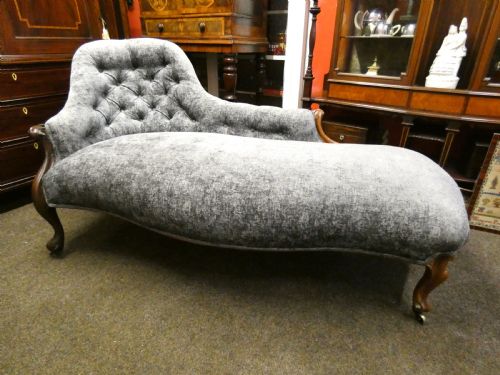
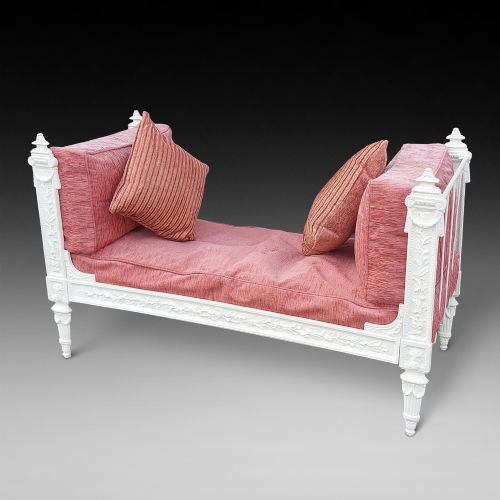
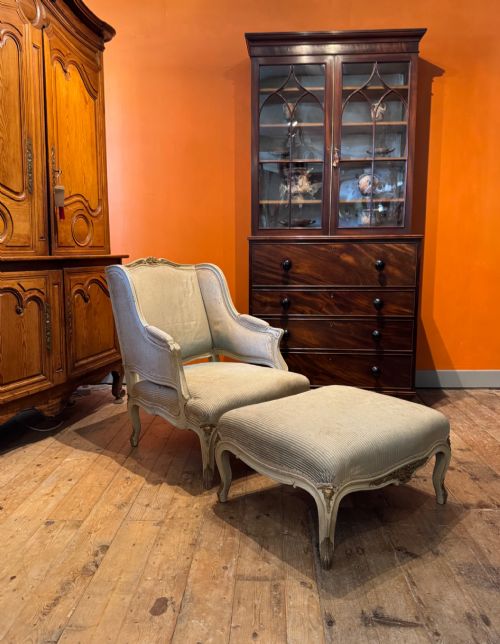
You are most likely to meet Victorian versions and pieces bearing Louis XV style or Louis XVI style influences. These range from duchesse brisée forms to painted day beds and carved wooden frames upholstered in fabric or linen.
How they were made
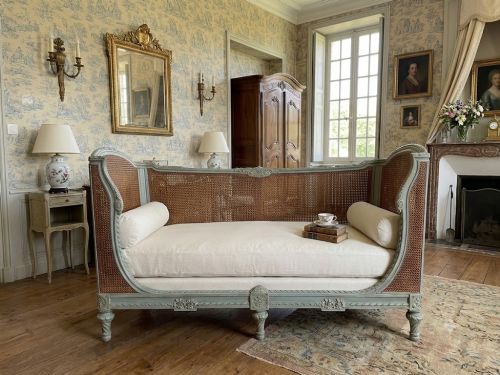
Makers shaped these frames from timbers such as walnut, mahogany, beech, and giltwood, occasionally incorporating brass details or cast iron. Upholstery relies on fabric, velvet, and linen, sometimes featuring buttoned finishes and cane work.
Construction methods combine traditional wood carving with painted or gilded surface treatments. Frames often display stylistic details rooted in French Rococo, Napoleon III, and French Empire traditions.
Listings on this site span Victorian, 19th Century, 1900, 1910, 1920, 1930, and 1880 periods.
What varies in quality
The standard of a piece rests on the crispness of its carved woodwork and the fidelity of its style, whether executed in the Louis XV manner or as a Victorian revival. Original paint finishes and untouched surface patination separate superior examples from standard ones.
Structural integrity within the timber frame and the quality of the upholstery materials, such as heavy linen or velvet, determine the overall execution. Finer examples retain integrated matching components, such as multi-part duchesse brisée sets.
The French Style Chaise Longue Glossary
- Duchesse brisée
- A multi-part daybed arrangement consisting of a chair combined with one or more footstools to create a continuous resting surface.
- Canapé Corbeille
- A basket-shaped settee or daybed with a curved, enveloping backrest.
- Giltwood
- Timber treated with a thin layer of gold leaf or gilt decoration across its carved surfaces.
- Napoleon III
- A nineteenth-century eclectic design period drawing heavily on earlier French royal styles.
- Piecrust
- A decorative moulded or carved edge resembling pastry crimping, often found on table tops or chair frames.
French Style Chaise Longue: Frequently Asked Questions
What is a french style chaise longue used for?
These pieces provide an intermediate seat between a chair and a bed, intended for daytime resting and lounging in a parlour or bedroom.
Their elongated form allows the user to recline fully while remaining seated upright against a raised headrest.
How do I place a chaise longue in a room?
A chaise longue sits well away from walls, often angled to take advantage of natural light or positioned as a central statement piece.
Ensure there is enough clear floor space around the curved end and backrest so the silhouette remains visible.
How do I identify a Victorian piece from a French style one?
Victorian versions often utilise heavy walnut timbers with deep buttoned velvet upholstery and robust proportions suited to nineteenth-century British interiors.
French style pieces from the Louis XV or Louis XVI traditions lean towards painted or giltwood frames, lighter carved ornament, and cane inserts.