



Victorian Conversation Sofa
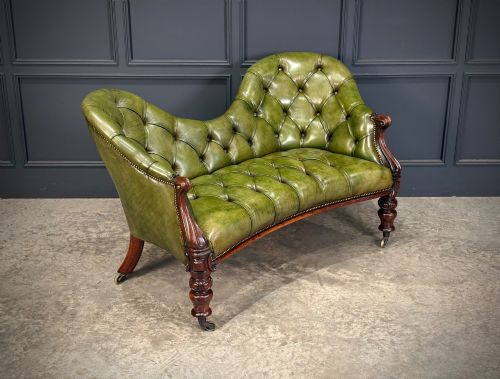
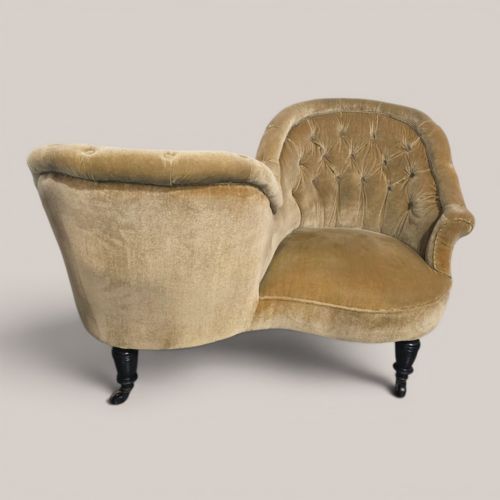
A victorian conversation sofa is an upholstered seat designed for face-to-face seating, bringing character and intimate seating arrangements to a room.
Victorian Conversation Sofa
A victorian conversation sofa offers a distinctive form where two or three people sit facing opposite directions, facilitating ease of dialogue without straining the neck. The pieces seen span the nineteenth century, including early victorian examples alongside later items up to nineteen ten.
Most variations on this page take the form of circular conversation seats, double-ended settees, and love seats. Frames take shape in mahogany, walnut, rosewood, and oak, often paired with button upholstery and velvet or leather coverings.
Moorish revival and rococo revival styles appear alongside standard nineteenth century framing. Buyers encounter pieces utilising barley twist supports and serpentine showwood outlines.
How They Were Made
Cabinet makers built the structural frames using dense hardwoods like mahogany, walnut, rosewood, and oak. These timbers were carved, turned, or polished to expose rich grain patterns along showwood rails.
Upholstery techniques involved deep buttoning through fabric, velvet, or leather. Brass hardware and castors frequently supported the heavy hardwood bases.
What Varies in Quality
The refinement of the timber carving and the complexity of the frame dictate the standing of a piece. Elaborate showwood mouldings, barley twist turnings, and circular configurations show greater ambition than simpler settee forms.
The choice of covering material and the depth of buttoning affect the presentation. Original leather and rosewood or walnut frames command attention for their tactile qualities.
The Victorian Conversation Sofa Glossary
- Conversation sofa
- An upholstered seating form designed for multiple occupants to sit facing different directions simultaneously. These pieces are also known as gossip chairs or courting seats.
- Showwood
- Exposed timber framing on an upholstered seat where the polished wood forms a decorative border. Mahogany and walnut are typical showwood materials.
- Button upholstery
- A traditional technique where deep buttons are pulled tight into the padding to create a padded, quilted surface. This method appears frequently on leather and velvet covers.
- Rococo revival
- A nineteenth century decorative style drawing on asymmetrical scrollwork, naturalistic foliage, and curved outlines. It is commonly found on mid century frames.
Victorian Conversation Sofa: Frequently Asked Questions
What is a conversation sofa used for?
A victorian conversation sofa allows multiple people to sit together while facing different directions. This layout supports easy dialogue and social interaction in a drawing room.
Historically, these seats accommodated formal social calls and permitted polite conversation without awkward posture. Today, they serve as focal points in large living spaces.
How do I place a conversation sofa in a room?
Circular conversation seats require open floor space so people can walk around them entirely. Placing one in the middle of a room highlights the curved frame and accessible seating angles.
Smaller double-ended settees fit well against walls or within bay windows. Their dual-facing design still offers distinct seating directions within a room's layout.
What materials are typical for these sofas?
Frames utilise hardwoods including mahogany, walnut, rosewood, and oak. Showwood sections display the natural grain of these timbers along the exposed borders.
Coverings consist of fabric, velvet, and leather, often secured with deep buttoning. Brass components and castors frequently appear on the feet of nineteenth century examples.
How do I distinguish early victorian pieces?
Early victorian examples often feature rosewood or mahogany frames with simpler structural lines. They date from around eighteen fifty and reflect transitional styles before later revival movements.
Later nineteenth century pieces incorporate heavier walnut frames, barley twist turnings, or more elaborate moorish revival and rococo influences.