



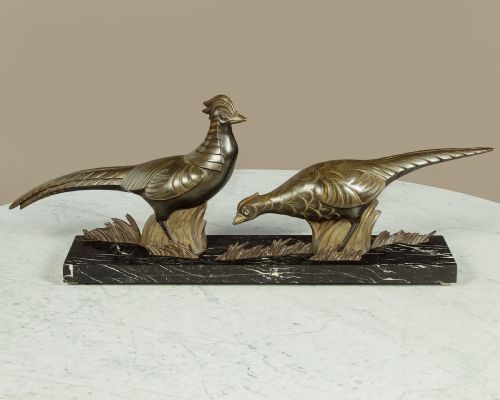






French Spelter Statue
A french spelter statue brings nineteenth- and twentieth-century continental foundry work into a room, offering expressive figures at an accessible scale.
Understanding French spelter statue pieces
A french spelter statue represents domestic decorative sculpture produced across several distinct periods, including late nineteenth-century realism, Art Nouveau, and Art Deco. These pieces take the form of single female models, woodsmen, water carriers, wolfhounds, busts of historical figures such as Napoleon, and pairs of decorative figures.
Buyers meet works spanning from eighteen-eighty through to nineteen-thirty, reflecting changing aesthetic tastes from classical and nineteenth-century French designs to the sweeping lines of Art Nouveau and the geometric styling of the nineteen-thirties.
Materials and construction methods
Foundries cast these figures in spelter, a zinc alloy, which served as a lighter and more economical alternative to solid bronze. Makers often applied a bronze finish, bronzed finish, or patinated bronze surface treatment to mimic the appearance of traditional bronze casting.
Many of these sculptures incorporate mixed media bases and mounts, utilising materials such as marble, alabaster, and wood to support the metal figures.
Retail Price Guide 2026
Typical UK retail prices for french spelter statue, calculated from the Sellingantiques database of over a million retail prices indexed since 2003. This retail price guide relies exclusively on Sellingantiques data; no external sources or auction records are used, so the figures do not describe the wider market.
Listings for this phrase include works made from spelter, alabaster, bronze finish, patinated bronze, metal, wood, and marble across distinct periods.
Markers of distinction and craftsmanship
Quality separates mass-produced decorative items from finer foundry work through the crispness of the casting detail in facial expressions, drapery, and hair. Better pieces retain clear definition in the original tooling rather than showing soft, blurred edges from worn moulds.
The sophistication of the surface finish dictates visual appeal, with superior patination and bronze-finish applications maintaining depth and tone rather than appearing flat or uniform.
Auguste Moreau
The French Spelter Statue Glossary
- Spelter
- A zinc alloy used extensively in nineteenth- and twentieth-century French foundries for decorative figures. It provides a workable metal that accepts patination.
- Patinated bronze
- A surface treatment applied to spelter to simulate the aged appearance of genuine bronze. This finish creates varying shades of brown, green, or dark metallic tones.
- Art Nouveau
- A decorative style popular around nineteen-hundred characterised by organic, flowing lines and natural motifs. Figures from this period often depict stylised female forms with long, sweeping hair.
- Art Deco
- A design movement prominent in the nineteen-thirties favouring geometric shapes, stylised forms, and modern industrial lines. Figures adopt sharper angles and contemporary dress.
Frequently Asked Questions
What is spelter metal?
Spelter is a zinc-based alloy that European foundries used widely for decorative sculptures because it melted at lower temperatures than bronze and cast easily.
Makers valued it for producing affordable domestic ornaments that captured intricate details while remaining significantly lighter than solid bronze pieces.
Are these pieces solid bronze?
No, these sculptures are cast from zinc alloy rather than copper and tin bronze. Foundries used this material as a cost-effective alternative to satisfy the nineteenth-century demand for decorative art.
Surfaces were frequently treated with a bronze finish to give the visual impression of solid metal without the associated weight and cost.
How do I date a statue?
Dating relies on stylistic clues such as clothing, hair styling, and the overall design movement of the piece, ranging from nineteenth-century realism to Art Nouveau and Art Deco.
Signatures, foundry stamps, or associated base materials like marble and alabaster also provide helpful indicators of the era of production.