


French Parquetry Lamp Table
A french parquetry lamp table brings geometric woodwork and refined French design into a room, offering a functional surface for lighting.
French Parquetry Lamp Table
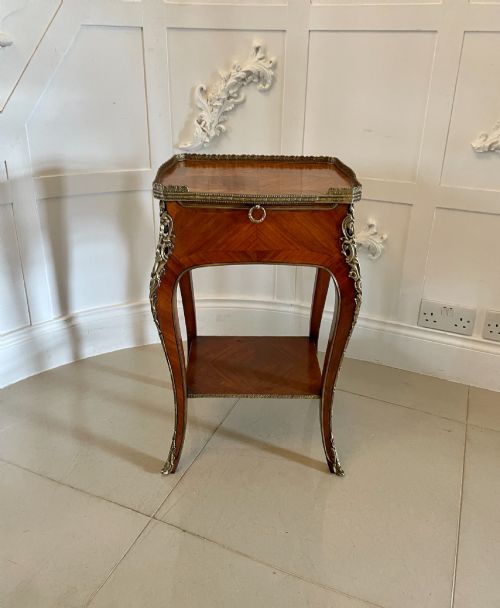
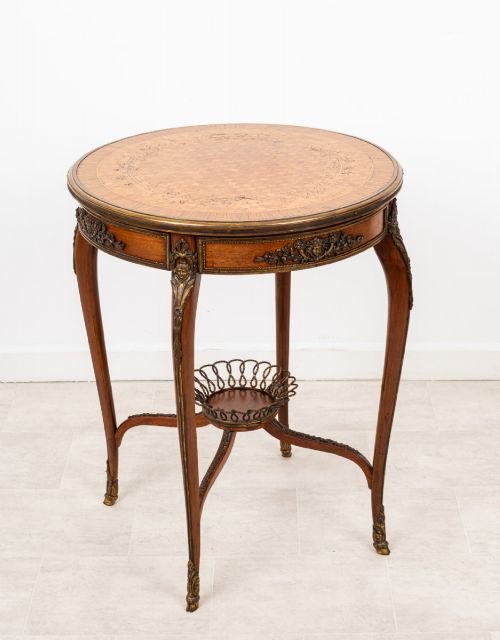
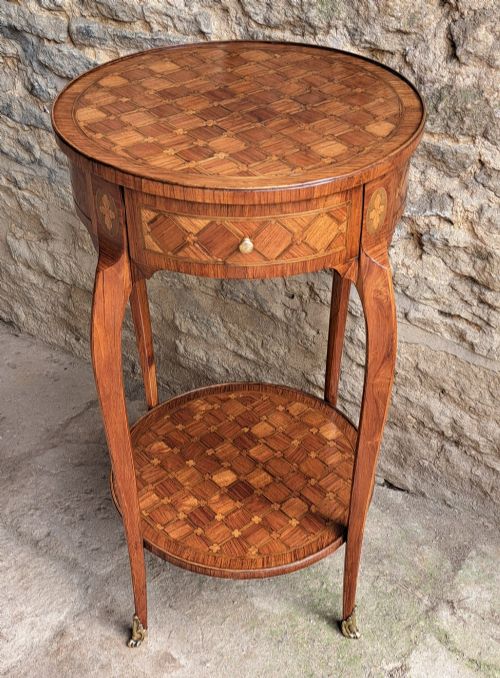
A french parquetry lamp table combines decorative wood veneers arranged in geometric patterns with compact proportions suited for placement beside seating. The selection here spans the nineteenth century into the early twentieth century, featuring forms such as occasional tables, side tables, and centre tables.
Buyers regularly encounter pieces styled in the Louis XV and Louis XVI revivals, alongside circular Guéridon designs and kidney-shaped models. These tables often incorporate single drawers, two tiers, or raised galleries, utilising shapes intended for domestic sitting rooms and boudoirs.
The majority originate from the nineteenth century, utilising designated periods from eighteen-sixty to nineteen-twenty, reflecting classic French cabinet-making traditions adapted for holding lamps and small decorative objects.
Materials and construction
Cabinet-makers constructed these tables using a foundation of hardwoods such as mahogany, oak, and walnut, overlaid with figured veneers including kingwood, rosewood, tulipwood, and satinwood. These veneers are precisely cut and arranged in parquetry and marquetry patterns across the tops and sides.
Metal mounts in ormolu, gilt-metal, and brass enrich the framework, frequently appearing on feet, shoulders, and pierced galleries around marble tops. Selected examples utilise inset marble slabs within circular or kidney-shaped wooden surrounds.
Listings feature woods including walnut veneer, kingwood, rosewood, mahogany, and satinwood, combined with marble and brass.
Markers of quality
The precision of the parquetry geometry and the crispness of the timber grain separation dictate visual distinction across the range. Finer examples display meticulous matching of veneers across curved surfaces and drawer fronts.
The execution and weight of the ormolu or brass mounts also separate standard workshop output from exceptional pieces. Cast mounts with sharp chisel work and secure integration into the wooden chassis indicate superior craftsmanship.
A Hugnet Paris·François Linke
The French Parquetry Lamp Table Glossary
- Parquetry
- Geometric mosaic woodwork formed by small pieces of veneer laid down in repeating patterns such as squares, cubes, or triangles. This technique creates a durable and visually dynamic decorative surface on table tops.
- Ormolu
- Gilded bronze mounts applied to furniture edges, legs, and corners for ornamentation. The process involves coating bronze with a mercury-gold amalgam and heating it.
- Guéridon
- A small French circular table supported by a central column or legs, originating in the seventeenth century. They frequently feature marble tops and brass galleries.
- Kingwood
- A dense, heavy Brazilian hardwood featuring rich brown colouring with dark streaks, widely used in French eighteenth and nineteenth-century cabinet-making. It forms the primary decorative veneer on many superior tables.
- Gallery
- A small raised brass or metal rim fitted around the perimeter of a table top to prevent items from sliding off. They are commonly found on marble-topped occasional and lamp tables.
French Parquetry Lamp Table: Frequently Asked Questions
What is a French parquetry lamp table?
A French parquetry lamp table is a small decorative stand featuring geometric wood veneer patterns, designed to hold a lamp in a sitting room.
These pieces typically date from the nineteenth and early twentieth centuries, incorporating styles derived from Louis XV and Louis XVI periods.
What woods were used in these tables?
Cabinet-makers utilised a foundation of oak, mahogany, or walnut, overlaid with exotic veneers such as kingwood, rosewood, tulipwood, and satinwood.
These timbers were selected for their contrasting natural grain patterns and colours to create geometric parquetry designs.
Where were these tables placed?
These tables were historically positioned beside seating areas, against walls, or between windows in French parlours and boudoirs.
Their compact proportions allowed them to function as bedside tables, lamp stands, or occasional surfaces for holding small decorative items.