


Louis XVI Gueridon Table
A louis xvi gueridon table brings classical proportion and refined French craftsmanship into a room as an indispensable centre or side piece.
Louis XVI Gueridon Table
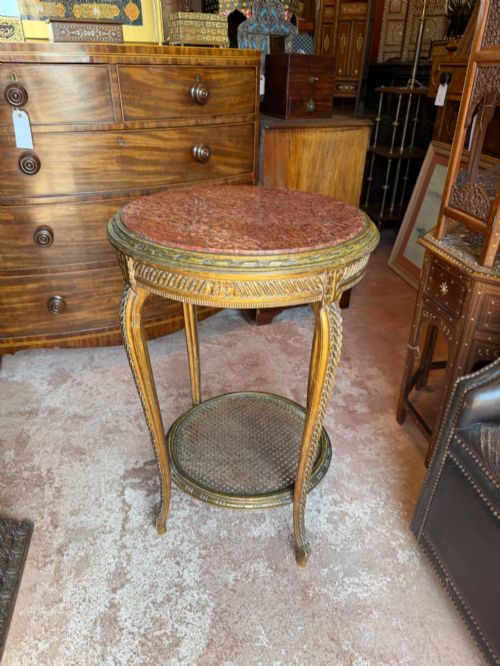
When you search for a louis xvi gueridon table, you encounter round or occasionally octagonal occasional pieces designed in the French neoclassical manner. These tables generally appear as circular freestanding stands with inset marble tops, resting on slender tapering legs.
The versions most commonly met on this page date from the nineteenth century into the early twentieth century, spanning periods of revival such as the 1880s and 1900s. Makers and workshops drew heavily upon eighteenth-century vocabulary, producing side tables, centre tables, and lamp tables influenced by cabinetmakers like Weisweiler and Linke.
How They Were Made
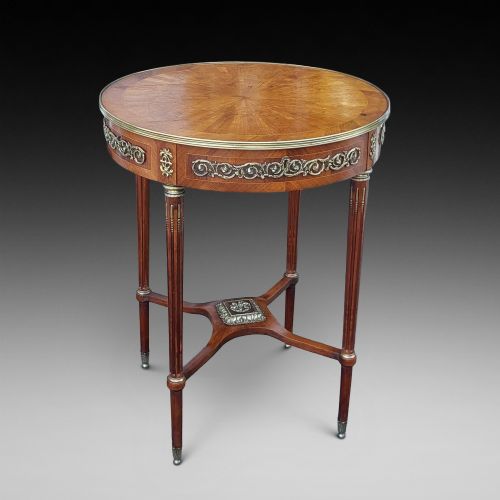
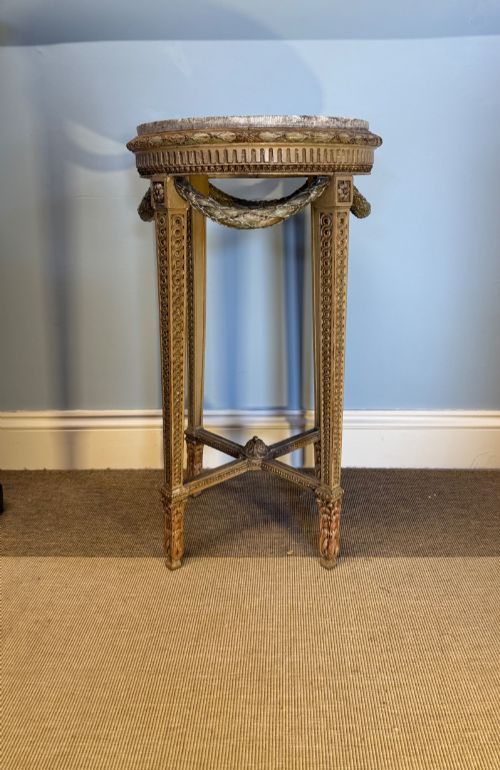
Carpenters constructed the carcasses from timbers such as mahogany, walnut, kingwood, and satinwood, frequently employing intricate parquetry and marquetry inlay across the tops and apron rails. Workshops also utilised painted wood and giltwood surfaces to achieve lighter neoclassical decorative schemes.
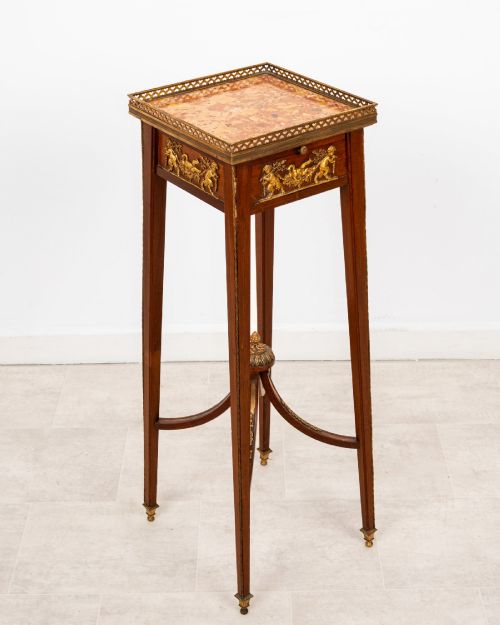
Mounts cast in ormolu, brass, and bronze provide structural enrichment around the aprons and feet, while inset slabs of white, rouge, or onyx marble form the upper surfaces. Many examples incorporate pierced brass galleries encircling the stone or timber tops to secure items placed upon them.
Listings feature pieces spanning the 1860s to the 1920s, utilising marble, mahogany, ormolu, and kingwood.
What Varies in Quality
Quality rests upon the precision of the cabinetwork and the crispness of the cast metal mounts. Finer examples display tightly fitted parquetry geometries, clean veneers, and heavy gilt-bronze or ormolu mounts with sharply chased details rather than soft, cast-indistinct hardware.
The choice and finishing of materials also distinguish grades of production, from simple turned mahogany stands to elaborately inlaid satinwood or ebony tables featuring porcelain plaques and substantial marble slabs.
François Linke·A Hugnet Paris·Weisweiler·Henry Dasson
The Louis XVI Gueridon Table Glossary
- Gueridon
- A small circular table on a central pillar or three to four legs. Originating in seventeenth-century France, the form evolved into light occasional tables suited for display and service.
- Ormolu
- Gilded bronze used for decorative mounts and hardware. The technique involves applying a mercury-gold amalgam to cast bronze before firing.
- Parquetry
- Geometric wood inlay forming patterned surfaces on tabletops and friezes. Craftsmen assemble small blocks of contrasting timbers like kingwood and mahogany.
- Galleries
- Raised metal or wooden rims fitted around the perimeter of tabletops. They prevent objects from sliding off circular occasional furniture.
- Neoclassical
- A style drawing inspiration from classical antiquity, prioritising symmetry, straight lines, and restrained ornamentation over baroque curves.
Louis XVI Gueridon Table: Frequently Asked Questions
Where do I place a gueridon table?
These round tables fit easily beside seating furniture or stand independently in hallways and drawing rooms as centre pieces. Their compact footprints make them adaptable for displaying lamps or decorative objects.
Because the tops are frequently stone, placement benefits from areas with stable traffic where the stone and timber frame receive adequate clearance.
How do I care for marble tops?
Marble surfaces require gentle cleaning with mild soap and water, avoiding acidic cleaners that etch the polished stone. Using coasters protects the porous material from staining.
Timber bases and gilt mounts benefit from periodic dusting with a dry cloth to preserve the finish without damaging delicate patination.
How do I distinguish revival periods from original pieces?
Most examples found today belong to nineteenth-century and early twentieth-century revival movements rather than the eighteenth-century reign of Louis XVI. Construction marks, timber shrinkage, and the specific casting quality of ormolu mounts help determine the exact period of manufacture.
Cabinetmakers of the 1880s and 1900s deliberately copied eighteenth-century prototypes, adopting the vocabulary of makers like Weisweiler while utilising contemporary nineteenth-century workshop techniques.
What is the difference between a side table and a centre table?
Centre tables are finished on all sides to stand freely in the middle of a room, viewed from any angle. Side tables typically feature a designated front and are positioned against walls or beside upholstery.
Round gueridon formats function well in both roles, though examples with drawers or specific frieze decoration often orient towards walls.