






Painted French Gueridon
A painted french gueridon brings compact elegance to a room, offering a round surface supported by a central pillar.
Painted French Gueridon
A painted french gueridon is a round table designed to stand independently as a centre table, plant stand or occasional piece. These tables frequently appear from the nineteenth century onward, reflecting periods such as the eighteen-fifties, eighteen-eighties, and nineteen-hundreds.
Most examples found here take the form of side tables, bistro tables, or pedestals with fitted stone tops. The styles range through Louis sixteenth, Rococo revival, and Empire revival, often showing provincial or chateau origins.
Buyers choose a painted french gueridon for its distinct silhouette and decorative surface. The combination of painted wood, carved details, and marble creates a functional piece that doubles as a display surface.
How they were made
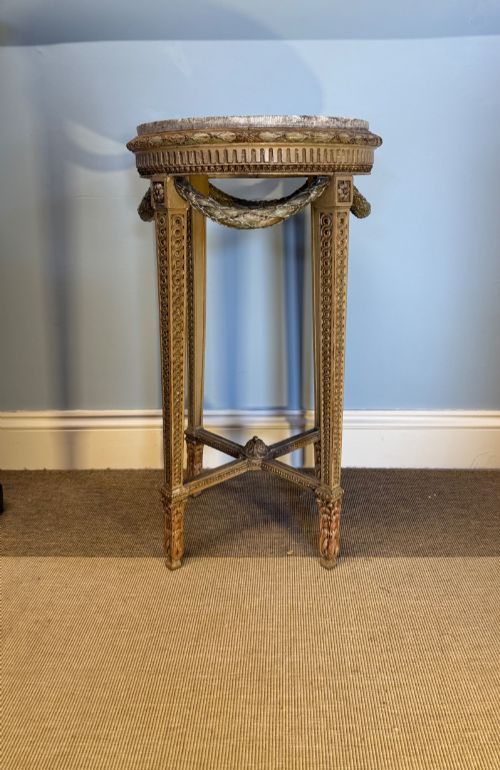
Makers constructed the framework using carved wood, cast iron, and painted wood, frequently applying parcel gilt or parcel silvered highlights over the painted surfaces. This combination of materials provided both structural stability for heavier tops and intricate detail around the apron and base.
Marble tops form an integral part of the construction on many pieces, providing a cool, durable surface that contrasts with the painted timber or cast iron below. Brass accents and mounts occasionally appear to finish the edges and joints.
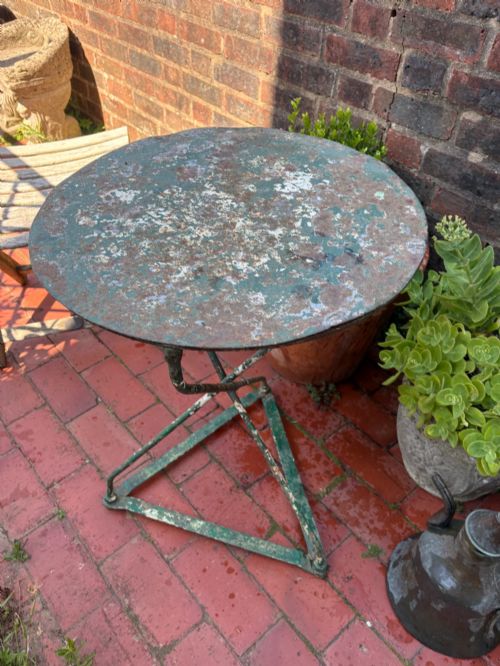
Green paint on a cast iron pillar gives a nineteenth-century table a stubborn garden-bench charm indoors.
What varies in quality
Quality in a painted french gueridon rests in the crispness of the carved wood and the harmony of the proportions between the top and the central support. Pieces with finely sculpted bases and well-fitted marble slabs demonstrate superior workshop execution.
The application of paint and gilding also dictates the level of refinement, with layered finishes and subtle parcel gilding showing greater care than simpler coats of paint. Cast iron examples vary according to the sharpness of the moulded detail in the metal.
The Painted French Gueridon Glossary
- Gueridon
- A small round table on a single central pillar or column. Originating in the seventeenth century, these tables evolved into popular decorative forms by the nineteenth century.
- Parcel Gilt
- Wood or metal decorated with thin applications of gold leaf on specific raised areas. This technique highlights carved motifs against a painted background.
- Torchere
- A tall, slender stand or pedestal used originally to hold a torch or candle, and later adapted for lamps or decorative objects.
- Rococo Revival
- A nineteenth-century style drawing on the flowing curves, asymmetry, and naturalistic ornamentation of the eighteenth-century Rococo movement.
Painted French Gueridon: Frequently Asked Questions
What is a gueridon table?
A gueridon is a French round table supported by a single central column rather than standard legs. These pieces functioned traditionally as small side tables, plant stands, or centre tables in formal rooms.
Today, they serve well beside armchairs or as display surfaces in hallways and drawing rooms, adding French character to an interior.
Are all gueridon tables made of wood?
While wood forms the primary material for the frames and pillars, many examples incorporate heavy marble tops. Some nineteenth-century versions also utilise cast iron for the base to provide extra weight and stability.
Painted finishes and parcel gilding frequently cover the wooden elements to enhance the decorative appearance.
How do I style a painted gueridon?
The compact round shape makes a painted gueridon suitable for awkward corners, narrow hallways, or beside a sofa. Use the marble or wooden surface to display a lamp, a vase, or small decorative objects.
The neutral or painted tones allow these tables to blend easily with both traditional and contemporary room schemes.
How can I tell the period of a gueridon?
Dating relies on observing the stylistic details, such as Empire revival motifs, Louis sixteenth proportions, or Rococo curves. The materials, including the type of paint, cast iron components, and marble thickness, also point toward specific decades in the nineteenth and twentieth centuries.
Comparing the joinery and the wear patterns on the painted surfaces helps confirm the age of the piece.