


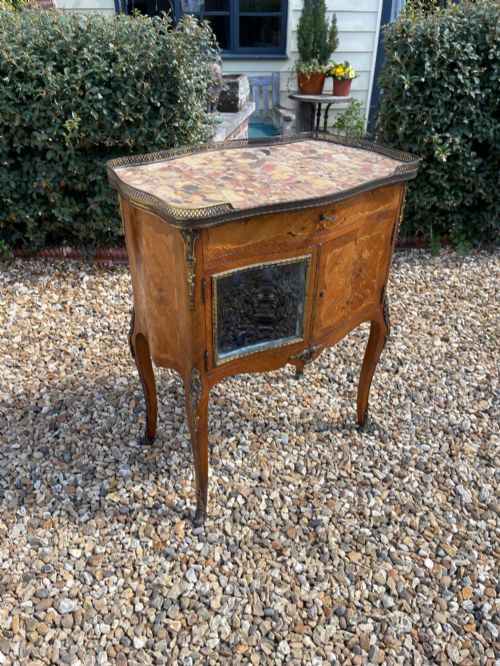


Brass Gallery Marble Table
A brass gallery marble table brings together a smooth stone surface and a protective metal rim, offering a refined piece for any room.
Brass Gallery Marble Table
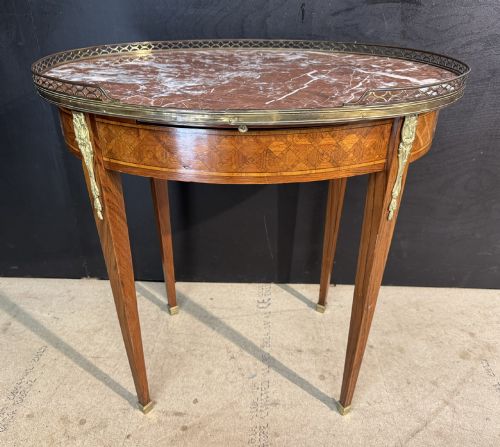
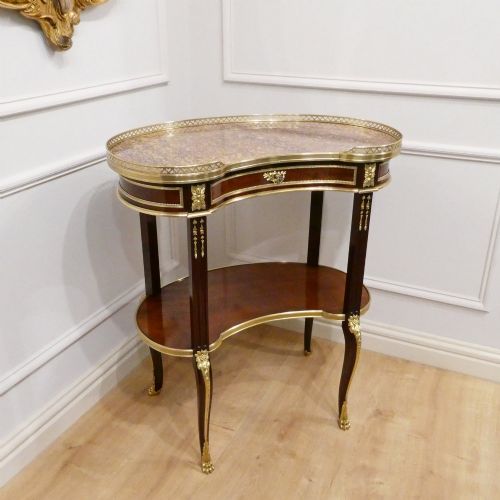
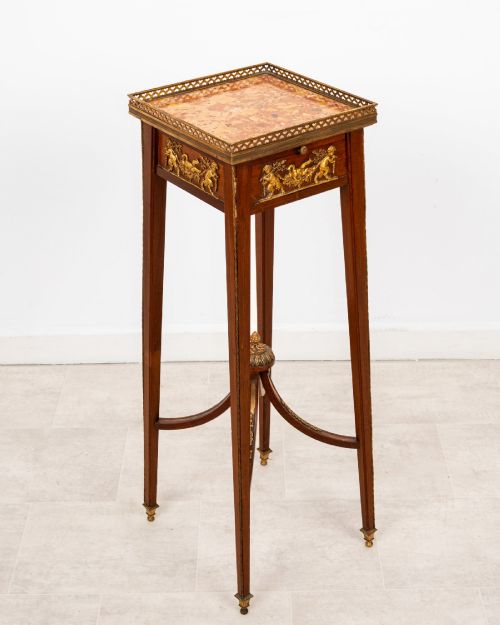
When you search for a brass gallery marble table, you encounter a selection of occasional furniture originating predominantly from nineteenth and early twentieth century France. These pieces function as side tables, bedside cabinets, wine tables, and guéridons, combining utility with decorative presence.
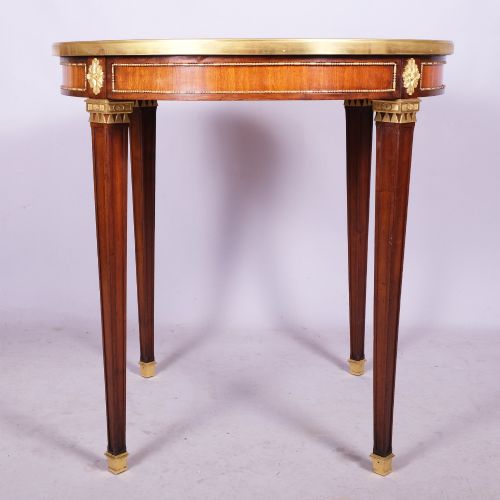
The most frequent form on this page pairs a circular or kidney-shaped stone top with a perforated metal railing around the edge, supported by tapered or column legs. Walnut, mahogany, kingwood, and painted wood provide the underlying structures for these designs.
Styles lean heavily towards French neoclassical aesthetics, including Louis XVI and Empire revivals, alongside rococo flourishes. The combination of veined stone and polished metal remains consistent across side tables, commodes, and plant stands.
Distinctions in quality
The refinement of the cast brass gallery and ormolu mounts separates standard production from superior examples. Finely chased metalwork demonstrates the hand of a skilled artisan rather than mass casting.
The selection and matching of marble slabs, alongside precise cabinetwork in the mahogany or kingwood frames, determine the overall execution. Subtle details such as inlaid stringing and well-turned wooden legs indicate higher workshop standards.
Listings span the nineteenth century through the 1930s, encompassing Victorian and Edwardian periods alongside French revival styles.
Maison Millet·François Linke
The Brass Gallery Marble Table Glossary
- Gallery
- A raised metal or wooden railing running along the edge of a table or shelf. It prevents items from sliding off the stone surface.
- Guéridon
- A small French table supported by one or more columns, popular during the nineteenth century. These often feature circular marble tops.
- Bouillotte table
- A small neoclassical round card table featuring a raised brass gallery and candle sconces. They frequently incorporate marble tops.
- Ormolu
- Gilt bronze mounts applied to furniture for decorative accent. The technique involves coating bronze with a layer of finely ground gold mercury amalgam.
- Breche d'alep
- A multi-coloured quarried marble featuring brecciated fragments in tones of brown, grey, and cream. It appears frequently on French commodes and tables.
Brass Gallery Marble Table: Frequently Asked Questions
How do I style a marble table?
Marble-topped tables work well as bedside surfaces, lamp tables, or small drinks stands in a living space. Their compact footprint allows for flexible placement.
Keep heavy items to a minimum to let the stone and metal details remain visible. The smooth surface resists everyday wear when treated with care.
What stone is used on these tables?
These tables commonly feature white, rouge, or breche d'alep marble inserts, alongside occasional onyx surfaces. Each slab displays natural veining.
The stone is cut to fit flush within the wooden frame, often surrounded by the perforated brass gallery.
Are these tables French in origin?
The majority of these pieces originate from French workshops dating from the nineteenth and early twentieth centuries. Styles reflect neoclassical and revival periods.
Design vocabulary draws heavily on Louis XVI and Empire aesthetics, executed in mahogany, walnut, and kingwood.