



French Ormolu Inkstand
A french ormolu inkstand brings heavy gilt bronze and polished marble to a desk, offering functional writing gear designed to anchor a room.
French Ormolu Inkstand
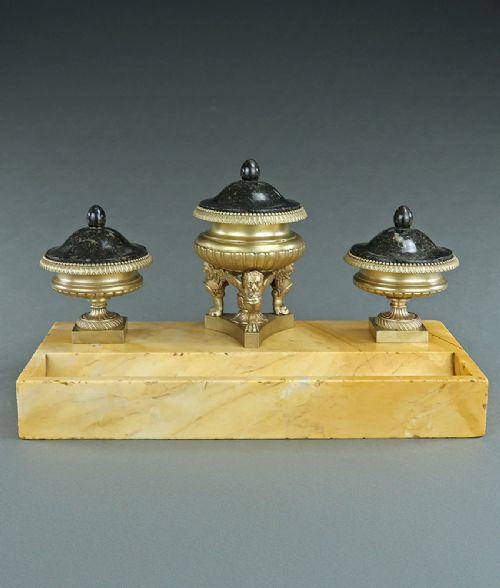
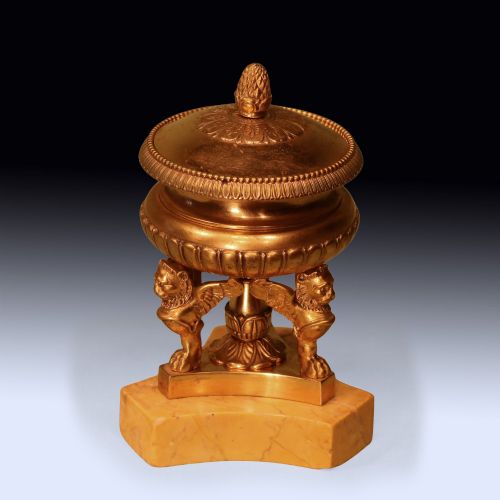
A french ormolu inkstand sits among desk accessories as a heavy, sculptural object intended for writing desks and libraries. The versions met most often on this page combine cast metal with stone bases, taking forms from desk sets to double encriers.
The periods span the eighteenth century through the early twentieth century, with nineteenth-century pieces dominating the selection. Stylistic choices range from French Empire and Neoclassical to Napoleon III and Art Nouveau.
Makers and designers worked within traditional desk forms, incorporating glass inserts, porcelain panels, and figural bronzes. These objects served functional roles for writing while functioning as ornamental centerpieces.
Materials and Technique
The primary construction relies on bronze, which receives a fire-gilt finish to create the characteristic ormolu surface. This gilded bronze is cast and chased to render crisp decorative details.
Piers, plinths, and bases employ heavy stones including Sienna marble, vert marble, and onyx marble. Glass and porcelain elements integrate into the designs to hold ink and accommodate pens.
Metal cats and kittens occasionally guard the ink.
Evaluating Quality
The refinement of the casting and chasing separates the top of the range from standard pieces. Sharp detail in the bronze work and careful integration of the marble base indicate higher workmanship.
The weight and selection of materials influence the overall character of the object. Heavier stone mounts and well-preserved gilding distinguish the finer examples from simpler desk accessories.
Albert Marionnet·Moser
The French Ormolu Inkstand Glossary
- Ormolu
- Gilded bronze produced by applying a mercury and gold amalgam to cast metal and heating it to drive off the mercury. This technique creates a rich golden surface that defines French metalwork of the period.
- Encrier
- A French term for an inkstand or inkwell. These portable writing vessels house ink reservoirs and pen holders.
- Standish
- An alternative word for a stand or tray holding inkwells, sanders, and pen compartments. It forms a complete writing set for a desk.
- Champleve
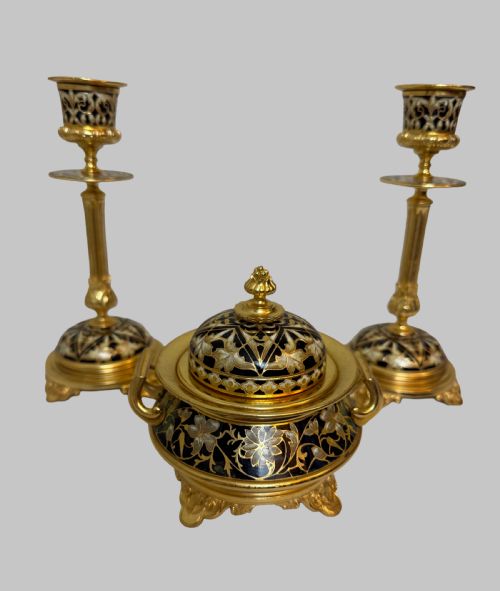
- An enamelling technique where troughs or cells are carved into the metal surface and filled with vitreous enamel before firing. It appears on nineteenth-century decorative metalwork.
- Empire
- A Neoclassical design style spanning the early nineteenth century, drawing inspiration from ancient Roman and Greek forms. It employs formal symmetry and martial motifs.
French Ormolu Inkstand: Frequently Asked Questions
What is an ormolu inkstand?
An ormolu inkstand is a desk accessory made from fire-gilt bronze, often mounted on a marble base and fitted with glass or porcelain inkwells.
These pieces functioned as writing equipment and decorative objects on nineteenth-century desks.
How do I date a french ormolu inkstand?
Dating relies on stylistic clues like Empire symmetry, Napoleon III ornamentation, or Art Nouveau lines, alongside material choices such as marble and bronze.
Comparing the cast details and overall form helps place a piece within the eighteenth, nineteenth, or early twentieth century.
What materials are used?
The primary materials are cast bronze with a gilded ormolu finish and various stones like Sienna marble, vert marble, and onyx.
Additional elements include glass ink inserts, porcelain panels, and patinated bronze figures of animals or busts.
Where were these placed?
These pieces sat upon writing desks, library tables, and bureau plat surfaces in formal rooms.
They provided ink and desk storage while adding a decorative presence to the interior.