

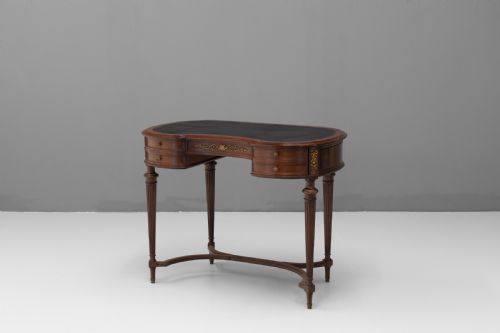


French Kidney Table
A French kidney table offers a curved, serpentine footprint designed to hug a chair or corner while serving as a refined writing desk, side table or bedside stand.
French Kidney Table
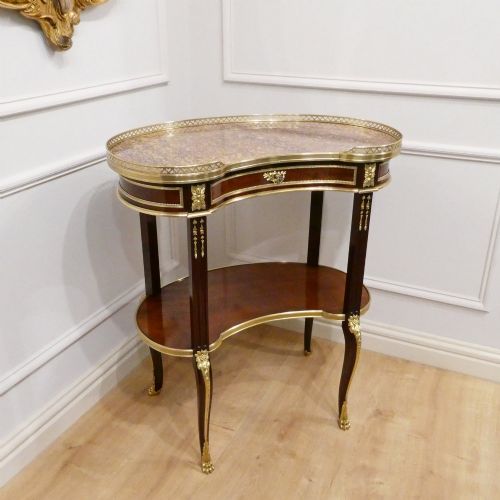
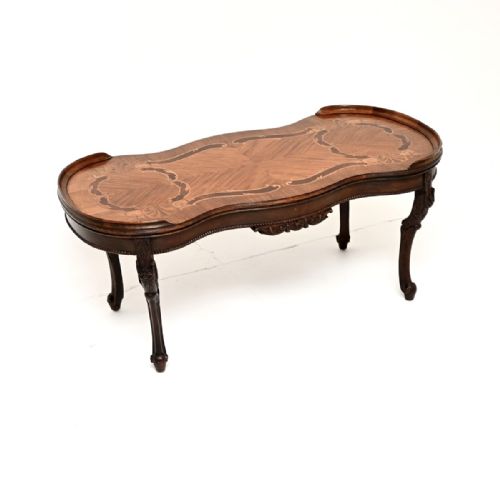
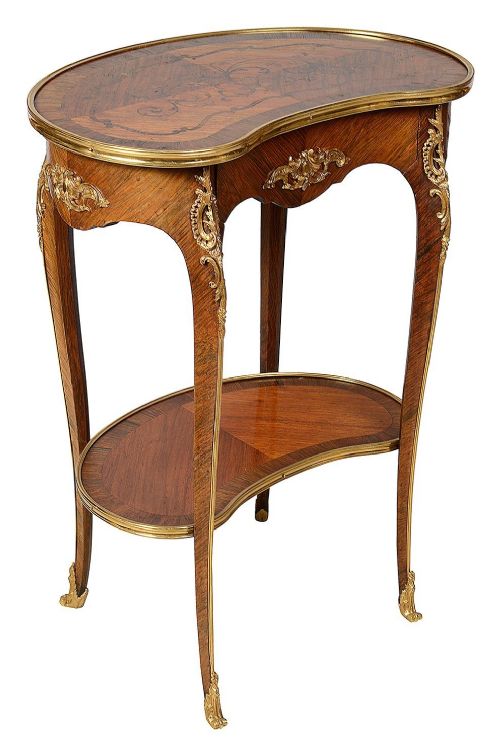
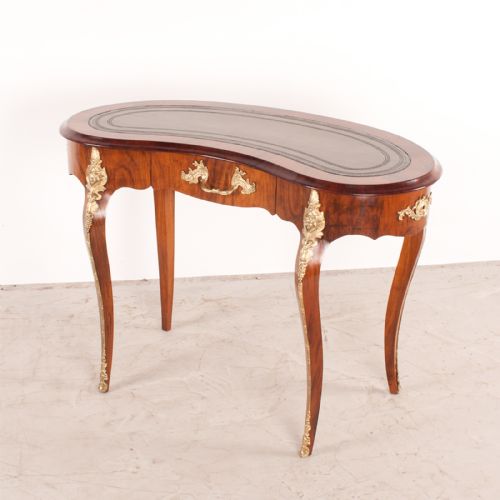
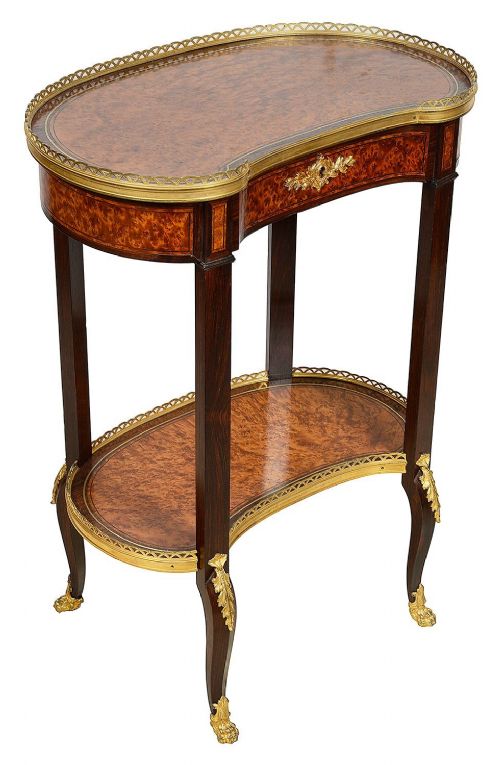
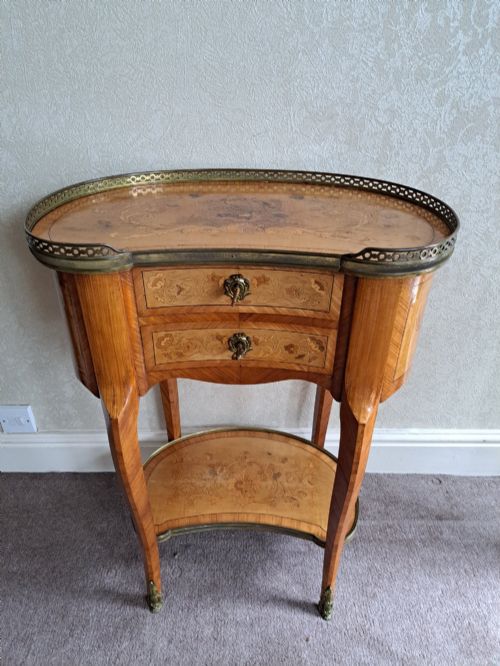
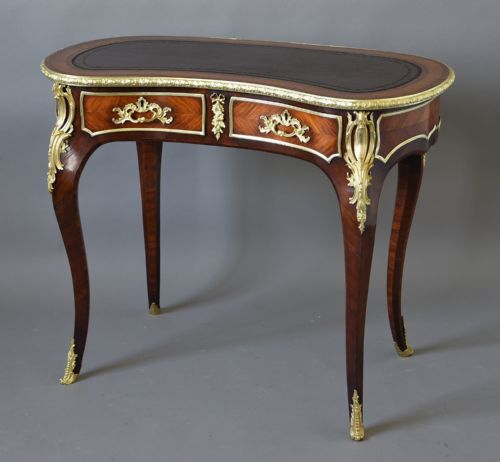
A French kidney table is defined by its characteristic indented bean-shaped top, allowing the user to sit closer to the writing surface or fit neatly beside a bed or armchair.
The pieces on this page span the nineteenth century into the early twentieth century, appearing predominantly as side tables, occasional tables, writing desks, and bedside cabinets.
Makers drew heavily on Louis XV and Louis XVI revival aesthetics, producing both freestanding library pieces and smaller two-tier or marble-topped variants.
Materials and Construction
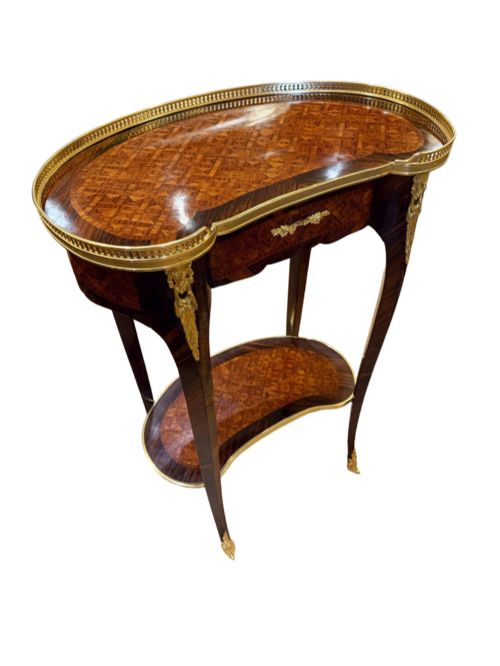
Cabinetmakers utilised rich timber veneers including mahogany, kingwood, walnut, rosewood, and burr walnut, often arranged in intricate marquetry or geometric parquetry patterns across the curved tops.
Mounts in cast bronze and ormolu accentuate the serpentine outlines, framing drawers, legs, and galleries with classical chased detailing.
Many surfaces are finished with inset leather writing panels or topped with polished marble surrounded by pierced brass galleries.
Several bedside pairs exist here, proving that even eighteenth-century tastes demanded symmetrical tables flanking the mattress.
Assessing Quality and Execution
The standard of a French kidney table rests largely on the precision of the veneer work and the crispness of the bronze or ormolu mountings rather than simple age.
Superior examples exhibit seamless curvature in the woodwork alongside heavy, well-chased mounts, whereas simpler versions rely on plain mahogany or straightforward polished walnut veneers.
The integrity of the structural frame, particularly how firmly the slender cabriole legs support the curved top under weight, distinguishes workshop production.
Maison Millet·F. Linke
The French Kidney Table Glossary
- Marquetry
- Inlaid wood veneers forming decorative pictures or floral motifs across a tabletop. This technique requires considerable skill to fit pieces into curved surfaces.
- Ormolu
- Gilt bronze mounts applied to furniture edges and legs for decorative effect. The gilding gives a rich golden finish that catches the light.
- Parquetry
- Geometric patterns formed by small wood veneers laid in symmetrical arrays. It appears frequently on the surfaces of these desks and side tables.
- Cabriole leg
- A curved furniture leg inspired by animal limbs, tapering outward at the knee and inward at the foot. It is a defining feature of Louis revival pieces.
- Bureau-plat
- A flat-topped writing table, often fitted with drawers. These versions adopt the curved kidney outline for domestic use.
French Kidney Table: Frequently Asked Questions
What were kidney tables used for originally?
These tables served primarily as compact ladies writing desks, dressing tables, or bedside stands where a curved front allowed closer access.
Their versatile footprint also suited them for use as occasional lamp tables or small display pieces in a drawing room.
How do I distinguish Louis XV from Louis XVI styles?
Louis XV pieces embrace asymmetrical curves, flowing floral marquetry, and sweeping cabriole legs.
Louis XVI furniture introduces neoclassical straight tapered legs, cleaner architectural lines, and symmetrical parquetry panels.
Are marble tops original to these tables?
Many surviving examples, particularly bedside tables and wash or dressing stands, were manufactured with fitted white or veined marble slabs.
These stone tops were chosen for durability and water resistance when holding pitchers, lamps, or wash accessories.
How do I care for wood and leather surfaces?
Polished timber veneers require occasional waxing with a neutral paste to nourish the grain and protect against dry air.
Leather writing inserts benefit from gentle cleaning and leather balm to prevent cracking while avoiding harsh chemical solvents.